Page of Swords Tarot as Feelings: Curious About You in a Way That Won't Stop Asking Questions
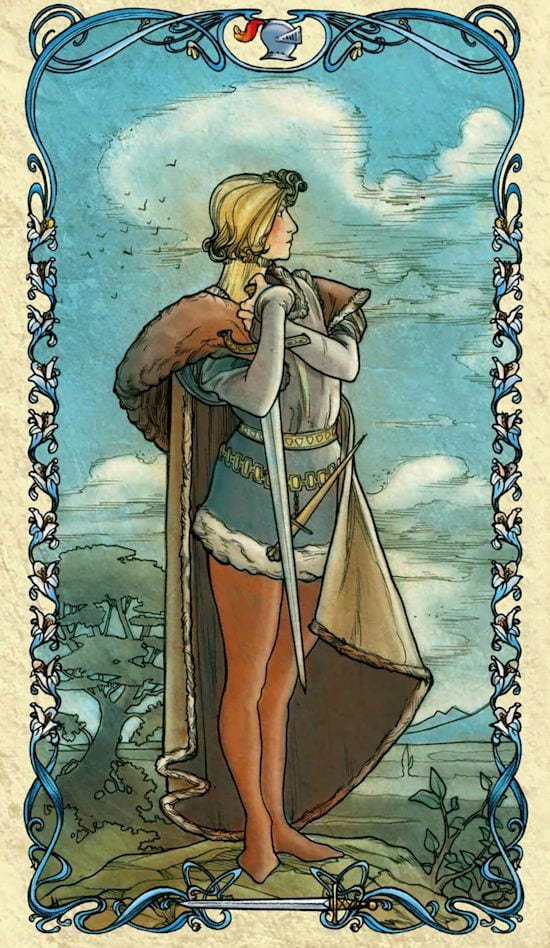
A young figure holds a sword skyward, eyes scanning the horizon for information
A youth stands on uneven ground, sword raised, hair and clothes whipping in the wind. They’re not fighting — they’re watching. Alert, sharp-eyed, standing on the balls of their feet like someone ready to move in any direction depending on what they see. The sword isn’t a weapon here. It’s an antenna — tuned to pick up signals, detect changes, gather intelligence.
That’s the Page of Swords. And as feelings, it’s the card of someone who is fascinated by you — but processes that fascination through their mind, not their heart.
Compare this to the Page of Wands, who discovers you with delight and runs toward you with open arms. The Page of Swords discovers you with intrigue and steps back to observe from a better angle. The Wands Page says “I want to know you.” The Swords Page says “I want to understand you” — which is a very different thing, and often takes much longer.
When someone feels the Page of Swords toward you, you’ve captured their attention completely. But their attention comes with a magnifying glass, not a bouquet.
Upright: as feelings for you
Intense mental curiosity about who you are. This person thinks about you — a lot. But their thinking is analytical, not romantic. They’re not imagining your life together; they’re trying to figure you out. What makes you tick? Why did you say that? What did you mean by that text? They approach you the way a scientist approaches an interesting specimen: with fascination, precision, and a notepad.
Attraction expressed through questions and debate. The Page of Swords doesn’t flirt like the Wands cards (bold, physical, direct). They flirt through conversation — sharp observations, probing questions, playful challenges that test your intellect. If someone is constantly engaging you in debate, picking apart your opinions, or asking questions that go deeper than small talk, they might be feeling the Page of Swords.
Keeping emotional distance through mental engagement. The shadow side: this person uses their intellect as a buffer against vulnerability. As long as they’re analyzing you, they don’t have to feel anything about you. The mental engagement is real, but it’s also a defense — a way to stay interested without being at risk.
Vigilance and slight suspicion. The Page of Swords is alert to deception. As feelings, this person may be watchful — not trusting you fully yet, looking for inconsistencies, testing your honesty through careful observation. The interest is there. The trust is still being built.
Youthful, sharp, not fully formed. Like all Pages, this is a beginning. The Page of Swords represents feelings that are mentally aware but emotionally immature — the person knows they’re interested but hasn’t developed the emotional vocabulary to express it. They might come across as aloof, when really they’re just not sure how to bridge the gap between thinking about you and feeling for you.
Reversed: as feelings for you
Curiosity turned to gossip or manipulation. The reversed Page takes the upright’s sharpness and twists it. Instead of studying you with genuine interest, they might be gathering information to use against you, gossiping about your private conversations, or using their observations as ammunition in arguments.
Mental scattered-ness replacing clarity. The reversed Page can mean someone whose thoughts about you are chaotic rather than sharp — jumping from conclusion to conclusion, unable to form a coherent picture, second-guessing every impression.
Cold, cutting communication. The reversed Page’s words can wound — not through passion but through precision. Sarcasm that goes too far. Observations that are technically true but cruelly delivered. The sharp mind aimed not at understanding but at hurting.
Immaturity in handling intellectual attraction. The reversed Page might be someone who doesn’t know what to do with their interest in you — so they express it badly. Negging instead of flirting. Challenging instead of connecting. Using intelligence as a weapon of distance rather than a bridge of connection.
Context: as feelings in different situations
Someone you’re dating
Upright: They find you fascinating but haven’t dropped into their feelings yet. Dates feel more like stimulating interviews than romantic encounters. The conversation is electric; the emotional warmth is pending.
Reversed: The analytical energy is creating distance instead of connection. They’re so busy studying you that they’ve forgotten to enjoy you.
An ex’s feelings
Upright: They’re thinking about you with sharp clarity — analyzing what happened, studying the patterns, trying to understand the relationship from an intellectual distance. Not nostalgic. Investigative.
Reversed: They’re using what they know about you destructively — sharing private details, drawing harsh conclusions, or rewriting the relationship’s story with themselves as the detective who figured it all out.
A new connection
Upright: You’ve sparked an intense mental fascination. They want to know everything about you — but through observation and conversation, not emotional risk. Give them intellectual stimulation and they’ll stay captivated. Push for emotional depth too fast and they’ll retreat.
Reversed: The interest is there but it’s expressing itself awkwardly — stilted conversations, accidentally insulting observations, or the kind of over-analysis that kills chemistry before it has a chance to develop.
Page of Swords vs. other cards as feelings
Page of Swords vs. Page of Wands. Wands is excitement. Swords is analysis. Wands wants to explore you. Swords wants to decode you. Wands says “let’s go on an adventure together!” Swords says “tell me your theory on why people fall in love.”
Page of Swords vs. Page of Cups. Cups is dreamy emotional connection — poetry, imagination, gentle feeling. Swords is sharp mental connection — questions, debate, intellectual challenge. Cups writes you a poem. Swords sends you an article and asks what you think.
Page of Swords vs. Ace of Swords. The Ace is a breakthrough of clarity — sudden, complete, decisive understanding. The Page is the process before the breakthrough — gathering data, asking questions, approaching clarity without quite arriving. The Ace knows. The Page is learning.
What the Page of Swords as feelings is really telling you
Here’s the truth about the Page of Swords: being interesting to someone is not the same as being loved by them — but it’s often where love begins for people who live in their heads.
Not everyone falls in love through the heart first. Some people fall through the mind — and for them, the Page of Swords is the first card of the love story. The fascination comes before the feeling. The questions come before the declarations. The understanding comes before the vulnerability. It’s slower. It’s less dramatic. But when a Page of Swords person finally bridges the gap between thinking about you and feeling for you, the connection that forms has a kind of depth that purely emotional attractions rarely achieve.
The sword is raised. The wind is blowing. And somewhere, someone is watching you with the sharpest eyes and the most restless mind — not because they don’t care, but because they care in the only language they know: thought.
Try it yourself
Pull a card with this question: “What would the person analyzing me discover if they stopped thinking and started feeling?”
Because the Page of Swords is always about the gap between mental engagement and emotional arrival. Your next card will reveal what lives beneath all the questions — the feeling that the analysis is both protecting and preventing.
The sword catches the wind. The eyes are sharp. And the most important question isn’t the one they’re asking about you. It’s the one they haven’t asked themselves: what happens when I stop studying and start feeling?
Frequently Asked Questions
What does the Page of Swords mean as someone's feelings for me?
The Page of Swords as feelings means this person is intensely curious about you — but from a safe distance. They're watching, analyzing, gathering information before they commit to feeling anything openly. Their interest is real but it lives in their head, not their heart. They're studying you like a fascinating puzzle they haven't decided whether to solve.
Is the Page of Swords a positive card for love feelings?
Mixed. The Page of Swords shows genuine interest and intellectual engagement, but it can also mean someone who overthinks instead of feeling, who keeps you at arm's length through analysis, or who is more interested in understanding you than actually connecting with you. The curiosity is flattering. The emotional distance is frustrating.
What does the Page of Swords reversed mean as feelings?
Reversed, the Page of Swords means the curiosity has turned toxic — gossip, spying, manipulation through information, or using what they know about you as a weapon. Alternatively, it can mean someone whose mental sharpness has dulled into confusion, leaving them scattered and unable to process what they feel.
How is the Page of Swords different from the Page of Wands as feelings?
The Page of Wands is excited — all butterflies and enthusiasm, wanting to explore you with joy. The Page of Swords is investigative — all questions and analysis, wanting to understand you with precision. Wands says 'you're exciting!' Swords says 'you're interesting — let me figure out why.'