Seven of Wands Tarot Card Meaning: The Hill You Chose — Now Defend It
First impression
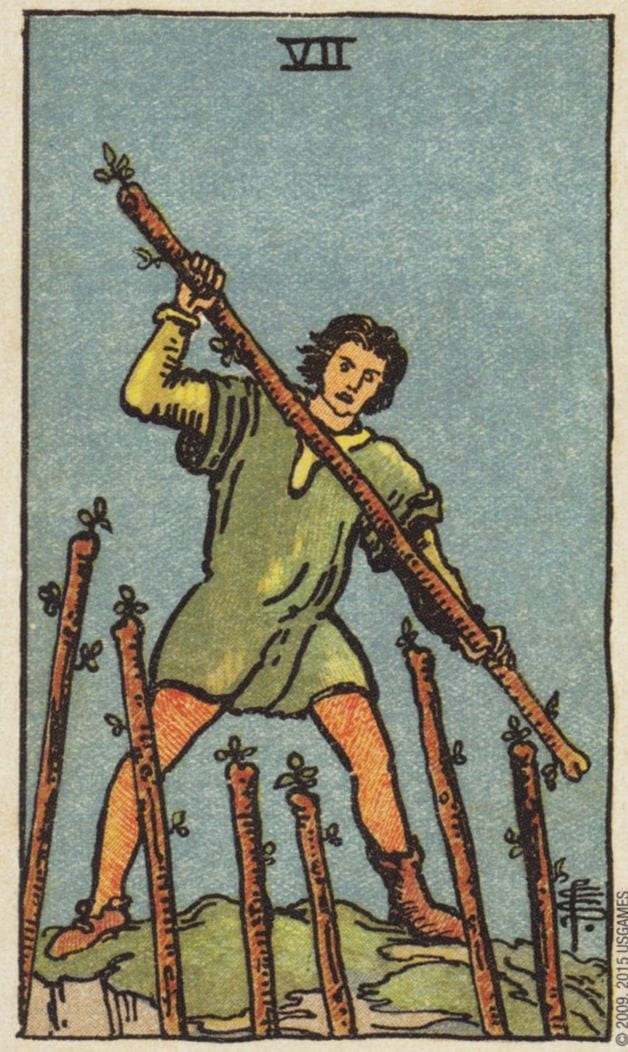
A man stands on a hilltop, wand raised, fighting off six wands that thrust up from below. He has the high ground — but barely. His footing is uneven. His face shows strain, not panic. And there’s a detail most people miss on first glance: his shoes don’t match. One boot, one sandal. He wasn’t ready for this fight. It came for him anyway.
That’s the Seven of Wands. Not the card of starting a fight — the card of finishing one that showed up uninvited.
The Six of Wands gave you the victory parade. The Seven is what happens the morning after, when the people who didn’t win start pushing back. You climbed the hill, planted your flag, and now everyone below wants your spot. The Seven doesn’t ask whether you deserve to be here. It asks whether you’ll stay.
This is one of the most misunderstood cards in the deck. People see conflict and assume something is wrong. But the Seven of Wands isn’t about things going wrong — it’s about things going right enough that others want what you have. Success made you visible. Visibility made you a target. Now you defend.
Card symbolism
The hilltop. High ground — advantageous position earned through effort. You didn’t randomly end up here. You climbed. The hill represents the achievement, the reputation, the belief, the relationship — whatever you built that’s now under pressure. It’s yours. The question is whether you’ll hold it.
The six wands from below. Opposition. Not one challenger — many. The Seven of Wands rarely faces a single adversary. It’s the collective push: competitors, critics, doubters, the general pressure of people who want your position or disagree with your stance. They’re not coming from above — they’re coming from below, which means you still have the advantage. For now.
The mismatched shoes. The most telling detail. One boot, one sandal — he was caught mid-dressing. The fight started before he was ready. The Seven of Wands often arrives when you’re not fully prepared for the challenge. You don’t have the perfect plan, the complete argument, the polished defense. You have conviction and whatever you were wearing when the attack started.
The defensive stance. He’s not charging downhill. He’s holding position. The Seven of Wands is fundamentally defensive — this isn’t about conquest or expansion. It’s about keeping what you already have. The energy is “I’m not moving” rather than “I’m coming for you.”
The single wand in hand. He holds one wand against six. The odds look bad on paper. But he has the high ground, and one focused person with conviction can outlast six scattered challengers. The Seven of Wands says: the odds aren’t the whole story.
Upright meaning
The Seven of Wands upright means defending your position, standing firm under pressure, courage when challenged, and the refusal to back down from what you’ve earned or what you believe.
Standing your ground. Something you built is under attack — your reputation, your project, your relationship, your beliefs. The Seven says: don’t retreat. You earned this position. The pushback isn’t evidence that you’re wrong — it’s evidence that you’re relevant enough to threaten. Stand.
Challenge from below. People are coming for your spot. Competitors at work. Critics online. Family members who don’t approve of your choices. The Six was the parade; the Seven is the cost of visibility. When you succeed publicly, you also fail publicly — and not everyone wants you to succeed again.
Courage under fire. The Seven of Wands is a courage card, but it’s the messy kind — not the gleaming hero on a white horse, but the person with mismatched shoes and a sore arm who refuses to step aside. It’s courage that looks like stubbornness from the outside and feels like exhaustion from the inside. It holds anyway.
Defending beliefs. Sometimes the battle isn’t external. Sometimes the Seven of Wands means defending an unpopular opinion, a creative vision others don’t understand, a value everyone else has abandoned. The card doesn’t promise you’ll change their minds. It promises that standing firm has its own value, regardless of the crowd below.
Being tested. The Seven often appears at moments of testing — situations designed (by life, not by malice) to see whether you actually believe what you say you believe. It’s the job offer that tests your commitment to your own business. The temptation that tests your relationship. The criticism that tests whether your confidence is real or performative.
Reversed meaning
The Seven of Wands reversed is what happens when the defense falters — or when you realize you’ve been defending the wrong hill.
Giving up. The wands from below finally pushed through. You stepped down, stepped aside, let someone else take the position. Sometimes this is surrender; sometimes it’s wisdom. The reversed Seven asks you to be honest about which one it is.
Overwhelmed by pressure. Too many battles on too many fronts. You can’t defend everything at once, and the constant need to justify your position has worn you down. The reversed Seven often appears during burnout — not from the work itself, but from the endless defense of the work.
Caving to outside pressure. You changed your mind — not because you found better information, but because the pushback got too uncomfortable. You abandoned a belief, a boundary, or a relationship because defending it cost more than you were willing to pay. The reversed Seven asks: did you choose this, or did you just get tired?
Wrong hill to die on. The most important reversed meaning: maybe this position isn’t worth defending. Maybe you climbed the wrong hill. Maybe the belief you’re fighting for is outdated, the job you’re protecting is making you miserable, or the relationship you’re defending isn’t actually good for you. The reversed Seven gives you permission to put down the wand and walk away — not out of weakness, but out of clarity.
Self-doubt eroding your stance. You’re still on the hill, still holding the wand, but you don’t believe in the fight anymore. The external challenge exposed an internal crack: maybe they’re right. Maybe you don’t deserve this. The reversed Seven can mean losing not because you were defeated, but because you defeated yourself.
In love and relationships
Upright. The Seven of Wands in love means defending a relationship against outside forces. Family that disapproves. Friends who think you can do better. Circumstances — distance, timing, cultural differences — that work against you. For couples, this card says the relationship is being tested, and the test will show whether you’re both willing to fight for it. For singles, the Seven means knowing exactly what you want in a partner and refusing to settle, even when loneliness or social pressure pushes you toward “good enough.”
Reversed. You stopped fighting for the relationship — or you’re fighting for one that doesn’t deserve the effort. The reversed Seven in love often appears when someone gives in to family pressure, abandons their standards to avoid being alone, or realizes they’ve been defending a relationship out of stubbornness rather than love.
In career and finances
Upright. Defending your professional position. Someone wants your job, your client, your project. Competition is real and coming from multiple directions. The Seven of Wands in career says: your position is strong, but you’ll need to actively protect it. Don’t assume past success guarantees future security. Financially, the Seven means defending your financial boundaries — saying no to requests for money, holding firm on pricing, not caving to pressure to spend beyond your means.
Reversed. Losing professional ground. A competitor outmaneuvered you, or you stopped defending your position because the corporate politics exhausted you. The reversed Seven can also mean finally leaving a job you’ve been defending for too long — realizing that the energy you spend fighting to keep this position would be better invested in building a new one.
In health and well-being
Upright. Fighting illness or maintaining a health routine against resistance — whether that resistance is your own habits, unsupportive environments, or a condition that keeps pushing back. The Seven of Wands in health is resilience: refusing to give up on recovery, defending boundaries around self-care even when others demand your energy. It’s the card of the person who keeps showing up to physical therapy, keeps taking the meds, keeps fighting even when progress feels invisible.
Reversed. Giving up on a health goal or letting others override your health boundaries. Letting stress from external conflicts destroy your wellbeing because you stopped defending your peace. Also: recognizing that a particular health approach isn’t working and having the wisdom to try something different instead of stubbornly defending a failing strategy.
Key combinations
Seven of Wands + The Emperor. Absolute authority. You hold the hill with the full weight of structure and discipline behind you. Defending a position of established power — and winning decisively.
Seven of Wands + Five of Wands. Challenge upon challenge. You’re defending your position while new conflicts erupt. Multiple opponents, multiple fronts — exhausting but survivable if you stay focused.
Seven of Wands + The Hermit. Defending a position of solitude. Standing firm in your need for space, privacy, or time alone — especially when others think you should be more social, more available, more willing to compromise your boundaries.
Seven of Wands + Eight of Cups. The defense ends — because you chose to walk away. Not surrender but departure. You looked at the hill, looked at the challengers, and decided this isn’t where you want to be anymore. A powerful combination of wisdom and release.
Seven of Wands + Strength. Defending with grace instead of force. Inner strength sustaining your position — not through aggression but through patience, compassion, and the quiet certainty that you belong where you stand.
Seven of Wands + Ten of Wands. The defense has become a burden. You’re holding the hill, but the cost is crushing you. This combination warns: winning isn’t winning if it destroys you in the process.
Seven of Wands + The Star. Hope after defense. You held firm, the storm passed, and now there’s healing. The Star comes to replenish what the Seven’s battle drained.
The card’s advice
The Seven of Wands says: the fact that you have to fight doesn’t mean you’re losing. It means you have something worth fighting for.
This is the card for everyone who’s been told to “just let it go” about something they can’t let go — because it matters. The relationship that’s hard but real. The career path everyone questions. The belief that doesn’t fit the room. The Seven of Wands doesn’t promise the fight will be easy or that everyone will eventually agree with you. It promises that standing firm is its own form of integrity.
But here’s the flip side: choose your hills. Not every challenge requires full-force defense. Not every critic deserves a response. Not every push from below is an attack — sometimes it’s feedback, and the strongest position is the one that can absorb new information without collapsing.
The mismatched shoes are the key. You won’t be perfectly prepared. You won’t have the ideal argument, the complete armor, the elegant defense. You’ll have what you had when the challenge started: your conviction, your experience, and whatever you were wearing when the wands came flying.
That’s usually enough. Hold the hill.
Try it yourself
Pull a card with this question: “What am I defending right now — and is it actually mine to defend?”
Because the Seven of Wands is only powerful when the hill is worth holding. If you’re defending something out of habit, pride, or fear of admitting you chose wrong — the card asks you to examine that honestly. The bravest thing the Seven can teach you isn’t always to keep fighting. Sometimes it’s to look at the hill, look at the wands, and ask whether this is really where you want to make your stand.
And if the answer is yes — plant your feet. Raise your wand. Let them come.
Frequently Asked Questions
Is the Seven of Wands a yes or no card?
The Seven of Wands is a yes — but a fighting yes. It says the outcome you want is possible, but you'll have to defend it. Nothing will be handed to you. If you're willing to hold your ground, the answer is yes. If you're hoping for an easy path, this card says think again.
What does the Seven of Wands mean in love?
In love, the Seven of Wands means defending a relationship against outside pressure — family disapproval, friends' opinions, distance, circumstances working against you. For singles, it means knowing what you want and refusing to settle, even when the dating landscape pushes you toward compromise.
What does the Seven of Wands reversed mean?
Reversed, the Seven of Wands means you're losing ground — either because you gave up fighting or because you're fighting battles that aren't worth winning. It can indicate caving to pressure, exhaustion from constant defense, or the realization that the hill you're standing on isn't actually yours.
What is the difference between the Seven and Nine of Wands?
The Seven of Wands is actively fighting — you're on the hilltop, wand swinging, defending right now. The Nine of Wands is after the fight — battered, exhausted, one last challenge to face. Seven is battle. Nine is endurance after battle. Both require courage, but Seven's is fresh and Nine's is worn.