Six of Pentacles Tarot Card Meaning: The Scales That Weigh What You Give and What You Get
First impression
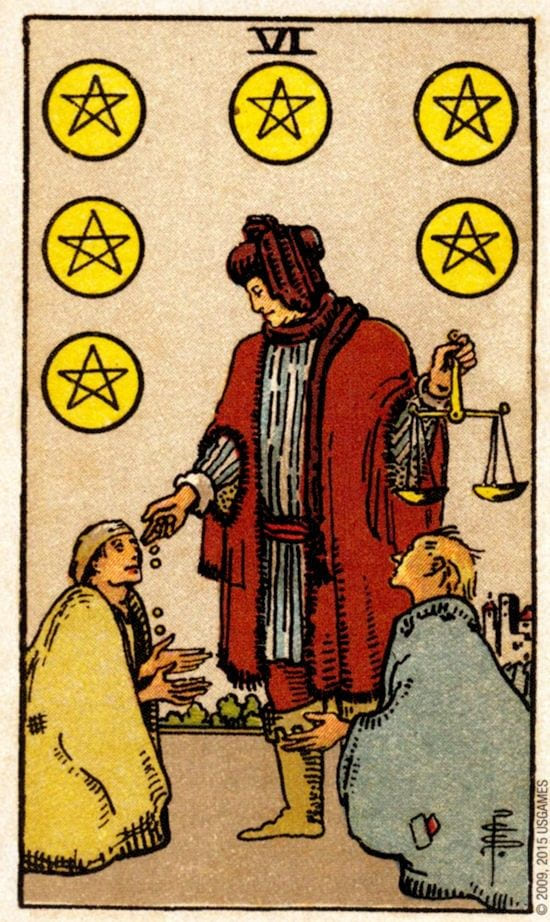
A wealthy merchant stands between two kneeling figures, dropping coins into their outstretched hands. In his left hand, he holds a set of balanced scales. His posture is upright, his clothing rich. The figures below him are dressed poorly — they receive what he offers with bowed heads. Six golden pentacles float around the scene, distributed but not equally.
That’s the Six of Pentacles. The card of generosity — and the card that asks the uncomfortable question: who holds the scales?
This card is more complex than it first appears. On the surface, it’s a picture of kindness — someone who has, sharing with those who don’t. Beautiful. But look closer: the giver stands while the receivers kneel. The scales are in his hand, not theirs. He decides how much, when, and to whom. The Six of Pentacles isn’t just about generosity — it’s about the power dynamics of generosity. Who gives, who receives, and what that arrangement does to the dignity of both.
Card symbolism
The scales. The merchant holds balanced scales — the same symbol carried by Justice. This connects generosity to fairness: giving isn’t just about feelings, it’s about measuring what’s right. But critically, the scales are in the giver’s hand. The person with resources decides what’s fair. This is the card’s central tension: is true fairness possible when one person holds all the measuring tools?
The falling coins. Money drops from one hand into others. The flow of resources is active, visible, and directional — from top to bottom, from the standing figure to the kneeling ones. This represents material support in action: not just promised, but actually delivered. Help isn’t theoretical in this card. It’s happening now.
The kneeling figures. Two people receive with bowed heads and open hands. Their position is submissive — they look up at the giver, dependent on his decision. This is the uncomfortable truth of receiving: it requires a certain surrender of pride. The card doesn’t judge them for needing help. But it does make you notice the power dynamic at play.
The merchant’s rich clothing. His prosperity is visible — he has clearly more than enough. The Six suggests that generosity comes most naturally from abundance. But it also asks: does his wealth make him the right person to decide who deserves help?
The six pentacles. Distributed around the scene but not equally. Some float near the giver, some near the receivers. The number six in tarot represents harmony and balance — but this distribution isn’t perfectly balanced. It’s managed balance, decided by one party.
Upright meaning
The Six of Pentacles upright means generosity, sharing resources, receiving help when needed, the balance of giving and taking, and the examination of power dynamics in material exchanges.
Generosity from abundance. You’re in a position to give — time, money, knowledge, support — and the card encourages you to do so. The Six appears when sharing your resources would create real benefit for someone who needs it. This isn’t about giving until it hurts. It’s about giving from overflow, from genuine abundance, because you can and because it matters.
Receiving help. The other side of the coin: you may be the one who needs help, and the Six says it’s coming. A loan, a gift, mentorship, a favor from someone with more resources than you currently have. The card’s advice: receive graciously. Needing help isn’t weakness — it’s a temporary position that will reverse when your circumstances change.
Fair exchange. The scales represent measured, thoughtful distribution. The Six isn’t about throwing money around — it’s about giving where it’s needed most, in the amount that’s appropriate, with the awareness that resources have limits. This is strategic generosity: impactful, considered, not wasteful.
Power dynamics in giving. Every gift creates a relationship. The Six of Pentacles asks you to examine that relationship honestly. When you give, are you creating gratitude or dependence? When you receive, are you maintaining your dignity or surrendering it? The healthiest exchanges are those where both parties feel respected — not just helped or grateful.
Karma and circulation. What you give comes back. The Six of Pentacles is connected to the idea of karmic exchange — resources flow to where they’re needed, and the person giving today may be the one receiving tomorrow. The scales balance over time, not in any single transaction.
Reversed meaning
The Six of Pentacles reversed reveals the shadow side of generosity — giving that controls, receiving that diminishes, and exchanges that are anything but fair.
Strings attached. The reversed Six is the gift that comes with conditions — money offered with expectations, help given only to create obligation, generosity that’s actually a leash. The person giving isn’t being kind; they’re investing in your compliance.
Power imbalance. One person holds all the resources and uses that position to maintain control. The reversed Six can represent financial abuse — a partner who controls money, a boss who underpays to keep employees dependent, a parent who gives money to control adult children’s decisions.
Self-depletion through giving. You’ve given so much that you have nothing left. The reversed Six sometimes means you’re the person who keeps pouring from an empty cup — always helping others, never asking for help yourself, until your own resources are completely exhausted.
Refusing to receive. Pride that prevents you from accepting needed help. The reversed Six can mean you’re the person walking past the stained glass window from the Five of Pentacles — help is available, but you’d rather struggle alone than admit you need it.
Unfair distribution. Resources going to the wrong people, or in the wrong amounts. The scales are tilted — someone is getting too much while someone else gets too little, and the person holding the scales either doesn’t notice or doesn’t care.
In love and relationships
Upright. The Six of Pentacles in love asks the essential question: who gives and who receives in this relationship? At its best, this card represents a partnership where both people are generous — with time, attention, affection, and effort — and both receive gratefully. But it often appears when the balance is off: one person does all the emotional labor, all the planning, all the compromising, while the other simply benefits. The Six asks couples to audit their exchange. For singles, this card can mean attracting someone through genuine kindness, or receiving romantic attention from someone in a position of authority or greater resources.
Reversed. Love with conditions. The reversed Six in love represents the partner who gives — financially, emotionally, practically — but uses that generosity as leverage. “After everything I’ve done for you” is the reversed Six’s signature phrase. Also: a relationship where one person’s financial power creates unhealthy dependence, or where giving has become a substitute for genuine emotional connection.
In career and finances
Upright. Financial flow in your favor. The Six of Pentacles in career can mean a raise, a bonus, a client payment, or financial support for a project. It represents resources arriving from above — someone with authority deciding to share. On the giving side, it can mean you’re in a position to mentor, invest, or fund someone else’s growth. Financially, this is one of the better cards: money is moving in the right direction. But remember the scales — is the exchange fair?
Reversed. Workplace power imbalance. The reversed Six in career means someone is using financial leverage to control — a boss who underpays but “makes up for it” with vague future promises, a client who pays late because they can, a colleague who takes credit for your work. Financially: debt that creates dependence, loans with unfair terms, or charitable giving that’s really marketing disguised as generosity.
In health and well-being
Upright. Help arriving for health needs. The Six of Pentacles in health means receiving support — from healthcare providers, insurance, family helping with medical costs, or community resources for wellness. It can also mean being in a position to help someone else with their health journey. The card emphasizes: health care is often collaborative, and accepting help is part of healing.
Reversed. Health support with conditions or complications. The reversed Six in health can mean inadequate help — insurance that doesn’t cover what you need, support that comes with judgment, or helpers who control your health decisions rather than supporting them. Also: giving so much to caregiving others that your own health deteriorates.
Key combinations
Six of Pentacles + Justice. The fairest possible exchange. Both cards carry scales — together, they represent generosity guided by true fairness and equity. Legal matters resolved justly, fair distribution of shared resources, or a karmic debt being properly settled.
Six of Pentacles + The Emperor. Generous authority. The Emperor’s structure and power combined with the Six’s giving creates a leader who shares resources wisely — a good boss, a fair institution, a government program that actually helps. Also: receiving support from an authority figure.
Six of Pentacles + Five of Pentacles. Help arriving during hardship. The most directly hopeful combination — the Five’s cold and lack is answered by the Six’s generosity. Someone is about to offer exactly what you need. Accept it.
Six of Pentacles + The Devil. Generosity with chains. The Devil’s control dynamics corrupt the Six’s giving — this is the gift that traps, the loan that enslaves, the help that creates dependency by design. Be very careful about what you accept and what you owe.
Six of Pentacles + Two of Cups. Mutual generosity in partnership. The Two’s emotional connection plus the Six’s material sharing creates a relationship where both people give freely and receive joyfully. One of the best combinations for balanced love.
Six of Pentacles + Ten of Pentacles. Generational generosity. The Ten’s family wealth flows through the Six’s channels — inheritance, family support, resources passed down through generations. Also: building wealth not just for yourself but for those who come after.
Six of Pentacles + Four of Pentacles. Tension between giving and holding. The Four wants to keep everything; the Six wants to share. This combination often represents the internal struggle between security and generosity — wanting to help but being afraid that giving will leave you without enough.
The card’s advice
The Six of Pentacles says: examine the scales. Not just what you give or receive, but the relationship those exchanges create.
Generosity is beautiful. Receiving is necessary. But the space between giving and receiving is more complex than it looks. Every gift shifts a power dynamic. Every act of receiving creates a small vulnerability. The Six of Pentacles doesn’t ask you to stop giving or stop receiving — it asks you to do both with awareness.
When you give: give because someone needs it, not because giving makes you feel powerful. Give without making the receiver feel small. Give without keeping a ledger of debts owed. And give from genuine abundance — not from a place that will leave you empty.
When you receive: receive without shame. Needing help is human, not humiliating. But also: notice the terms. Is this gift truly free? Does this help come with expectations? Are you trading autonomy for assistance?
The scales balance when giving and receiving flow freely between people who respect each other — when today’s giver might be tomorrow’s receiver, and neither position carries shame. That’s the Six of Pentacles at its best: not charity that elevates one and diminishes the other, but circulation that honors everyone it touches.
Try it yourself
Pull a card with this question: “In my most important relationship, am I mostly giving or mostly receiving — and is that balance working for both of us?”
Because the Six of Pentacles reveals something we often avoid examining: most relationships aren’t perfectly balanced, and the imbalance often creates more tension than either person admits. The card doesn’t demand perfect equality. It demands honest awareness — and the willingness to adjust the scales when they’ve tipped too far in one direction.
The coins are falling. The question is: into whose hands? And are the scales truly balanced?
Frequently Asked Questions
Is the Six of Pentacles a yes or no card?
The Six of Pentacles is a yes — especially if your question involves generosity, receiving help, or fairness. Resources are flowing, and the universe is in a giving mood. But check the scales: is the exchange balanced? A yes that creates dependency isn't truly generous.
What does the Six of Pentacles mean in love?
In love, the Six of Pentacles means examining who gives and who receives in your relationship. Ideally, both partners give generously and receive gratefully. But this card often appears when the balance is off — one person gives everything while the other only takes. Healthy love requires the scales to tip both ways.
What does the Six of Pentacles reversed mean?
Reversed, the Six of Pentacles reveals unhealthy power dynamics in giving — charity with strings attached, generosity used as control, debts that create obligation rather than gratitude. Also: refusing help you genuinely need, or giving so much you've depleted yourself completely.
Does the Six of Pentacles mean I'll receive money?
Often yes — the Six frequently signals financial help arriving: a gift, a loan, a raise, unexpected support. But it's not free money without context. The card asks you to receive graciously and to give when it's your turn. The flow of resources works best when it moves in both directions.