Six of Swords Tarot Card Meaning: You Don't Have to Be Healed to Leave
First impression
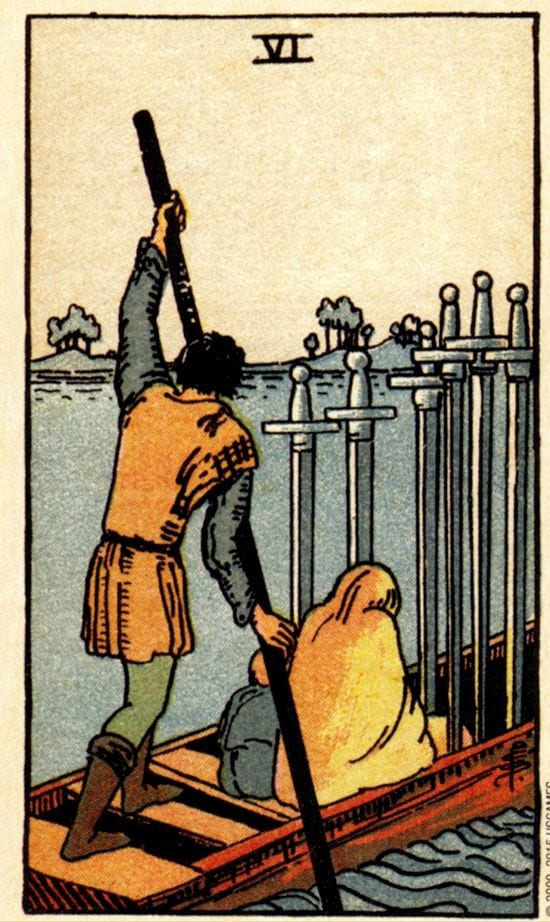
A cloaked figure sits in a boat with a small child, being ferried across a body of water. Six swords stand upright in the bow, planted in the hull like silent passengers. Behind them, the water is rough and choppy. Ahead, it’s smooth. The boatman rows steadily. Nobody speaks. Nobody looks back.
That’s the Six of Swords. The quietest departure in the entire tarot deck. No slamming doors, no dramatic exits, no burning bridges. Just a boat, moving slowly from turbulence toward calm, carrying everything that couldn’t be left behind.
And here’s what makes this card more honest than almost any other: the swords are in the boat. She didn’t leave her pain on the shore. She didn’t heal before departing. She took the swords with her — the memories, the lessons, the scars — because that’s how real transition works. You don’t wait until you’re whole to leave what broke you. You leave while broken, and the healing happens on the water.
Card symbolism
The boat. Transition itself. Not a permanent home, not a destination — a vehicle between two states. The boat represents the process of change: you’re no longer where you were, not yet where you’ll be. You’re in between, and the in-between is uncomfortable but necessary.
The six swords. Baggage. Not in a shameful way — in a factual one. The swords are the thoughts, beliefs, experiences, and wounds you carry from the old situation into the new one. They’re heavy. They take up space. But they’re yours, and pretending you could leave without them would be the real lie.
The rough water behind. What you’re leaving. Turbulence, conflict, pain — the situation that became impossible to stay in. The water churns because the past is still active, still powerful, still pulling. But you’re already past it. It’s behind the boat, not under it.
The calm water ahead. What you’re moving toward. Not paradise — just calmer. The Six of Swords doesn’t promise a perfect destination. It promises relief. Less pain. More space to think. Enough stillness to begin processing what happened.
The cloaked figure and child. Vulnerability in transit. The hunched posture suggests grief, exhaustion, the weight of leaving. The child represents innocence, hope, or the part of you that’s still intact despite everything. They’re together — the wounded adult and the part that can still grow.
The boatman. Help. You’re not making this crossing alone. Someone or something is carrying you: a friend, a therapist, a decision you finally made, the sheer momentum of having said “enough.” The boatman doesn’t ask questions. He just rows.
Upright meaning
The Six of Swords upright means transition from a painful situation toward something better, healing that happens through movement rather than stillness, the courage to leave before you’re ready, and the quiet knowledge that the worst part is already behind you.
Moving on. The central meaning: you are leaving something difficult. A relationship, a job, a mindset, a city, a version of yourself. The departure isn’t triumphant — it’s heavy, quiet, necessary. The Six of Swords doesn’t celebrate the leaving. It acknowledges the cost and moves anyway.
Healing through change. This card says: sometimes you can’t heal in the place that hurt you. You need distance, movement, new scenery — not because running solves things, but because staying in the source of pain prevents the healing from beginning. The boat isn’t escape. It’s the first step of recovery.
Better times ahead. The calm water is real. It’s not imaginary, it’s not a lie you’re telling yourself to justify the leaving. The Six of Swords promises — quietly, without fanfare — that the destination is genuinely better than where you came from. Not perfect. Better. And right now, better is enough.
Mental shift. Swords are the suit of the mind, and the Six represents a thought transition: shifting from one way of seeing to another. The old perspective served you once and doesn’t anymore. You’re crossing from “this is my life” to “this was my life, and something new is forming.”
Travel. Sometimes literal: moving, relocating, traveling over water, crossing a border. The Six of Swords frequently appears around physical relocations — especially ones motivated by necessity rather than excitement.
Reversed meaning
The Six of Swords reversed is the boat that never launches — or the one that turns around.
Unable to move on. You know you need to leave, but you can’t. The shore is still holding you — through fear, attachment, obligation, or the simple inability to imagine life on the other side. The reversed Six often appears when someone has already decided to go but keeps delaying the departure.
Returning to old patterns. You left, and then you went back. The familiar pulled harder than the unknown pushed. The reversed Six can mean relapsing — not just in the addiction sense, but in the emotional one: returning to the relationship you left, the job you quit, the mindset you outgrew.
Unfinished business. The past won’t release you because something there needs completion. A conversation unhad, an apology ungiven, a truth unspoken. The reversed Six sometimes says: you can’t cross until you finish what’s on this shore.
Resistance to necessary change. Life is offering you the boat and you’re refusing to board. Change feels like loss rather than transition, and the safety of the known — even painful known — beats the uncertainty of new water. The reversed Six asks: what are you actually protecting by staying?
Rough crossing. The transition is happening, but it’s not smooth. Turbulence during the journey, setbacks mid-change, the uncomfortable realization that moving on is harder than you expected. The reversed Six can mean the healing journey has complications — but it’s still a journey, and it’s still moving forward.
In love and relationships
Upright. The Six of Swords in love means leaving — and leaving in love is almost never simple. For someone ending a relationship: you’re moving away from something that was hurting you, and even though you know it’s right, the boat is heavy. For couples: you’re transitioning together through a difficult period, rowing toward calmer waters as a team. The swords are the issues you’re both carrying, and the calm water is the relationship you’re rebuilding on the other side. For singles healing from heartbreak: the worst part is over. You’re in transit between the pain and whatever comes next. Keep rowing.
Reversed. Can’t leave the ex. Can’t stop checking their social media. Can’t let go of the anger, the hope, or the fantasy that things might go back to how they were. The reversed Six in love is the breakup that doesn’t take — the person who leaves and returns, leaves and returns, caught between knowing they should go and not being able to stay gone.
In career and finances
Upright. Leaving a toxic workplace. Changing careers. Relocating for a new opportunity. The Six of Swords in career is the resignation letter — not the angry one, but the quiet one. The departure that happens because you realized the environment was slowly destroying something important, and the only fix was distance. Financially, the Six can mean a period of financial transition — tightening the belt during a move, investing in a fresh start, or leaving a financially stable but emotionally unbearable situation.
Reversed. Staying in the job that’s killing you because the alternative feels worse. Or: making the career change and then doubting it constantly, one foot in the new role and one mentally still at the old desk. Financially: the transition costs more than expected, or financial fears keep you trapped in a situation you’ve already outgrown.
In health and well-being
Upright. Recovery in motion. Leaving a health situation behind — getting out of an environment that was making you sick, starting treatment that represents a real change, or the mental shift from “I’m living with this” to “I’m moving through this.” The Six of Swords in health is the patient who changes doctors, the person who leaves the stressful city, the mind that shifts from despair to active healing. It’s not the end of the journey — it’s the beginning of the better part.
Reversed. Stuck in a health pattern you can’t break. Knowing what changes are needed but being unable to make them. The reversed Six in health can mean recovery that stalls or symptoms that return because the root cause was never truly left behind. Also: resistance to mental health treatment — knowing therapy or medication could help but refusing to board the boat.
Key combinations
Six of Swords + The Star. Healing is real and it’s coming. The Star’s hope meets the Six’s journey — you’re traveling toward genuine restoration. The combination says: the calm water leads to healing light. Keep going.
Six of Swords + Three of Swords. Leaving heartbreak behind — but carrying the pain with you. The Three’s wound is in the boat, and the Six is the journey through it. Grief in motion. Healing not despite the pain, but alongside it.
Six of Swords + The Tower. Forced departure. Something collapsed, and now the only option is the boat. The Tower destroyed the shore; the Six provides the way out. Painful but necessary — and the new shore will be built on stronger ground.
Six of Swords + Ten of Cups. The journey leads home. The emotional turbulence ends in family harmony, genuine belonging, or the emotional home you’ve been traveling toward. Worth every mile of difficult water.
Six of Swords + The Moon. The journey through fog. You’re leaving, but you can’t see where you’re going. The Moon says the destination is hidden — trust the boat, trust the water, trust that moving away from pain is always the right direction, even when you can’t see the shore ahead.
Six of Swords + Eight of Cups. Double departure. Walking away emotionally (Eight) and physically transitioning (Six). The leaving is complete — heart and body both in the boat. No looking back this time.
Six of Swords + Ace of Cups. A new emotional beginning waits at the destination. Whatever you’re leaving, what you’re heading toward includes love, connection, or emotional renewal. The new cup is on the other shore.
The card’s advice
The Six of Swords says: you don’t have to be healed to leave. You don’t have to be ready. You just have to get in the boat.
This is the card for everyone who’s been waiting for the “right time” to move on — from a relationship, a job, a habit, a place, a way of thinking. The Six of Swords says the right time was when the water behind you started churning. The right time was when staying started hurting more than the fear of leaving. The right time might have been a while ago, and that’s okay. The boat is still here.
The swords in the hull are the truth most people don’t want to hear: you will carry this with you. The pain doesn’t vanish at the shoreline. The memories don’t dissolve in salt water. You take them into the new life — but in the new life, surrounded by calmer water, you can finally look at them. Process them. Decide which ones to keep and which to release into the deep.
The cloaked figure is you, and the child is the part of you that can still grow, still trust, still open. The boatman is whatever force carried you here — your own decision, someone’s help, the universe’s insistence that you deserve better water.
Don’t look back. The rough water can’t reach you anymore. The calm is ahead. And all you had to do was board.
Try it yourself
Pull a card with this question: “What am I carrying in the boat — and does it still belong with me?”
Because the Six of Swords isn’t just about leaving. It’s about what you bring to the other side. Some swords belong in the new life — the lessons, the self-knowledge, the hard-won wisdom. Others are just weight — old grudges, stale identities, pain you’re keeping because putting it down feels like forgetting.
The boat can carry you. But the lighter the load, the smoother the crossing.
Row on. The calm is waiting.
Frequently Asked Questions
Is the Six of Swords a yes or no card?
The Six of Swords is a quiet yes — yes, things are moving in the right direction, but it won't feel like victory. This card says yes through departure: leaving what isn't working in order to reach what will. The answer is yes, but the journey has weight.
What does the Six of Swords mean in love?
In love, the Six of Swords means transition — leaving a painful relationship, healing from heartbreak, or moving with your partner toward calmer emotional territory. It's not the excitement of new love. It's the relief of finally moving away from what was hurting you.
What does the Six of Swords reversed mean?
Reversed, the Six of Swords means you're stuck — unable to leave, unable to move on, or returning to the same painful place you've already tried to escape. Unfinished business keeps pulling you back, or fear of the unknown keeps you in familiar pain.
Does the Six of Swords mean travel?
It can — literally. Travel over water, relocation, moving to a new city or country. But more often it's metaphorical travel: a mental or emotional journey from one state to another. The destination isn't a place. It's a state of mind where the water is finally calm.