Six of Wands Tarot Card Meaning: The Parade You Didn't Know You Needed
First impression
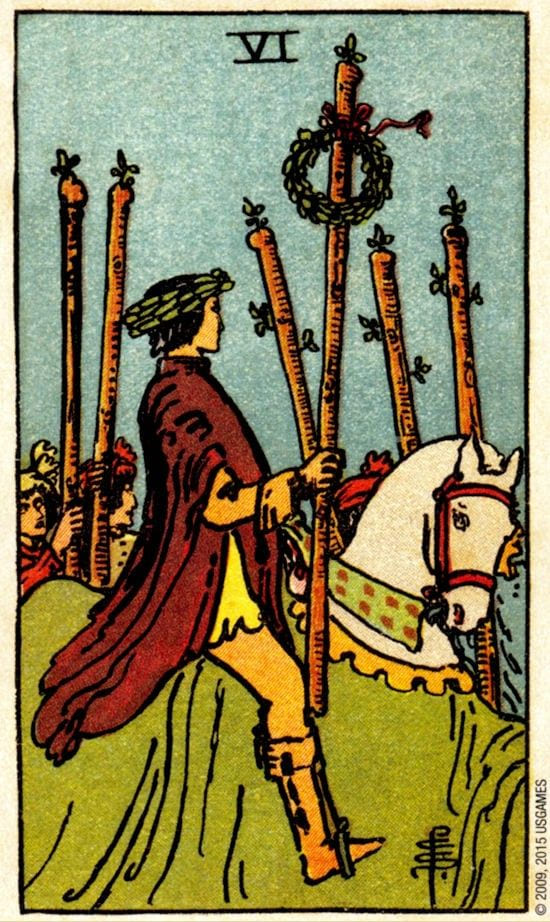
A man rides a white horse through a cheering crowd. On his head, a laurel wreath. On the wand he carries, another wreath. The crowd below reaches up — not to pull him down, but to celebrate. He sits tall in the saddle, eyes forward, the posture of someone who fought for this and won.
This is the Six of Wands. The victory parade. The moment after the battle when the world finally sees what you did.
But here’s what makes this card more complicated than it looks: the Six of Wands isn’t just about winning. It’s about being seen winning. The crowd matters. The wreath matters. The white horse matters. Strip away the audience and you’d have a different card entirely — maybe Strength, maybe the Nine of Pentacles. What makes the Six of Wands unique is that the victory is public. And public victories come with a price tag most people don’t read until later.
Card symbolism
The white horse. Purity of purpose, strength, and status. White horses in art have always been reserved for heroes and leaders. This isn’t a workhorse — it’s a parade horse. The distinction matters: this card is about the display of achievement as much as the achievement itself.
The laurel wreaths. Two of them — one on his head, one on his wand. Laurel has been a symbol of victory since ancient Greece. The double wreath emphasizes that this isn’t a minor win. It’s been acknowledged, crowned, and made official. You didn’t just succeed — success was declared.
The crowd. This is what separates the Six of Wands from every other success card. The crowd is looking up, reaching toward the rider. They represent public acknowledgment — the colleagues who congratulate you, the friends who share your post, the audience that votes for you. The Six of Wands is one of the few cards in tarot where other people’s opinion is part of the meaning.
The rider’s posture. Upright, confident, looking ahead — not down at the crowd. He receives the recognition but doesn’t grovel for it. The ideal Six of Wands energy is confidence without arrogance: you know what you did, and you’re okay with people knowing too.
The wands held by the crowd. The people below also carry wands. They’re not passive spectators — they’re participants. They too had fire, ambition, energy. The rider won among them, not above them. This is a victory within a community, not over it.
Upright meaning
The Six of Wands upright is the card of victory, public recognition, triumph after struggle, and the confidence that comes from being acknowledged.
Victory after effort. This isn’t luck or inheritance. The Six of Wands follows the Five — the conflict, the competition, the chaos of clashing wands. You went through that, and you came out the other side holding the wreath. The victory tastes better because it was earned through struggle, not handed to you.
Public recognition. The key word is public. This isn’t a quiet, private satisfaction — it’s recognition that others can see. A promotion announced company-wide. A project that gets praise from leadership. An achievement that your community acknowledges. The Six of Wands says: people notice what you did.
Self-confidence. Not the fragile kind that needs constant reassurance — the kind that comes from evidence. You tried something hard. You won. And now you carry yourself differently because you know you can. The Six of Wands is the confidence that comes from having done the thing, not from positive affirmations about maybe doing it someday.
Leadership acknowledged. Others are looking to you now. The crowd isn’t just celebrating — they’re following. The Six of Wands often appears when you’ve stepped into a leadership role and people are responding to it. You set the direction, and they’re walking with you.
Momentum. Victory breeds victory. The Six of Wands often marks the point where things start building on themselves — one success opens the door to the next. The confidence, the visibility, the proof of concept — it all compounds.
Reversed meaning
The Six of Wands reversed is what happens when the parade is over — or when it never happened at all.
Private success, no recognition. You did the work. You hit the target. And nobody noticed. The reversed Six is the brilliant project that got buried in a reorganization. The weight loss nobody mentioned. The personal breakthrough you can’t explain to anyone because they weren’t there for the struggle. The achievement is real; the applause is missing.
Self-doubt after success. The parade happened, but you didn’t believe it. Imposter syndrome at its most corrosive: you won, everyone’s celebrating, and all you can think is “they’ll figure out I don’t deserve this.” The reversed Six often shows up in people who can achieve but can’t receive — who deflect every compliment and question every win.
Fall from grace. The horse stumbled. The crowd turned. Yesterday’s hero is today’s cautionary tale. The reversed Six can mean a public failure, a reputation hit, or the terrifying experience of watching support evaporate once you’re no longer winning.
Ego unchecked. The wreath went to your head. You started confusing the applause with your identity — believing you’re special because people clap, rather than trusting that the work has value regardless of who notices. The reversed Six warns: if your confidence depends on an audience, it isn’t confidence. It’s performance.
Comparison and envy. Watching someone else’s parade and wondering why you don’t have one. Social media makes this version of the reversed Six brutally common — seeing other people’s public victories and concluding that your own private struggles aren’t enough.
In love and relationships
Upright. The Six of Wands in love is the relationship that others admire. The couple people toast at dinner. The partnership that looks as good as it feels. For couples, this card means a phase of mutual pride — you’re genuinely proud of each other, and you’re not shy about showing it. Engagements, public declarations, the relationship milestone that everyone celebrates. For singles, the Six of Wands signals a phase of magnetic confidence — you’re attracting attention because you’re radiating “I know my worth” energy. People notice someone who moves like they’ve already won.
Reversed. The relationship looks perfect from outside but feels hollow inside. Or: a partner whose ego needs constant feeding — someone who treats the relationship like a trophy rather than a partnership. Also: the fear of being publicly vulnerable in love — refusing to “go official” because what if it fails and everyone sees.
In career and finances
Upright. The promotion. The award. The client win everyone heard about. The Six of Wands in career readings is unambiguous good news: you’re succeeding, and your success is visible. This card often appears around milestone moments — presentations that land, projects that ship to praise, leadership roles that feel earned. Financially, the Six suggests a period of abundance that’s the direct result of effort — bonuses, raises, returns on investments you made with skill, not luck.
Reversed. Working hard with zero recognition. The colleague who gets credit for your ideas. The career that’s objectively successful but feels empty because nobody sees the cost. Or: workplace politics turning against you — yesterday you were the golden employee, today the culture shifted and you’re on the outside. Financially, the reversed Six can mean overspending to look successful rather than actually building wealth.
In health and well-being
Upright. The recovery milestone. The doctor saying “your numbers look great.” The fitness goal reached and genuinely felt in your body. The Six of Wands in health is the moment where effort becomes result — and importantly, where that result is visible. Others can see you’re healthier, stronger, more alive. It’s also the confidence boost that comes from overcoming a health challenge — the knowledge that your body can fight and win.
Reversed. Health achievements nobody notices, or worse, that you can’t feel despite the numbers improving. Recovery that looks good on paper but doesn’t feel like victory inside. Or: the pressure of maintaining a healthy image — performing wellness for others while struggling privately.
Key combinations
Six of Wands + The Sun. The most triumphant combination in the deck. Not just winning — winning joyfully, radiantly, with your whole heart. Public success that also feels genuinely good. No hidden costs, no imposter syndrome. Pure, earned, radiant victory.
Six of Wands + Ten of Cups. Victory at home. Family celebrates your achievement, or the achievement IS your family — the relationship, the home, the life you built together. The parade ends at your own front door.
Six of Wands + The Tower. Swift reversal. A very public fall. The higher the horse, the harder the drop. This combination warns: don’t build your identity on the parade, because parades end.
Six of Wands + Seven of Wands. You won — now defend it. The Six’s victory is immediately challenged by the Seven’s competition. Success attracted attention, and not all of it is friendly. Stand your ground.
Six of Wands + The Hermit. Victory followed by withdrawal. You won, the crowd cheered, and now you need to be alone to figure out what it actually means. Not all winners want the spotlight forever.
Six of Wands + Three of Swords. The victory hurt someone. Your win came at another’s expense, and the heartbreak is real. Or: winning what you thought you wanted, only to realize it came with a loss you didn’t anticipate.
Six of Wands + Page of Wands. Beginner’s triumph. The first big win in a new venture. Early-stage success that proves the concept and fuels the fire for everything that follows.
The card’s advice
The Six of Wands says: you won. Let yourself feel it. But don’t let it be the last thing you feel.
There’s a peculiar danger in public recognition — it feels so good that you start chasing the feeling instead of the work that created it. The wreath is a symbol. The horse is a symbol. The crowd is temporary. What’s permanent is the thing you did to get here: the effort, the skill, the willingness to enter the arena when you weren’t sure you’d win.
Enjoy the parade. You earned it. Take the compliment, accept the award, post the photo. But when the crowd goes home and the wreaths dry out, make sure there’s still something underneath — a purpose, a next project, a reason to ride that has nothing to do with who’s watching.
The best version of the Six of Wands isn’t someone who needs the applause. It’s someone who deserves it and would keep going without it.
Try it yourself
Pull a card with this question: “What achievement in my life deserves more recognition — and am I willing to claim it?”
Because sometimes the Six of Wands isn’t about waiting for others to throw you a parade. Sometimes it’s about being your own crowd — acknowledging what you did, wearing your own wreath, riding forward on a horse you saddled yourself.
The applause is nice. But the victory was always yours.
Frequently Asked Questions
Is the Six of Wands a yes or no card?
The Six of Wands is a strong yes — one of the most affirming cards in the deck. It signals victory, success, and things going in your favor. If you're asking whether something will work out, this card says: yes, and people will notice.
What does the Six of Wands mean in love?
In love, the Six of Wands means a relationship that others admire — a couple people look up to. For singles, it signals a confident phase where you attract attention naturally. The card asks whether you want love or whether you want to be seen being loved.
What does the Six of Wands reversed mean?
Reversed, the Six of Wands points to a private victory nobody celebrates, self-doubt despite success, or the crash that comes when public approval disappears. It can also mean ego taking over — confusing being admired with being worthy.
What is the difference between the Six of Wands and The Sun?
Both are cards of success, but the Six of Wands is specifically about public recognition — being seen, celebrated, applauded by others. The Sun is about inner joy and radiance that doesn't need an audience. The Six needs the crowd. The Sun shines regardless.