Spiritual Bypassing: Are You Using Tarot to Avoid Your Real Problems?
The reading that changed how I think about readings
A few years ago, a client came to me for her third reading in two weeks. Same question every time: Should I leave my relationship?
The first reading was clear. The second confirmed it. But here she was again, shuffling the cards, looking for a different answer. Or maybe not even a different answer — just the act of asking felt safer than the act of deciding.
I put the cards down and said something I don’t say often: “I think what you need right now isn’t another reading.”
She looked at me like I’d taken away her life raft.
That’s when I understood: tarot can be medicine, but it can also be anesthesia. And sometimes the difference between the two is hard to see.
What is spiritual bypassing, exactly?
The term “spiritual bypassing” was coined by psychotherapist John Welwood in the 1980s. He defined it as “the tendency to use spiritual ideas and practices to sidestep or avoid facing unresolved emotional issues, psychological wounds, and unfinished developmental tasks.”
In simpler terms: using spirituality to run away from your problems while looking like you’re working on yourself.
It’s not unique to tarot. People bypass with meditation (“I’ll just sit with it” instead of addressing conflict), with yoga (“I’m focusing on my practice” instead of dealing with depression), and with manifestation (“I’m raising my vibration” instead of updating their resume).
But tarot has a unique risk factor: it gives answers. Or at least, it feels like it does. And when you’re afraid of making the wrong choice, an external authority — even one made of cardboard and ink — can feel like a relief.
7 signs you might be using tarot as an escape
I’ve seen these patterns in clients, and I’ve been honest enough to recognize a few in my own practice over the years. None of them make you a bad person. They make you human.
1. You ask the same question over and over
You did a reading about whether to accept the job offer. The cards said go for it. But it felt scary, so you pulled again. And again. And maybe asked a different reader too.
This isn’t seeking clarity — it’s seeking comfort. The cards already answered. What you’re looking for is the courage to act, and no amount of shuffling will produce that.
2. You pull cards instead of making decisions
“I’ll see what the cards say” has replaced “let me think about this.” Every choice — from major life decisions to what to say in a text message — gets outsourced to the deck.
Tarot is a tool for reflection, not a replacement for your own judgment. When you can’t choose what to eat for lunch without drawing a card, the tool has become a crutch.
3. You use readings to avoid difficult conversations
Instead of telling your partner how you feel, you do a reading about the relationship. Instead of asking for a raise, you pull cards about your career path. The insight feels productive, but nothing in your actual life changes.
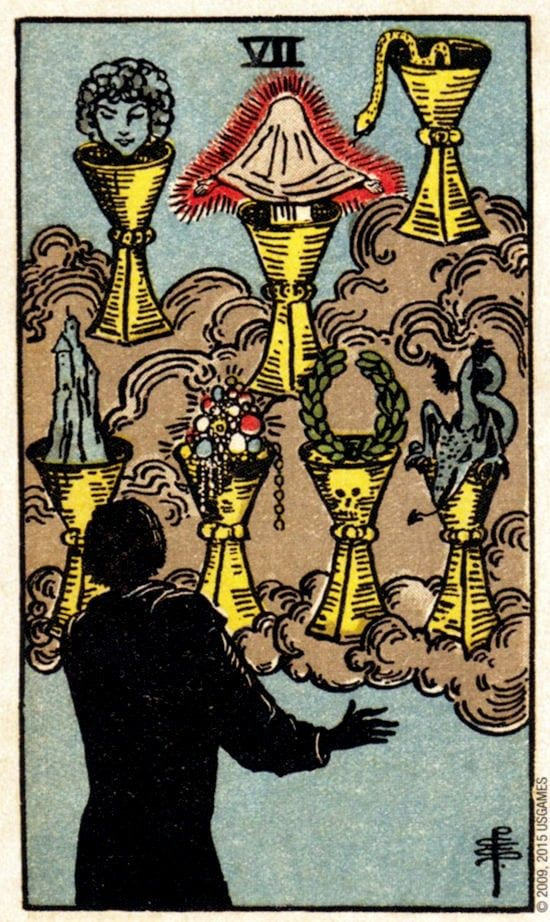
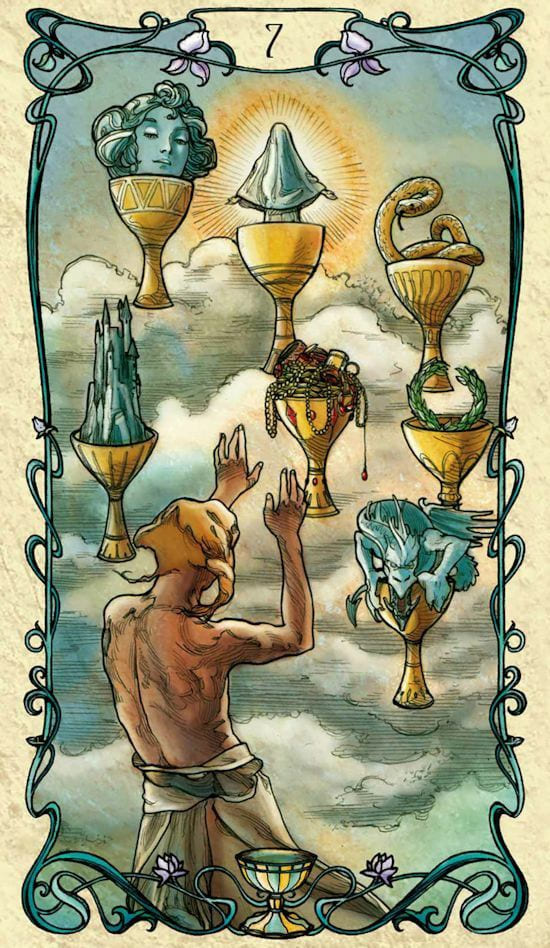
The Seven of Cups is the perfect image here — a figure staring at beautiful visions in the clouds while standing still. Fantasy feels like progress. It isn’t.
4. You interpret cards to hear what you want
The Tower came up in your love reading, but instead of sitting with its message of necessary upheaval, you rationalize: “Maybe it just means a surprise. Like a surprise proposal!”
When you find yourself doing mental gymnastics to make every card mean something comfortable, you’re not reading tarot. You’re using it as a projector for your wishes.
5. You feel anxious without your cards
You forgot your deck at home and your day feels off-balance. Someone asks you to make a quick decision and you panic because you can’t consult the cards first.
Healthy spiritual practice adds stability to your life. If removing the practice creates instability, the relationship has shifted from tool to dependency.
6. You use tarot language to avoid accountability
“Mercury retrograde made me do it.” “The cards warned me, so it’s not my fault.” “The universe is testing me” — said about consequences you created through your own choices.
Spiritual language can become a sophisticated way of dodging responsibility. The cosmos isn’t making your decisions. You are.
7. You’d rather get a reading than go to therapy
This one is sensitive, and I want to be careful here. Tarot can be a beautiful complement to therapy. I’ve seen readings open doors that clients then walk through with their therapist.
But tarot is not therapy. It can’t treat depression, process trauma, or diagnose anxiety disorders. If you’re consistently reaching for your deck when what you need is professional mental health support, that’s a bypass worth examining.
Why we bypass (and why it’s not your fault)
Spiritual bypassing isn’t a character flaw. It’s a coping mechanism, and like all coping mechanisms, it exists because at some point it helped you survive.
The world is overwhelming. When you’re drowning in uncertainty, tarot offers structure. Three cards, clear positions, a narrative that makes sense. Of course you reach for it.
Decisions feel dangerous. If you’ve been burned by bad choices — yours or others’ — outsourcing decisions to the cards feels safer. The responsibility shifts from you to the universe.
Sitting with pain is hard. Really, genuinely hard. Pulling a card about your grief is easier than sitting in a room with it for twenty minutes. The card gives you something to do with the feeling.
Spiritual communities reward it. When your community celebrates daily readings, constant card pulls, and “asking the universe” as the solution to everything, bypassing doesn’t just feel normal — it feels virtuous.
Understanding why you bypass is the first step toward doing it differently.
How tarot can actually help (when used honestly)
The irony is that tarot, used with integrity, is one of the best tools against spiritual bypassing. The deck doesn’t tell you what you want to hear. It tells you what you need to see.
The honest self-check
Before any reading, ask yourself: Am I pulling this card because I need insight, or because I’m avoiding action?
If the answer is “avoiding action,” put the deck down. Do the thing you’re afraid of doing. You can pull a card afterward to reflect on how it went.
The one-question rule
Give yourself one reading per question. Not one reading per day on the same question — one reading total. Write down the answer. Sit with it. Act on it. If you feel the urge to ask again, reread your notes instead.
The action card
After every reading, add one step: “What is the one real-world action this reading is asking me to take?” Write it down. Put a deadline on it. A reading without action is just entertainment.
The “what am I avoiding?” spread
Three cards, brutally honest:
- What I’m using tarot to avoid right now — The uncomfortable truth
- What I’m afraid will happen if I face it — The fear driving the avoidance
- What I gain by facing it directly — What becomes available when you stop running
This spread works because it uses the tool against the bypass. The cards become a mirror, not an escape hatch.
When tarot readers enable bypassing
I need to be honest about this: readers can be part of the problem.
If a client comes to me three times with the same question, and I keep charging them for readings without addressing the pattern, I’m enabling spiritual bypassing for profit.
Good readers will sometimes say:
- “The cards are giving you the same message as last time.”
- “I think you already know the answer.”
- “This might be something to explore with a therapist.”
- “What stopped you from acting on the last reading?”
If your reader never challenges you, never pushes back, and is always available for “just one more reading” — consider whether they’re serving your growth or their income.
The balance: devotion without dependency
There’s a beautiful space between “tarot is nonsense” and “I can’t function without my cards.” That space looks like:
- Using tarot for reflection, not instruction
- Pulling cards to deepen understanding, not to delay decisions
- Treating readings as one input among many — alongside your own intuition, trusted friends, professional advice, and plain common sense
- Being willing to hear hard truths from the cards and act on them
- Taking breaks from reading when you notice yourself getting compulsive
- Combining spiritual practice with practical action — therapy, exercise, honest conversations, financial planning
The deck is 78 cards of extraordinary wisdom. But the wisdom only works if you take it off the table and into your life.
A reading for right now
If this article hit a nerve — and I hope it did, gently — here’s a single-card pull you can do right now:
“Where in my life am I using spiritual practice to avoid something that needs my direct attention?”
Pull one card. Sit with it. Don’t pull another.
And then do the thing.
Frequently Asked Questions
What is spiritual bypassing with tarot?
Spiritual bypassing with tarot means using readings to avoid taking action on real problems. Instead of doing the hard work — having the conversation, making the decision, going to therapy — you pull another card hoping the universe will handle it for you.
How do I know if I'm using tarot to avoid my problems?
Key signs: asking the same question repeatedly hoping for a different answer, pulling cards instead of making decisions, using readings to avoid difficult conversations, and feeling anxious when you can't consult the cards. If tarot creates dependency rather than clarity, it's become a bypass.
Is it bad to do tarot readings every day?
Daily readings aren't inherently problematic — a morning card pull for reflection is healthy practice. It becomes a problem when you can't start your day without cards, when you consult them for every small decision, or when the practice creates anxiety instead of reducing it.
How can I use tarot in a healthy way?
Use tarot as a mirror for self-reflection, not as an oracle telling you what to do. Set boundaries — like one reading per question. Act on the guidance you receive instead of pulling more cards. And pair tarot with real-world action: therapy, honest conversations, practical decisions.