Tarot and Dreams: How to Use Cards to Interpret Your Dreams
The same language, different hours
Dreams and tarot cards speak the same language. It’s the language of symbols — water means emotion, fire means passion, towers mean sudden upheaval, journeys mean transformation. Your subconscious mind uses this language all night long, building elaborate stories from images and sensations. Tarot uses it during the day, laying out those same archetypal images on a table for you to read.
The difference is structure. Dreams are wild — they jump, shift, contradict themselves, and dissolve the moment you try to grab them. Tarot is organized — 78 cards with established meanings, positions in a spread, a framework for interpretation. When you bring a dream to the tarot table, you’re translating something chaotic into something you can work with.
This isn’t about the cards predicting what your dreams mean. It’s about using one symbolic system to illuminate another — letting tarot be the translator between your sleeping mind and your waking understanding.
Tarot cards that speak the dream language
Some cards carry more dream energy than others. When these cards appear in a reading — especially one about a dream — pay extra attention.
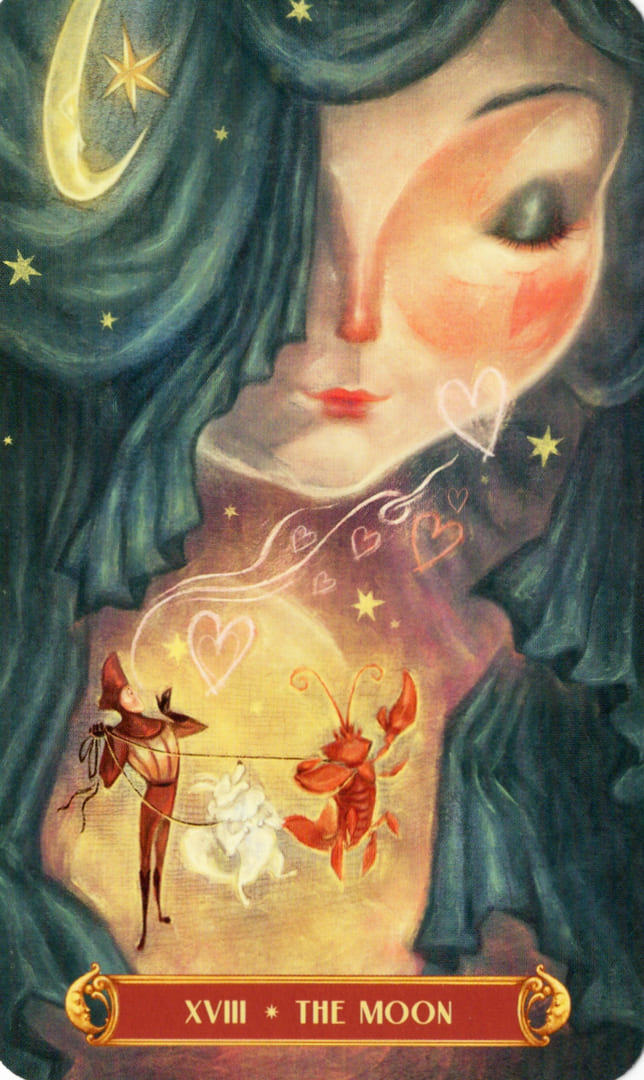
The Moon (XVIII)
The Moon is the dream card. Its landscape is literally the territory of dreams — two towers marking the threshold between worlds, a path disappearing into darkness, a pool of water reflecting something other than what stands above it. When the Moon appears in a dream reading, the dream is pointing to something your conscious mind doesn’t want to see. The message is real, but it’s deliberately veiled.
The High Priestess
If the Moon is the dream landscape, the High Priestess is the dreamer — the part of you that receives information through channels other than logic. She appears in dream readings when the dream is delivering genuine intuitive knowledge. Something you know but haven’t consciously acknowledged is trying to surface.
The Seven of Cups
The Seven of Cups is the dream as wish fulfillment, fantasy, or warning. Seven cups floating in clouds — some holding treasures, some holding nightmares. This card in a dream reading suggests the dream is showing you desires, fears, or illusions that need examination. Not everything the dream offers is real.
The Star
The Star appears in dream readings when the dream is healing you. After nightmares or difficult dream periods, the Star says: this dream is medicine. It’s processing trauma, releasing pain, or delivering hope. Trust it, even if it felt strange.
The Four of Swords
Rest, recovery, and the wisdom that comes during sleep. The Four of Swords in a dream reading often means the dream is literally part of your body’s healing process — your mind sorting, filing, and releasing the day’s experiences.
A dream interpretation spread
Use this spread when a dream lingers — when you wake up knowing it meant something but can’t quite grasp what.
Position 1: The surface — What the dream was showing you at face value. The literal content, the images, the story.
Position 2: The depth — What’s underneath the dream. The emotional truth the symbols are carrying. This is usually the most important card.
Position 3: The source — Where this dream is coming from. Is it processing yesterday’s stress? Is it drawing from a deep, long-standing issue? Is it connected to something you’ve been avoiding?
Position 4: The message — What the dream wants you to know. The actionable insight — the thing that changes once you understand it.
Position 5: The integration — How to carry this dream’s wisdom into your waking life. What to do with what you’ve learned.
Pull these cards as soon after waking as possible, while the dream’s emotional residue is still present. The closer to the dream, the more accurate the reading tends to be.
How to build a tarot-dream practice
Step 1: The dream journal
Keep a notebook by your bed. The moment you wake up — before checking your phone, before speaking to anyone — write down whatever you remember. Fragments are fine. A single image is fine. “I was in a house that wasn’t my house” is enough to start.
Dream recall is a skill that improves with practice. The more you write, the more you’ll remember.
Step 2: The morning pull
After writing the dream, pull a single card and ask: “What does this dream want me to understand?” Don’t overthink the connection — let your intuitive response to the card create the bridge. Sometimes the link is obvious (you dreamed of water, you pulled the Ace of Cups). Sometimes it’s abstract. Both are valid.
Step 3: The evening reflection
Before sleep, review your morning card and dream. Notice any connections between the card’s energy and how your day unfolded. Did the dream’s message become clearer through the day’s events? Write a sentence or two about it.
Step 4: The weekly pattern
At the end of each week, look back at your dream-card pairings. Patterns emerge fast:
- Do certain cards appear more often with certain dream themes?
- Do recurring dreams connect to the same card?
- Do nightmares consistently pair with specific cards?
These patterns are your personal dream-tarot dictionary — a translation guide that’s unique to your psyche.
Common dream themes and their tarot connections
Falling
Cards: The Tower, the Fool (reversed), Ten of Swords What it means: Loss of control, a structure collapsing, fear of failure. The Tower version is sudden and transformative — something needed to fall. The Fool reversed is fear of taking a risk. The Ten of Swords is the anxiety of hitting bottom.
Being chased
Cards: Eight of Swords, the Devil, Five of Swords What it means: Avoidance. Something you’re running from in waking life is catching up in dreams. The Eight of Swords suggests the trap is mental — you could stop running anytime. The Devil says you’re chained to whatever’s chasing you. The Five of Swords points to a conflict you’re avoiding.
Flying
Cards: The World, the Star, Six of Swords What it means: Freedom, transcendence, or escape. The World is the purest form — you’ve risen above. The Star is spiritual flight — hope lifting you out of darkness. The Six of Swords is flying away from something difficult toward something better.
Water
Cards: Any Cups card, the Moon, the Star What it means: Emotion, the subconscious, flow. Calm water = emotional peace. Turbulent water = emotional upheaval. Drowning = overwhelmed by feelings. The specific Cups card that appears tells you which emotional energy the water represents.
Houses and rooms
Cards: The Emperor, Four of Wands, Three of Pentacles What it means: Your inner architecture — your sense of self, your security, your place in the world. Unknown rooms suggest unexplored parts of yourself. Crumbling houses point to identity shifts. The cards specify which structure is involved.
Death in dreams
Cards: Death (XIII), the Tower, Ten of Swords, Judgement What it means: Transformation, not literal death. Something is ending so something new can begin. The Death card is the cleanest version — a natural transition. The Tower is a violent ending. Judgement is the ending that leads to spiritual awakening.
When dreams and readings echo each other
Pay attention when a card from a recent reading appears as a symbol in your dreams. This is your subconscious processing the reading — absorbing its message at a deeper level than your waking mind could manage.
Similarly, notice when a dream theme appears in your very next reading. You dream about crossing a bridge, and the next morning you pull the Six of Swords (a figure crossing water). These echoes aren’t coincidence — they’re your two symbolic systems calibrating to each other, building a shared vocabulary that makes both practices more powerful.
The more you work with tarot and dreams together, the thinner the boundary between them becomes. Your readings start to feel more dream-like — intuitive, imagistic, emotionally rich. Your dreams start to feel more readable — structured, symbolic, delivering messages you can actually use.
That’s the partnership working. Two ancient practices, finally introduced to each other, discovering they’ve been telling the same stories all along.
Frequently Asked Questions
How can tarot help me understand my dreams?
Tarot and dreams share the same symbolic language — water for emotions, towers for sudden change, journeys for transformation. When a dream leaves you confused, pulling cards about it translates dream symbolism into tarot symbolism, which is easier to interpret because tarot gives you a structured framework. The cards don't replace your dream — they illuminate it from a different angle.
What tarot spread should I use for dream interpretation?
A simple three-card spread works well: (1) What was the dream showing me? (2) What emotion or energy is behind it? (3) What action or awareness does it call for? Pull these cards while the dream is still fresh — ideally in the morning before your day takes over. Keep it simple so the dream's own language doesn't get buried under too many cards.
Which tarot cards are most connected to dreams?
The Moon (XVIII) is the primary dream card — illusion, the subconscious, and the shadowy territory between waking and sleeping. The High Priestess represents intuitive knowing that comes through dreams. The Seven of Cups shows dreams as fantasy and imagination. The Star often appears when dreams carry messages of hope or healing. The Four of Swords connects to rest and the insights that come during sleep.
Should I keep a dream journal alongside my tarot journal?
Yes, or better yet, combine them. Write the dream first thing in the morning, then pull cards about it and record those too. Over time, you'll notice that certain dreams consistently connect to certain cards — and that pattern recognition makes both your dream recall and your tarot readings sharper.