Tarot and Meditation: How to Use Cards as a Meditation Focus
Why tarot and meditation work together
Meditation and tarot seem like different practices — one is about emptying the mind, the other about filling it with images and meaning. But they’re closer than they appear.
Both require present-moment awareness. Both ask you to observe without immediately reacting. Both use a focal point — breath in meditation, images in tarot — to anchor attention and create space for deeper knowing to emerge.
When you combine them, each practice strengthens the other. Meditation makes you a better tarot reader because it trains you to notice subtle impressions before your analytical mind drowns them out. Tarot gives meditation a rich visual anchor that keeps you engaged in ways that counting breaths sometimes can’t.
This isn’t esoteric theory. It’s a practical technique that takes five minutes, requires no special training, and will change how you relate to your cards.
The basic practice: card gazing
This is the foundation of tarot meditation. Everything else builds from here.
Step 1: Pull a card. You can choose one deliberately (a card you want to understand better, or one that keeps appearing in readings) or pull one randomly for the day.
Step 2: Set the card in front of you at a comfortable viewing distance. Sit comfortably. Close your eyes and take three deep breaths to settle.
Step 3: Open your eyes and look at the card. Not studying it — looking at it. Let your eyes rest softly on the image the way they’d rest on a sunset or a painting in a gallery.
Step 4: For the next 5-10 minutes, simply be with the card. Notice what catches your attention. A color, a symbol, a figure’s expression, a detail in the background you’ve never noticed before. When thoughts arise — and they will — let them pass without chasing them. Return to the image.
Step 5: When the time feels complete, close your eyes for a moment. Notice what stays with you — an image, a feeling, a word. That residue is your meditation’s gift.
That’s it. No guided script, no special breathing technique, no visualization required. Just you and a card and five minutes of attention.
Entering the card: guided visualization
This is the next level — not just looking at the card, but stepping into it.
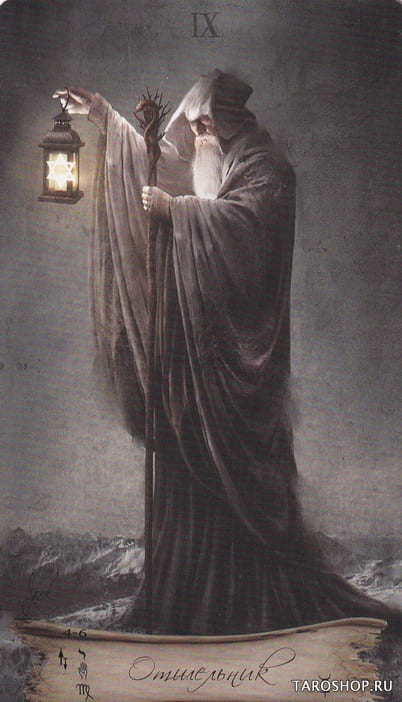
Step 1: Choose a card with a clear scene or landscape. Major Arcana cards work particularly well — the Star, the Moon, the Hermit, the World.
Step 2: Look at the card for a minute or two, absorbing the details. Then close your eyes.
Step 3: Imagine yourself standing at the edge of the card’s scene. What’s the ground like beneath your feet? What’s the temperature? What sounds do you hear? Build the sensory experience as vividly as you can.
Step 4: Walk into the scene. Approach the central figure. In your imagination, you might sit beside the Hermit on his mountain, or stand under the Star’s waterfall, or walk through the Moon’s landscape between the two towers.
Step 5: Ask the figure a question. It can be specific (“What do I need to understand about this situation?”) or open (“What do you want to show me?”). Then listen. The answer might come as words, images, feelings, or just a shift in the atmosphere.
Step 6: When ready, walk back to the card’s edge. Open your eyes. Write down whatever came to you, even if it doesn’t make sense yet.
This technique often produces surprising insights — things you wouldn’t have reached through ordinary card interpretation. Your subconscious mind fills in details that your conscious mind can’t invent on its own, and sometimes those details contain genuine wisdom.
Meditation techniques for specific purposes
For clarity before a reading
Sit with your deck for two minutes before any reading. Hold the deck in both hands. Close your eyes. Breathe slowly and set your intention: “I am open to whatever the cards need to show me.” This brief centering clears the mental noise that makes readings feel fuzzy or disconnected.
For understanding a difficult card
When a card appears repeatedly and you can’t figure out what it’s trying to say, dedicate a meditation session to it. Set it up for the card gazing practice and spend 10-15 minutes just being with it. The meaning that emerges through meditation is often personal and specific — exactly what the textbook definition couldn’t give you.
For processing a heavy reading
After a reading that stirred up strong emotions — whether for yourself or someone else — sit quietly with no card at all. Close your eyes. Place your hands on the deck. Breathe slowly for five minutes and let the emotional charge dissipate naturally. This prevents heavy readings from lingering in your mind and body hours later.
For daily guidance
Pull a card each morning, sit with it for three minutes, and ask: “What energy is present today?” Don’t interpret it analytically — just absorb the image. Throughout the day, notice when the card’s energy shows up in your experience. The Six of Pentacles in the morning might manifest as an unexpected act of generosity by afternoon. This practice builds pattern recognition that directly improves your reading accuracy.
The breath-card connection
This technique integrates breathwork with card meditation:
Inhale: Look at the card and breathe in what the card offers. If it’s the Star, breathe in hope and renewal. If it’s the Three of Swords, breathe in the courage to feel pain honestly.
Exhale: Release what the card is asking you to let go of. With the Star, exhale despair. With the Three of Swords, exhale the resistance to necessary grief.
Repeat: Continue for ten breath cycles. By the end, you’ve physically absorbed the card’s medicine through the intimate language of breath.
This technique is especially powerful with cards you resist. If you always dread pulling the Five of Pentacles, sit with it and breathe through the discomfort. Ten breaths of deliberately engaging with an uncomfortable card changes your relationship with it permanently.
Building a weekly practice
Here’s a simple weekly structure that deepens both your meditation and your tarot skills:
Monday: Pull a card for the week. Spend 5 minutes in card gazing meditation. Set the card on your nightstand or altar for the week.
Wednesday: Revisit the weekly card. Spend 5 minutes in guided visualization — enter the card and see what’s there. Notice if anything has changed since Monday’s meditation.
Friday: Reflect on how the weekly card showed up in your life. Journal about connections between the card’s energy and your experiences. This reflection is itself a meditation — a contemplative review of the week through the card’s lens.
Sunday: (Optional) Do a longer 15-20 minute session with a card of your choice. Use any technique that calls to you. This is your deep-practice day.
This structure takes about 15-20 minutes per week total and creates a rhythm that both practices thrive in.
What changes with practice
After a few weeks of regular tarot meditation, most people notice several shifts:
Readings become faster. Your intuitive response to cards speeds up because you’ve spent focused time with individual cards, building a deeper vocabulary than memorization alone can create.
Emotional charge decreases. Cards that used to trigger anxiety (the Tower, the Ten of Swords, the Devil) lose their emotional sting because you’ve sat with them in a non-reactive state. You’ve proven to your nervous system that looking at these cards is safe.
Detail awareness increases. You start seeing things in cards that you’ve been looking at for months or years without noticing. The background details, the color shifts, the symbolic objects that the artist placed deliberately.
Readings feel less mechanical. Instead of card → meaning → application, the process becomes more fluid. The card speaks to you directly because you’ve been in conversation with it through meditation.
The simplest version
If everything above feels like too much, here’s the absolute minimum:
Pull one card. Look at it for one minute in silence. Take three breaths. Put it back.
That’s a complete tarot meditation practice. It takes ninety seconds. Do it daily and you’ll be surprised how much it changes your readings within a month.
The cards don’t just carry meanings in their symbolism. They carry experiences — and meditation is how you access them.
Frequently Asked Questions
How do you meditate with tarot cards?
The simplest method: pull a card, set it in front of you, and gaze at it softly for 5-10 minutes. Don't analyze it. Let your eyes rest on the image while breathing slowly. Notice which details draw you in, what emotions arise, what stories the image suggests. When your mind wanders, return your attention to the card. That's tarot meditation in its most basic form.
Which tarot cards are best for meditation?
Major Arcana cards work best because their rich symbolism gives your mind more to explore. The High Priestess (intuition, inner knowing), the Star (hope, spiritual connection), the Hermit (solitary wisdom), and the World (completion, wholeness) are particularly powerful for meditation. But any card that calls to you is the right card to meditate with.
Can tarot meditation replace traditional meditation?
It can serve as your primary meditation practice if that's what works for you. Tarot meditation is a form of focused-attention meditation — you're concentrating on a visual object (the card) rather than breath or a mantra. It builds the same skills: present-moment awareness, emotional regulation, and the ability to observe thoughts without attachment. The tarot element simply adds symbolic depth.
How often should I practice tarot meditation?
Start with once or twice a week for 5-10 minutes. Consistency matters more than duration. Daily practice is ideal if you can maintain it, but even weekly sessions will deepen your relationship with the cards and improve your reading accuracy over time. The key is regularity — sporadic long sessions are less effective than short consistent ones.