Ten of Pentacles Tarot Meaning: Legacy & What You Leave Behind
First impression
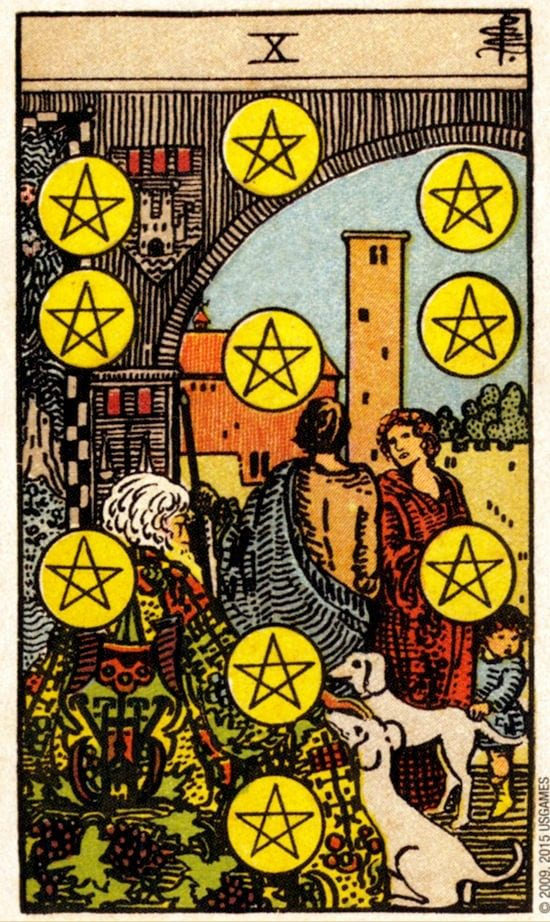
Three generations stand beneath a stone archway. An elder sits wrapped in a decorated robe, two white dogs at his feet. Behind him, a younger couple stands together — and if you look carefully, a child is there too, partly hidden, the newest link in a chain that stretches back beyond the frame.
Ten pentacles are arranged across the scene in the pattern of the Kabbalistic Tree of Life. Not scattered randomly — placed with intention, as if the wealth in this card isn’t just money but a system, a structure, a design that connects everything.
Behind them all: a castle. Solid stone walls. A home that has stood for generations and will stand for more.
The first time this card appeared for me, I was helping my mother organize old family photographs. Three generations of faces in a single box. The Ten of Pentacles landed and I felt something I couldn’t quite name — not nostalgia, exactly, but a sudden awareness of being part of a line. Of being both the result of everything that came before and the origin of whatever comes next.
That’s the heart of this card. It’s not about being rich. It’s about what you build that outlives you.
Symbolism
The three generations are the card’s soul. The elder who built the fortune. The adults who maintain it. The child who will inherit it. This isn’t a snapshot — it’s a story told across time. The Ten of Pentacles doesn’t ask what you have today. It asks what you’re creating for tomorrow.
The ten pentacles arranged in the Tree of Life pattern connect material wealth to spiritual architecture. This isn’t random abundance. It’s designed wealth — wealth with purpose, structure, and meaning. The Tree of Life represents the connection between the earthly and the divine, suggesting that true prosperity isn’t just financial. It’s the alignment of values, resources, and legacy.
The archway frames the scene like the entrance to an estate — a threshold between the public world and the private sanctuary of family and home. Everything inside the arch belongs to them. It was earned, built, protected.
The castle represents permanence. Not a tent or a house but a castle — stone, enduring, built to last centuries. The ambitions of the Ten of Pentacles aren’t quarterly. They’re generational.
The two dogs symbolize loyalty, protection, and the domestic life that wealth supports. They’re comfortable, calm, at home — not guarding against threats but resting in the security of a well-provided life.
The elder’s decorated robe tells a story of success that’s been lived in. The symbols on the fabric — grapes, castles, geometric patterns — represent the accumulated wisdom and experience of a life spent building something worth passing on.
As the final numbered card in the suit of Pentacles — the suit of earth, material reality, and physical legacy — the Ten represents the completion of the material journey. Every pentacle earned from the Ace’s first opportunity has been multiplied, invested, and transformed into something that serves not just the individual but the family, the community, the future.
Upright meaning
The Ten of Pentacles upright is the card of arrival — not the exciting, champagne-popping kind, but the deep, quiet kind where you look around at what you’ve built and realize it’s solid enough to last.
Generational wealth. Not just money in the bank — although it can mean that. The Ten of Pentacles is about the kind of wealth that compounds: property that appreciates, investments that grow, businesses that sustain families, financial structures that protect. If you’re thinking long-term about money, this card says you’re on the right track.
Legacy. What will people say about you when you’re gone? Not the obituary — the real answer. The Ten of Pentacles asks what you’re building that will outlast your own life. A business? A family? A set of values? A body of work? A tradition that your children’s children will carry forward? Legacy isn’t about fame. It’s about foundations.
Family and belonging. The Ten of Pentacles is deeply communal. It represents the family structure — however you define family — that provides identity, stability, and roots. It’s the card of family homes, holiday gatherings, traditions that nobody started but everyone maintains, the feeling of walking into a place and knowing you belong there because your people built it.
Established success. Not startup energy — arrival energy. The Ten of Pentacles represents the company that’s been running for 30 years, the career that’s reached its plateau of mastery, the financial plan that’s finally mature enough to provide. This is post-hustle. The work was done. Now it pays dividends.
Tradition and continuity. Some things have value precisely because they’ve endured. The Ten of Pentacles honors the recipe your grandmother made, the way your family celebrates, the principles that were passed down not through lectures but through example. Tradition isn’t always a cage — sometimes it’s a compass.
Reversed meaning
The Ten of Pentacles reversed is the legacy that cracks — either because it was built on the wrong foundation, or because the time has come to build something different.
Financial instability. Wealth that’s been mismanaged, squandered, or lost. Debt that threatens long-term security. Living beyond your means in ways that mortgage the future. The reversed Ten says the castle has structural issues — and ignoring them won’t make the walls stronger.
Family disputes. Fights over inheritance. Siblings who stop speaking over money. Wills contested, property divided, loyalties torn. The reversed Ten of Pentacles often appears when money becomes the language of family dysfunction — when what should connect people becomes the wedge between them.
Breaking from tradition. This is the most nuanced reading of the reversed Ten. Sometimes the legacy you inherited isn’t worth passing on. Sometimes the “family way” is toxic, limiting, or simply not yours. The reversed Ten can mean choosing to be the one who breaks the pattern — who refuses to pass on the trauma, the expectations, the cage disguised as tradition.
Short-term thinking. Sacrificing long-term security for immediate gratification. Day-trading instead of investing. Spending the inheritance instead of growing it. The reversed Ten warns: what feels good now can cost you everything later.
Generational trauma. The dark twin of generational wealth. Patterns of abuse, addiction, poverty, dysfunction, or emotional unavailability that travel down the family line. The reversed Ten can point to these patterns and say: you can be the one who stops them.
In love and relationships
Upright: The Ten of Pentacles in love is the card of the endgame — the relationship that’s ready to become a family. Meeting the parents. Moving in together. Getting engaged. Buying a house. Starting a family. This isn’t the thrilling romance of the Ace of Cups or the passionate pull of the Two. This is the love that files joint taxes and shares a mortgage and still holds hands at the table after decades.
For singles, the Ten of Pentacles suggests meeting someone through family or established social circles. Someone who values stability, shares your vision for the future, and is looking for a partner to build with — not just to date.
Reversed in love: Family interfering in the relationship. Differing values about money, tradition, or the future. A partnership that looks successful but feels hollow underneath. The reversed Ten in love asks: are you building a life together, or are you just performing one?
In career and finances
Upright: The Ten of Pentacles in career is the established company, the family business, the career that provides genuine security. It favors long-term planning: retirement accounts, pension funds, real estate, the kind of financial thinking that your future self will thank you for. If you’re starting a business, this card says build it to last — not to flip.
Reversed in career: A business or financial plan that’s failing to provide the security it promised. Working at a company that’s financially unstable. Career choices made for prestige or salary that don’t align with your values. The reversed Ten in career asks whether you’re building something sustainable or just something impressive.
In health and wellbeing
Upright: The Ten of Pentacles in health often points to hereditary conditions — the health patterns that run in families. It can also represent holistic family health: are you creating a home environment that supports physical and emotional wellbeing? It’s the card of family therapy, genetic awareness, and the health choices you model for the next generation.
Reversed: Inherited health conditions that need attention. Ignoring family medical history. Passing stress, poor habits, or unhealthy coping mechanisms to your children through example rather than genetics. The reversed Ten in health says: some of what you carry in your body came from your family. Understanding that isn’t blame — it’s information.
Key combinations
Ten of Pentacles + The Emperor: Building an empire. Structure, authority, and lasting power. This combination represents the founder energy that creates generational institutions.
Ten of Pentacles + The Tower: Legacy shattered. What was built for generations collapses. A family fortune lost, a business destroyed, a tradition violently ended. Painful, but sometimes the old structure needed to fall.
Ten of Pentacles + Six of Cups: The past and the future meet. Nostalgia, family traditions, childhood homes — this combination drips with the warmth of belonging and the sweetness of roots.
Ten of Pentacles + Four of Wands: Celebration of established success. Homecoming, housewarming, family reunions, marriage. The party that honors what’s been built.
Ten of Pentacles + The Hierophant: Traditional values forming the backbone of a legacy. Institutional wealth, educational foundations, religious or cultural inheritance. The combination of established wisdom and material security.
Ten of Pentacles + Five of Pentacles: Poverty within wealth. Someone in the family is being excluded from the prosperity. Or the wealth is there but the warmth isn’t — a rich family with cold relationships.
Ten of Pentacles + Death: The end of one legacy and the beginning of another. A family business closing. An inheritance that transforms your life completely. The old giving way so the new can grow.
The card’s advice
The Ten of Pentacles asks you a question that most people don’t think about until it’s too late: what are you building that will outlast you?
Not what you’re earning. Not what you’re buying. Not what you’re consuming or accumulating or showing off. What are you building — in the structural sense, the foundational sense, the “this will still be standing when I’m not” sense?
It might be a business. It might be a family. It might be a body of work, a community, a set of values you live so consistently that your children absorb them without being told. It might be as simple as a savings account that grows quietly while you sleep, or as complex as a family culture that teaches every new generation what it means to belong.
The Ten of Pentacles doesn’t care if you’re rich. It cares if you’re building. There’s a difference between someone who has money and someone who has a legacy. Money can be spent. A legacy compounds.
The elder in the card didn’t just accumulate coins. He built walls. He planted trees he would never sit under. He created a world where his children and grandchildren could stand beneath an archway and feel — not just financially secure, but fundamentally home.
That’s the Ten of Pentacles. Not wealth as status. Wealth as structure. Wealth as shelter. Wealth as love made material.
What are you building?
Try it yourself
Pull three cards with this question: “What am I building that will outlast me — and is it the thing I actually want to leave behind?”
Card 1: What you’re currently building (you may be surprised) Card 2: What you unconsciously inherited (patterns, values, advantages, or wounds) Card 3: What you’re choosing to pass on (and whether it’s worth passing)
The Ten of Pentacles says: you’re part of a chain. You received something from those who came before. You’re shaping something for those who come after. The only question is whether you’re doing it on purpose.
Frequently Asked Questions
Is the Ten of Pentacles a yes or no card?
The Ten of Pentacles is a strong yes — especially for questions about long-term stability, family matters, financial security, and building something lasting. It affirms that what you're building has real, enduring foundations. For short-term or impulsive questions, it says yes but think bigger.
What does the Ten of Pentacles mean in love?
In love, the Ten of Pentacles signals a relationship that's ready for traditional milestones — meeting the family, moving in together, marriage, building a home, starting a family. It represents love that has grown past excitement into something structural: shared values, shared goals, shared life. This is the 'forever home' of love cards.
Does the Ten of Pentacles mean I'm getting an inheritance?
It can, but the Ten of Pentacles defines inheritance broadly. It might mean literal money or property passing from one generation to another, but it also includes inherited values, family patterns, traditions, knowledge, or even generational trauma that needs addressing. The card asks: what have you received from those who came before, and what will you pass on?
What does the Ten of Pentacles reversed mean?
Reversed, the Ten of Pentacles warns about financial instability, family conflicts over money or property, breaking from family traditions, or short-term thinking that sacrifices long-term security. It can also positively mean choosing to break a toxic generational pattern — refusing to pass on what was passed to you.