Ten of Swords Tarot as Feelings: It's Over — and the Only Way Out Is Through the Dawn
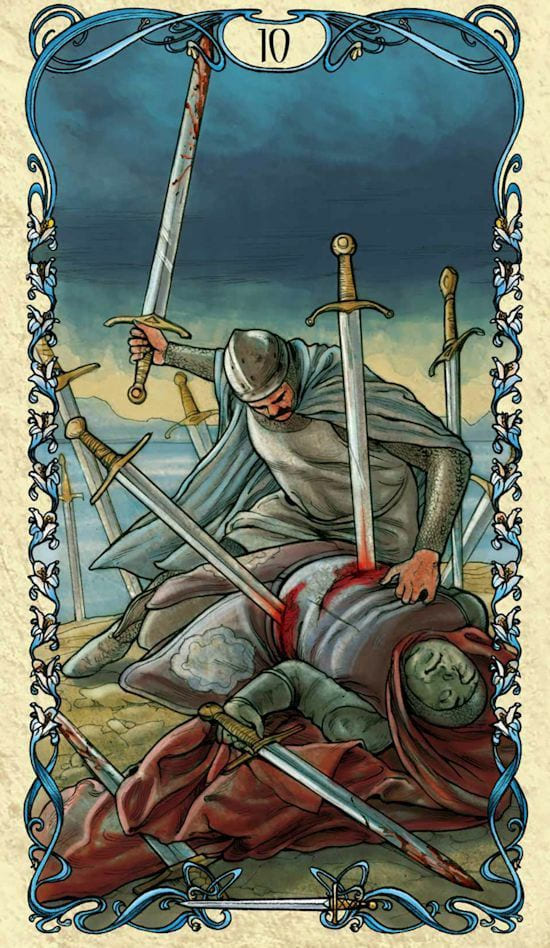
A figure lies face down with ten swords in their back — but the sun is rising
A body lies prone on the ground, ten swords driven into the back from neck to legs. The image is total defeat — overkill, even. One sword would have been enough. Ten is a statement. The scene should be hopeless. But look at the horizon: golden light is breaking through the darkness. The sky is shifting from black to gold. The worst has happened — and the dawn is coming anyway.
That’s the Ten of Swords. And as feelings, it’s the card of someone who has reached the absolute bottom — devastated, defeated, laid completely flat — and is about to discover that the only place left to go is up.
Here’s the paradox of the Ten of Swords: it’s simultaneously the most devastating and the most hopeful card in the suit. Devastating because nothing was spared — every illusion pierced, every hope skewered, every defense breached. Hopeful because when you’ve been stabbed ten times and you’re still breathing, the only remaining truth is: I survived the worst thing. And a person who has survived the worst thing is a person who can survive anything.
Upright: as feelings for you
Total emotional devastation. This person doesn’t feel hurt. They feel annihilated. Whatever happened between you — a betrayal, a brutal truth, the final collapse of something they’d been holding together with sheer will — it didn’t just wound them. It leveled them. They are lying face-down in the aftermath, unable to move, unable to process, just… there. On the ground. With ten swords.
The feeling of being completely done. The Ten of Swords is finality. This person doesn’t feel conflicted anymore. They don’t feel hopeful or wondering or uncertain. They feel done. The debating is over. The fighting is over. Whatever they were holding onto — hope, denial, the belief that things could be different — it’s been pierced for the last time.
Betrayal so deep it rewrites reality. If the Ten of Swords involves betrayal, it’s the kind that changes how someone sees the world. Not just “you hurt me” but “you changed my understanding of what people are capable of.” The trust isn’t just broken — the belief that trust is possible has been wounded. The swords in the back aren’t just pain. They’re education.
Dramatic expression of pain. The Ten of Swords can sometimes indicate someone who is being somewhat theatrical about their suffering — not that the pain isn’t real, but that ten swords might be more than the situation warrants. This person may be experiencing genuine hurt but expressing it at maximum volume.
The strange peace of having nothing left to lose. Underneath the devastation, there can be an unexpected calm. When everything has been taken, the anxiety of losing things disappears. When the worst has happened, the fear of the worst dissolves. The Ten of Swords person may feel destroyed — and paradoxically, more free than they’ve been in years.
Reversed: as feelings for you
Recovery from the bottom. The reversed Ten means the swords are being pulled out. Not all at once — one at a time, slowly, painfully. This person is getting up off the ground. They’re not healed. They’re not fine. But they’re rising, and the fact that they can rise after ten swords proves something about what they’re made of.
Refusing to stay down. The reversed Ten is defiance — the person who was supposed to be finished, who was told it was over, who had every reason to stay face-down in the dirt — choosing to get up anyway. Their feelings might include resentment, determination, and the specific kind of strength that only comes from having been completely destroyed and deciding that destruction isn’t the end.
Releasing the victim narrative. The reversed Ten can mean someone who is choosing to stop identifying with their devastation. Yes, they were hurt. Yes, it was terrible. But they’re deciding to stop lying face-down and start facing forward. The past is being released — not forgiven, not forgotten, but put down.
The worst is truly over. Sometimes the reversed Ten is simply the exhale — the moment when the last sword is pulled free and the person realizes they’re still alive. The relief can be enormous. The lightness of surviving the unsurvivable is its own kind of rebirth.
Context: as feelings in different situations
Someone you’re dating
Upright: Something has ended catastrophically. The Ten of Swords in dating means a devastating blow — a discovery, a betrayal, a conversation that ended everything. This isn’t a bump in the road. It’s the road collapsing.
Reversed: Recovering from something devastating that happened during dating. Getting up, dusting off, deciding whether the connection is worth rebuilding from the rubble.
An ex’s feelings
Upright: They feel completely destroyed by the end of your relationship. The Ten of Swords as an ex’s feelings is grief in its most raw form — the death of what was, the burial of what could have been, the total collapse of whatever dream they were carrying.
Reversed: They’re getting back up. The reversed Ten for an ex means the devastation phase is ending and reconstruction is beginning. Whether that reconstruction includes you depends on whether the relationship that died deserved resurrection.
A new connection
Upright: They’re coming to you from wreckage. In a new connection, the upright Ten means this person is freshly destroyed by something else — and they might not be capable of building anything new until they’ve finished processing the old collapse.
Reversed: Rising from the ashes and ready for something different. The reversed Ten in a new connection means they’ve done the grief work and are emerging — scarred but standing, devastated but determined, ready to try again with full awareness of what the worst looks like.
Ten of Swords vs. other cards as feelings
Ten of Swords vs. Three of Swords. The Three is targeted pain — three specific swords, three specific wounds. The Ten is total annihilation — every possible sword, maximum damage. The Three says “this hurts.” The Ten says “everything hurts, and it’s over.”
Ten of Swords vs. The Tower. The Tower destroys structures. The Ten of Swords destroys people (emotionally). The Tower collapses what you built. The Ten puts the final blade in what you believed. Both are catastrophic. The Tower is external. The Ten is personal.
Ten of Swords vs. Death. Death is transformation — the ending that makes room for rebirth. The Ten of Swords is the ending itself — lying face down, ten blades, maximum devastation. Death is a door. The Ten is the moment you hit the floor before you see the door. One looks forward. The other looks down.
What the Ten of Swords as feelings is really telling you
Here’s the truth about the Ten of Swords: the absolute worst thing has already happened. Which means it can’t happen again.
This is the card’s secret mercy. When someone feels the Ten of Swords, they’re not waiting for the blow — the blow already landed. All ten of them. And the person is still here. Ruined, maybe. Changed, certainly. But here. Breathing. Present. Alive on a field with a brightening sky.
If someone feels the Ten of Swords because of you, the situation is dire — but dire is not permanent. The Ten is the last card in the numbered Swords. What comes after is the Page — a new beginning, a fresh perspective, the sword held differently by hands that have learned what the blade can do. The devastation of the Ten is the soil from which the Page grows.
The dawn is there. It’s always been there, on the horizon of the Ten of Swords, waiting for the person on the ground to notice that the light is changing. The swords are in the back. The night is ending. And somewhere in the space between devastation and sunrise, the possibility of starting over is quietly, stubbornly, inevitably beginning.
Try it yourself
Pull a card with this question: “What rises from the ashes of what was destroyed between me and the person I’m thinking about?”
Because the Ten of Swords is never the last word. The sun rises. The body stirs. And from the most complete devastation comes the most complete opportunity for reinvention.
The swords are in the back. But the golden light is breaking. And the question has never been whether dawn comes after the darkest night. It always does. The question is what you build in the morning.
Frequently Asked Questions
What does the Ten of Swords mean as someone's feelings for me?
The Ten of Swords as feelings means this person feels completely devastated — not wounded, not hurt, but *finished*. They've hit rock bottom emotionally. Ten swords in the back is not a paper cut. It's the feeling of absolute defeat, total betrayal, or the end of every hope they were carrying. But here's the thing: the sky is brightening. Rock bottom is also the foundation.
Is the Ten of Swords the worst card for feelings?
It's the most dramatic, but not necessarily the worst. The Ten of Swords is the *end* of pain, not its continuation. It's so over that nothing more can be taken. And in that totality lies a strange mercy: when you've lost everything, you have nothing left to fear. The Ten of Swords is the darkest moment before dawn.
What does the Ten of Swords reversed mean as feelings?
Reversed, the Ten of Swords means the worst is genuinely behind them. They're pulling the swords out one by one. Recovery is beginning — not from a position of denial, but from someone who hit the absolute bottom and discovered that the bottom is where you push off from.
Does the Ten of Swords mean the relationship is definitely over?
In its current form, usually yes. But 'over' and 'finished forever' aren't always the same thing. The Ten of Swords ends one chapter completely. Whether a new chapter begins — with different dynamics, different awareness, different people — is a separate question. Some relationships die to be reborn. Some die to stay dead. The Ten doesn't specify which.