Ten of Wands & Four of Swords in Tarot: Burden Demands Rest
You can’t carry ten wands and heal at the same time
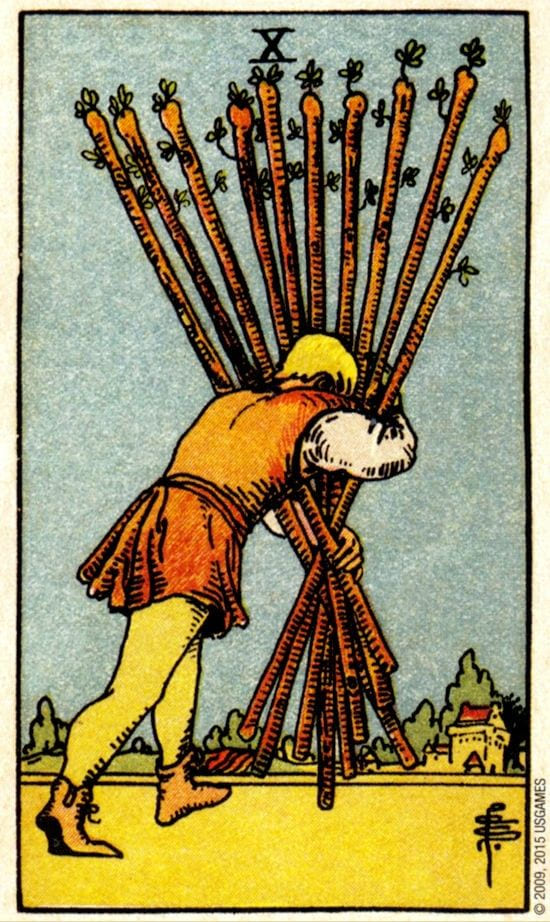
Look at the figure in the Ten of Wands. Bent forward, arms full, face hidden behind a bundle of wands so heavy he can barely see the path ahead. He’s not strong. He’s stubborn. And there’s a village in the distance — a destination — but at this rate, he’ll collapse before he reaches it.
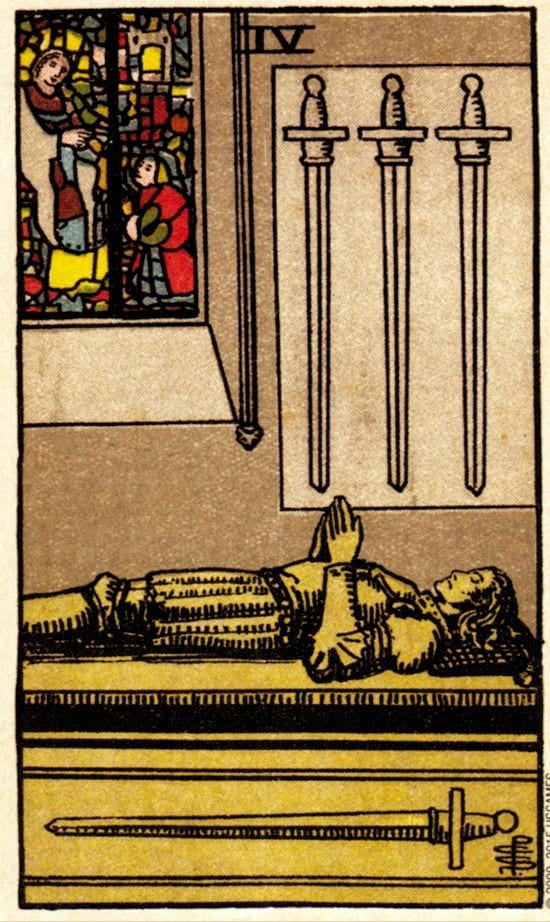
Now look at the Four of Swords. A knight lying in repose, weapons on the wall, hands folded in peaceful stillness. He stopped. He put it down. He chose rest over heroics.
When these two appear together, the message is painfully clear: the way you’re living is unsustainable, and the only cure is to stop. Not to manage better. Not to optimize your schedule. Not to push through one more week. To stop.
Ten of Wands: what happens when you say yes to everything
The Ten of Wands is the card of the person who does too much. Not because they have to — because they can’t stop. The extra project at work. The favor for a friend. The family obligation. The volunteer commitment. Each wand made sense when you picked it up. But ten wands together? Nobody can carry ten wands.
This card often appears for people who tie their worth to productivity. If you’re not busy, you’re not valuable. If you’re not exhausted, you’re not trying hard enough. If you’re not carrying everyone else’s weight, you’re selfish. The Ten of Wands is the physical manifestation of that belief — and the moment it becomes unsustainable.
Key qualities: burden, overwhelm, too much responsibility, self-imposed pressure, the inability to say no, the cost of carrying everything, approaching collapse.
Four of Swords: the cure you keep postponing
The Four of Swords is the card you’ve been meaning to listen to. Rest. Real rest. Not the “answer emails from bed” kind or the “scroll social media and call it a break” kind. The lie-down-close-your-eyes-let-the-world-handle-itself kind.
The knight in the Four of Swords didn’t just get tired. He made a strategic decision to withdraw. His swords are on the wall — accessible but not in his hands. He’s recovering not because he’s weak, but because he’s wise enough to know that continuing without rest is the real weakness.
Key qualities: deliberate rest, recovery, withdrawal, mental peace, putting the weapons down, strategic pause, restoration.
Together: the burnout breaking point
This combination is the tarot’s most direct intervention for burnout. Other combinations hint at it. These two spell it out.
The Ten of Wands says: you’re carrying too much. The Four of Swords says: put it down.
Not some of it. Not the easy parts. Put it down. The whole bundle. Right here. On the ground. And then lie down next to it and don’t pick it up again until your body tells you it’s ready — not your anxiety, not your guilt, not your boss, not your family’s expectations. Your body.
I see this combination most often in readings for:
- Working mothers who carry the full domestic load plus a career and have forgotten what rest feels like
- Entrepreneurs who launched a business and can’t delegate because “nobody does it like I do”
- Caregivers who’ve been looking after someone else for so long they’ve stopped looking after themselves
- Perfectionists who keep raising the bar until the bar is in the stratosphere and their back is broken
In every case, the pattern is the same: the person believes that putting anything down means failure. And the cards say: the failure is in not putting it down.
In love and relationships
If your relationship feels like a burden: That’s not a horrible thing to admit — and these cards create a safe space to admit it. The Ten of Wands says the dynamic has become lopsided: you’re carrying too much of the emotional, practical, or financial weight. The Four of Swords says: communicate that need and take space. A relationship where one person carries everything isn’t a partnership — it’s a job.
If your partner is burned out: They’re the Ten of Wands right now. They’re not distant because they don’t care — they’re distant because they have nothing left. The Four of Swords is what they need from you: not more demands, but permission to rest. Give them space without making it about you.
If you’re single and exhausted: Stop dating. Not forever — just until the Ten of Wands energy passes. You can’t show up authentically for someone new when you can barely show up for yourself. The Four of Swords says: rest first. The right person arrives more easily when you’re whole than when you’re empty.
In career and finances
The burnout card combination: If this appears in a career reading, it’s the most direct warning in the deck. You’re at capacity. Past capacity. The next thing you add will break something — your health, your relationships, your work quality, your sanity. The Four of Swords isn’t optional here. It’s urgent.
Delegation is the lesson: The Ten of Wands often appears for people who refuse to delegate. Notice that the figure is carrying all ten wands alone. The Four of Swords doesn’t just say “rest” — it says “let someone else hold some of these.” Hiring help, redistributing tasks, asking for support — these aren’t signs of weakness. They’re signs of the wisdom the Four of Swords represents.
Financial burden: If money stress is part of the overwhelm, these cards say: stop trying to solve everything at once. The Ten of Wands financial approach is “work more, earn more, solve every problem through effort.” The Four of Swords financial approach is “stop, assess, get clear on what actually matters, then act from clarity rather than panic.”
In personal growth
This combination asks the most uncomfortable question for overachievers: who are you without the burden?
Because here’s the thing about carrying ten wands: it becomes identity. “I’m the one who handles everything.” “I’m the strong one.” “People depend on me.” “I can’t stop because everything will fall apart.”
The Four of Swords gently challenges every one of those beliefs. What if you stopped and things didn’t fall apart? What if you put the wands down and discovered that some of them were never yours to carry? What if the world could handle itself for one afternoon while you napped?
The person who defines themselves by their burden has confused exhaustion with purpose. The Four of Swords offers a different definition: you’re not valuable because of what you carry. You’re valuable because of who you are when you’re not carrying anything.
The order matters
Ten first, Four second: Burnout before rest. You’ve reached the breaking point, and the rest is now mandatory. This is the reactive sequence — you pushed until you couldn’t, and now your body or circumstances are forcing the pause. Take it. The recovery will show you which of those ten wands you actually need to pick back up, and which ones were someone else’s all along.
Four first, Ten second: Rest before burden. You had a period of recovery, and now the demands are piling on again. This sequence is a warning: don’t let the Ten of Wands undo the Four of Swords’ work. You rested for a reason. Set boundaries before the bundle gets too heavy to put down again.
Both reversed: The Ten reversed suggests the burden is being released — you’re starting to put things down. The Four reversed suggests restlessness or resistance to rest. Together reversed: you know you need to stop but you can’t quite let yourself. The compulsion to carry is stronger than the permission to rest. The exit is one decision: pick the heaviest wand and set it down. Just one. Start there.
The permission you’ve been waiting for
Here it is, in two cards: you don’t have to carry all of this.
Not because you’re weak. Because ten wands is too many for anyone. Because the Four of Swords isn’t a reward for doing enough — it’s a right you have regardless of how much you’ve done. Because rest isn’t earned through exhaustion. It’s available right now, this moment, whether you’ve “finished” or not.
Put something down. Lie down. Close your eyes.
The world will still be here when you open them. And you’ll be stronger. Not because the rest made you tougher — because the rest reminded you that you were always enough without the wands.
Every single one of them.
Frequently Asked Questions
What does the Ten of Wands and Four of Swords mean together?
This combination is the tarot's clearest burnout signal. The Ten of Wands says you're carrying too much — the burden is unsustainable. The Four of Swords says the only solution is to put it down and rest. Together they're not suggesting you take a break; they're insisting.
Is this combination about being overwhelmed?
Yes. The Ten of Wands represents the point where responsibility, work, or emotional labor becomes too heavy to sustain. The Four of Swords represents the rest required to recover. If you pulled these cards, you're past the 'pushing through' stage. The pushing is what's breaking you.
What should I do if I pull Ten of Wands and Four of Swords?
Put something down. Not everything at once — one thing. Delegate a task, cancel an obligation, take a day off, ask for help. The cards aren't telling you to quit your life. They're telling you that your current pace will break something if you don't intervene. One burden set down is enough to start.
Does this combination mean I need to quit my job?
Not necessarily. The Four of Swords is about rest, not resignation. But if the Ten of Wands has been your permanent state at work — if you can't remember the last time you weren't overwhelmed — the combination asks a harder question: is the job the burden, or is the way you're doing the job the burden? Sometimes the fix is rest. Sometimes it's restructuring. Sometimes it's leaving.