Third Party in Relationship Tarot: Reading the Triangle
There are few things more disorienting than the feeling that someone else has entered your relationship — even if you can’t name them, even if you have no proof. The energy changes. Your partner becomes less present. Your gut says something is different. You turn to the cards because you need to understand what’s actually happening.
Reading tarot for a third-party situation is one of the most delicate readings there is. I want to be honest with you about what the cards can and can’t do here — and give you a spread that actually helps.
What Tarot Can and Can’t Reveal
Tarot can show you energy patterns — withdrawal, secrecy, divided attention, emotional disconnection. It can show you whether your own anxiety is distorting your perception, or whether what you’re sensing is genuinely there. It can help you understand your own needs and what you want to do next.
What tarot can’t do is name a specific person, confirm a specific event, or give you legal-level evidence. What it does give you — if you read honestly — is a picture of the current emotional landscape that’s often uncomfortably accurate.
Cards That Often Signal a Third Party
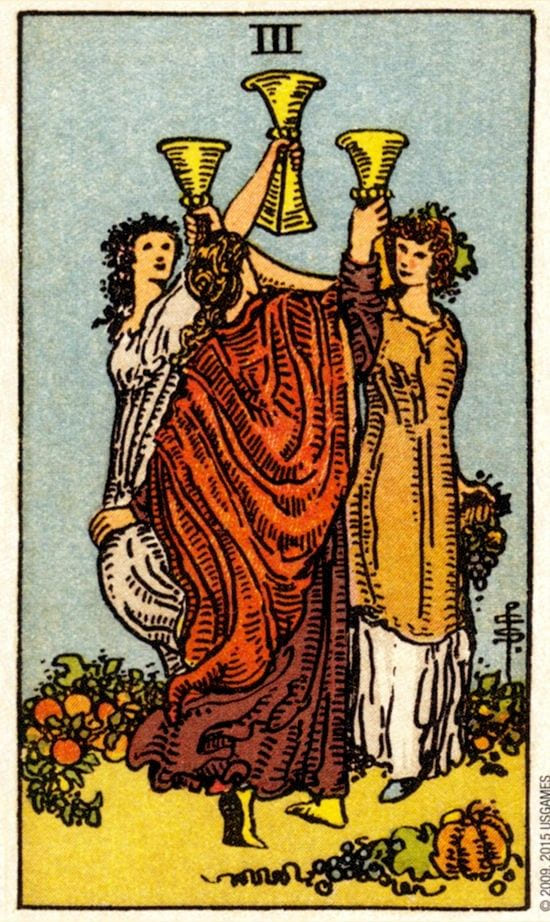
Three of Cups reversed — this is the card most associated with an unwelcome third party in a relationship. Upright, Three of Cups celebrates joyful connection. Reversed, it signals that someone is disrupting the harmony of a partnership. A traditional interpretation: someone is interfering with your relationship, consciously or not.
Seven of Swords — concealment and avoidance. Something is being kept from you. This might be an emotional connection, a relationship, or simply a truth your partner isn’t ready to speak.
The Moon — illusion, unclear perception, things hidden beneath the surface. When The Moon appears, something isn’t what it appears. This card can mean you’re misreading a situation (your anxiety creating shadows) or that there genuinely is something obscured that will eventually come to light.
The Devil — toxic attachment, obsession, chains that bind in unhealthy ways. In third-party readings, The Devil often represents either your partner’s pull toward someone else, or an existing entanglement that predates you.
Two of Swords — deliberate blindness, refusing to see. Someone — your partner, possibly you — has chosen not to look at something directly. A stalemate of avoidance.
Eight of Swords — feeling trapped, unable to see clearly or act. Often represents the querent in these readings: you know something, but you feel powerless to address it.
Five of Cups — loss and grief. When this appears, emotional investment has already shifted elsewhere. Something has already been given away.
Cards That Suggest You May Be Misreading the Situation
Not every difficult reading confirms a third party. These cards may signal that anxiety, rather than evidence, is the issue:
The Moon (yes, it works both ways) — confusion that’s internal. Your fears may be generating the feeling of a threat that isn’t there.
Seven of Cups — fantasy and projection. You might be filling in gaps with stories that aren’t real.
Nine of Swords — anxiety and rumination. This card often appears when someone is in an active worry spiral, interpreting neutral behavior as meaningful.
If you’re pulling primarily these cards and few of the “deception” cards, consider: is there a direct conversation you’ve been avoiding that could clear this up?
A 7-Card Third-Party Reading
This spread is designed to give you a clear picture of the relationship dynamic without spiraling into accusations or assumptions.
[1]  [2]  [3]  [4]
     [5]  [6]
          [7]
- Your current state — your emotional place in this relationship right now
- Their current state — their emotional investment and orientation
- The relationship dynamic — what’s actually between you both
- Hidden influence — what’s operating beneath the surface, seen or unseen
- What you need — what will actually serve your wellbeing here
- What needs addressing — the conversation or action that can’t be avoided
- Your path forward — the direction that honors your own truth
How to read it: Card 4 is the most sensitive position. Whatever appears here, read it without preemptive conclusions. The Moon in this position means something is unclear; it doesn’t mean they’re cheating. The Seven of Swords means concealment is present; it could be about many things. Don’t let one card tell the whole story.
Cards 5 and 6 together form your action pair — what you need and what you can’t avoid. These are where the reading becomes useful.
After the Reading: What to Do With What You Find
If the reading confirms something feels off: use that as encouragement to have the direct conversation you’ve been avoiding. The cards give you courage, not proof. “I’ve noticed you seem distant lately and I want to talk about it” is a conversation you can have without citing the tarot.
If the reading suggests you may be projecting: take that seriously too. Anxiety is capable of generating exactly the pattern you’re looking for. A conversation that addresses your needs without making accusations is still valuable.
If the reading is genuinely alarming: trust your gut. You asked the question because something had already shifted. The cards don’t create that feeling; they can only reflect what’s already present. You deserve clarity, and you deserve to have it spoken aloud between you.
Whatever the reading shows, you are the constant in this story. Your wellbeing, your clarity, your choices — those belong to you regardless of what he does.
Frequently Asked Questions
What tarot cards indicate a third party in a relationship?
The Three of Cups reversed, Seven of Swords, The Moon, The Devil, and Two of Swords are the most common third-party indicators. Three of Cups reversed is especially associated with an unwelcome outside presence disrupting an existing partnership.
Can tarot tell me if my partner is cheating?
Tarot can show energy patterns — secrecy, emotional withdrawal, divided attention — but it cannot name people or confirm specific actions. If multiple cards of deception, concealment, and divided loyalty appear, that's worth taking seriously and having a direct conversation.
What does the Seven of Swords mean in a relationship reading?
Seven of Swords in a relationship reading suggests something is being concealed — a secret, an avoidance, or behavior that's off. It doesn't automatically mean infidelity, but it does call for honest communication.
What should I ask tarot when I suspect a third party?
Ask 'What is the hidden dynamic in this relationship right now?' or 'What am I not seeing clearly about my partnership?' These are more useful than 'Is he cheating?' because they give you information about the energy, not accusations.
Is it ethical to do a tarot reading about a third person in your relationship?
You're reading about a dynamic that directly affects you — that's legitimate. Stay focused on what you need to understand and do, rather than trying to read someone else's private motivations in detail. The reading is to help you, not to judge them.