Three of Pentacles Tarot Card Meaning: The Cathedral Nobody Builds Alone
First impression
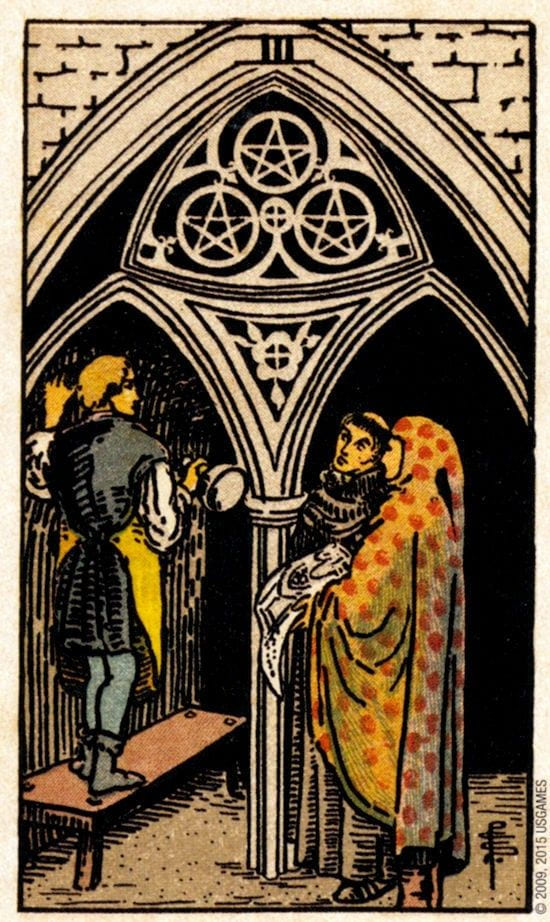
Inside a cathedral — still under construction — a young stonemason stands on a bench, chisel in hand, working on an ornate arch. Two figures in robes stand before him, holding architectural plans. One is a monk, the other appears to be an architect or patron. They’re discussing the work. The stonemason listens, but his hands are the ones shaping the stone. The plans are someone else’s vision. The skill is his.
That’s the Three of Pentacles. The card that says: great things are built by teams, not individuals. The vision needs the hands, the hands need the plan, and nobody here is unnecessary.
What makes this card profound is what it doesn’t show: competition. The monk isn’t fighting the architect. The stonemason isn’t resenting the plans. Everyone has a role, everyone’s contribution matters, and the cathedral — that beautiful, complex, impossible-for-one-person structure — is rising because each person brings what they uniquely can. This isn’t a card about compromise. It’s about synergy. The whole is literally greater than the sum of its parts, and every person in this image knows it.
Card symbolism
The cathedral. The building under construction is a cathedral — not a house, not a shop, but a cathedral. The scope matters. The Three of Pentacles is about building something that requires more than one person’s skill, more than one person’s vision, more than one lifetime of effort. It’s the project so large that collaboration isn’t optional — it’s structural.
The three figures. Each represents a different type of contribution. The stonemason brings craft — the ability to work with physical material. The architect brings vision — the plan that guides the craft. The monk brings purpose — the spiritual or institutional reason the cathedral exists at all. All three are necessary. Remove any one, and the project either has no direction, no execution, or no meaning.
The bench. The stonemason stands elevated on a bench — his craft literally lifts him up. Despite being the “worker” in this scene, he’s positioned at the highest point. This is the Three’s quiet statement about the dignity of skilled labor: the person who does the work is as essential as the person who designed it.
The architectural plans. The blueprints being reviewed represent shared vision made tangible. Ideas alone don’t build cathedrals. Plans on paper don’t build cathedrals. But plans discussed, refined, and executed by skilled hands — that builds cathedrals. The plans are held between two people, not one — collaboration in the design phase, not just the execution.
The three pentacles in the arch. Embedded in the stonework itself, the three pentacles represent the fruit of collaborative labor. They’re not lying on the ground to be picked up — they’re built into the structure. The reward of this card’s energy is permanent, structural, and visible to all.
Upright meaning
The Three of Pentacles upright means successful collaboration, craftsmanship recognized by others, the early stages of a meaningful project, learning from skilled mentors, and the understanding that your best work requires other people’s best work too.
Collaboration that works. Not forced teamwork, not a committee, but genuine collaboration — where different skills combine to create something none of the participants could have created alone. The Three of Pentacles appears when a project requires diverse expertise and the right people are actually working together effectively. The architect needs the builder. The builder needs the architect. And both need someone who believes in the project enough to fund it.
Craftsmanship and skill. This card values skill — not just effort, not just enthusiasm, but actual competence developed through practice. The stonemason isn’t winging it. He has trained, practiced, developed his craft until his hands can shape stone into beauty. The Three of Pentacles honors that kind of dedication and suggests your own skills are being recognized or will be soon.
Apprenticeship and learning. The stonemason is young. He may be a master of his craft, but the scene suggests he’s still learning, still receiving guidance from the planners. The Three often appears during periods of professional growth — new skills being developed, mentors being found, the exciting early stages where you know enough to contribute but not so much that you stop learning.
Shared vision. Everyone in this card is working toward the same goal. The monk wants a cathedral for worship. The architect wants a cathedral that stands. The stonemason wants a cathedral that’s beautiful. Same project, different angles, unified vision. This is what makes collaboration work — not agreement on method, but agreement on destination.
Quality over speed. Cathedrals took decades. The Three of Pentacles isn’t rushing. It values doing things right — solid foundations, precise joints, beautiful details that most people will never notice but that make the structure last centuries. This is the card of craftsmanship, not mass production.
Reversed meaning
The Three of Pentacles reversed means collaboration has broken down — and the cathedral is suffering for it.
Ego over teamwork. Someone on the team has decided their contribution matters more than everyone else’s. The reversed Three is the designer who ignores the engineer’s concerns, the manager who dismisses the worker’s expertise, the client who wants the impossible and refuses to hear “no.” When ego enters the collaborative space, the project stalls.
Poor communication. The plans aren’t being shared, the vision isn’t being communicated, and team members are working at cross-purposes. The reversed Three is the project where everyone is busy but nobody is coordinated — effort without direction, activity without progress.
Undervalued work. Your contribution isn’t being recognized. The reversed Three sometimes means you’re the stonemason whose skill keeps the project alive, but the architect takes all the credit and the patron doesn’t notice your hands are the ones doing the work.
Working alone when you shouldn’t be. Refusing to ask for help, refusing to collaborate, insisting on doing everything yourself. The reversed Three says: you can’t build a cathedral alone. Whatever you’re trying to do solo right now — it would go better, faster, and stronger with the right help.
Lack of skill or preparation. The flip side of craftsmanship: incompetence. The reversed Three can mean the project is suffering because someone on the team doesn’t have the skills they claimed, or because the planning phase was rushed and the foundation is weak.
In love and relationships
Upright. The Three of Pentacles in love represents partnership as a building project — both people actively constructing something together. This is the couple that talks about where they’re going, divides household and emotional labor thoughtfully, and treats their relationship as something that requires work (in the best sense — skilled, intentional, collaborative work). It’s not the most romantic card in the deck, but it might be the most functional. For singles, the Three often means finding someone through shared work or interests — a colleague, a classmate, someone you build something with before you fall for them.
Reversed. One person building while the other watches. The reversed Three in love is the relationship where one partner plans all the dates, initiates all the conversations, does all the emotional labor, and the other just… shows up. Also: a couple who can’t agree on what they’re building — different visions for the future, different priorities, different definitions of commitment. The card asks: are you actually building this together?
In career and finances
Upright. Peak career energy. The Three of Pentacles in career means collaborative work that produces excellent results — projects where the right team is assembled, each person’s expertise is valued, and the output is better than any individual could achieve. This is the card of successful teamwork, productive meetings, mentorship relationships that accelerate your growth, and the satisfaction of doing skilled work that others respect. Financially, the Three means working with advisors, pooling resources, or making financial decisions as a team (with a partner, accountant, or financial planner).
Reversed. Workplace dysfunction. The reversed Three in career means the team isn’t working — ego conflicts, poor management, unclear roles, or a culture where individual competition kills collaborative potential. This is the meeting that could have been an email, the project stuck in revision hell, the talented team producing mediocre work because nobody is coordinating. Financially: not seeking professional advice when you should, or getting poor financial guidance from someone who doesn’t have the expertise they claim.
In health and well-being
Upright. Your health improves through expert collaboration. The Three of Pentacles in health means working with professionals — doctors, therapists, nutritionists, trainers — whose expertise complements your self-knowledge. You know your body; they know the science. Together, you create a health approach that’s both personalized and evidence-based. This card also appears when a treatment plan requires coordination between specialists.
Reversed. Ignoring expert advice or working with the wrong health professionals. The reversed Three in health means either refusing to seek help (insisting on self-diagnosing, avoiding doctors, treating WebMD as a medical degree) or working with practitioners who aren’t coordinating — conflicting advice from different specialists, treatments that work against each other, a health team that isn’t actually a team.
Key combinations
Three of Pentacles + The Hierophant. Learning within structured institutions. A formal apprenticeship, academic program, or traditional mentorship. The combination suggests serious skill development through established channels — not self-taught, but formally trained.
Three of Pentacles + The Emperor. Structure meets craftsmanship. A project with strong leadership, clear hierarchy, and defined roles. This combination suggests a well-organized team under decisive authority — efficient, productive, and successful.
Three of Pentacles + Eight of Pentacles. The ultimate mastery combination. The Eight’s dedicated practice plus the Three’s collaborative learning means someone is building expert-level skill through both individual effort and team feedback. Exceptional professional development.
Three of Pentacles + The Tower. Collaborative work disrupted by sudden change. A project team broken apart by unexpected events — layoffs, reorganization, a key team member leaving. The combination asks: can the remaining builders adapt to the loss?
Three of Pentacles + Two of Cups. Partnership that builds something real. Not just emotional connection but practical collaboration — a romantic and working partnership combined. The couple that builds a business, a home, a life together through shared skills and mutual respect.
Three of Pentacles + Five of Pentacles. Feeling excluded from the team. The Five’s isolation contrasts with the Three’s collaboration — you’re watching others build something you want to be part of but can’t access. Also: skilled work that isn’t paying enough to sustain you.
Three of Pentacles + Ace of Pentacles. New collaborative opportunity with material potential. A new job offer, project proposal, or partnership that promises real rewards if the right team assembles. The beginning of something that could be built into something substantial.
The card’s advice
The Three of Pentacles says: you can’t build a cathedral alone. Stop trying.
There’s a culture that celebrates the solo genius — the lone founder, the self-made artist, the person who needs nobody. The Three of Pentacles gently corrects this myth. It says: the most impressive things humans have ever built were built by teams. The Sistine Chapel needed Michelangelo and the scaffolding builders. The pyramids needed architects and thousands of skilled laborers. Your project — whatever it is — needs more than just you.
This isn’t a weakness. The stonemason in the card isn’t diminished by working with the architect. He’s elevated. His craft finds its highest expression inside a structure that gives it context, purpose, and visibility. Alone, he could carve beautiful stones. Together, they’re building something that will stand for centuries.
Ask for help. Accept feedback. Recognize that the person with different skills than yours isn’t your competition — they’re your complement. The cathedral rises because everyone brings what they uniquely can, and nobody pretends they can do it all.
Try it yourself
Pull a card with this question: “Where in my life would collaboration make the difference between good enough and truly great?”
Because the Three of Pentacles knows something most overachievers resist: your best solo work is often inferior to your best collaborative work. Not because you’re not talented — the stonemason is clearly talented — but because the right team elevates every member’s contribution beyond what they could achieve alone.
The cathedral doesn’t need a hero. It needs a team. And the plans are already drawn — all that’s left is to build.
Frequently Asked Questions
Is the Three of Pentacles a yes or no card?
The Three of Pentacles is a yes — but a collaborative one. The answer is yes if you're willing to work with others, ask for help, or combine your skills with someone else's expertise. If you're trying to do everything alone, the Three says: that's why it's not working. Get the right people involved.
What does the Three of Pentacles mean in love?
In love, the Three of Pentacles means a relationship that succeeds through teamwork — both partners actively building something together. This isn't passive romance; it's the couple who divides responsibilities, communicates about goals, and treats the relationship as a shared project. Reversed: one person doing all the work.
What does the Three of Pentacles reversed mean?
Reversed, the Three of Pentacles means broken collaboration — egos clashing, poor communication, team members pulling in different directions. Someone isn't pulling their weight, contributions aren't valued, or the group has lost sight of the shared goal. Also: working alone when you shouldn't be.
Does the Three of Pentacles mean a new job?
Often yes — especially one involving teamwork, apprenticeship, or skill development. The Three frequently appears during career transitions that involve learning from others: new positions, training programs, mentorships, or joining a team where your specific skill matters. It's about finding your place in a larger structure.