Three & Ten of Swords in Tarot: When Pain Has a Point
The cards nobody wants to see
Let me be honest: when these two appear together in a reading, the room goes quiet. The person across from me usually knows what they mean before I say anything.
Three swords through a heart. A figure with ten swords in their back. There’s no way to sugarcoat these images, and I’m not going to try.
But I am going to say something that might surprise you: this is not the worst combination in the tarot deck. It’s one of the most painful, yes. But pain and hopelessness are not the same thing. And this combination, for all its brutality, carries a seed of something important.
Let me explain.
Three of Swords: the wound
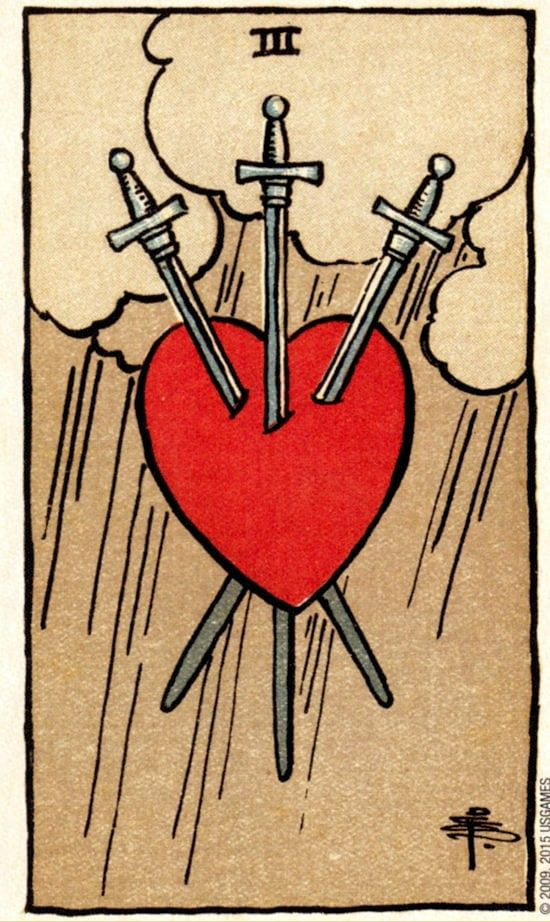
The Three of Swords is one of the most instantly recognizable cards in the deck. A red heart, pierced by three swords, against a background of grey rain clouds. No figures. No landscape. Just the heart, the swords, and the storm.
This card is about specific pain. Not vague sadness or general anxiety — a particular wound. The message you didn’t want to read. The truth you didn’t want to hear. The betrayal by someone you trusted. The Three of Swords is the moment the sword goes in — sharp, sudden, and impossible to ignore.
But here’s what people often miss: swords represent truth. The Three of Swords doesn’t wound you with lies — it wounds you with honesty. The pain comes from seeing something clearly that you might have preferred to keep blurred. A painful truth is still a truth.
Key themes: heartbreak, grief, painful honesty, betrayal, the wound that truth creates, sorrow that serves understanding.
Ten of Swords: the end
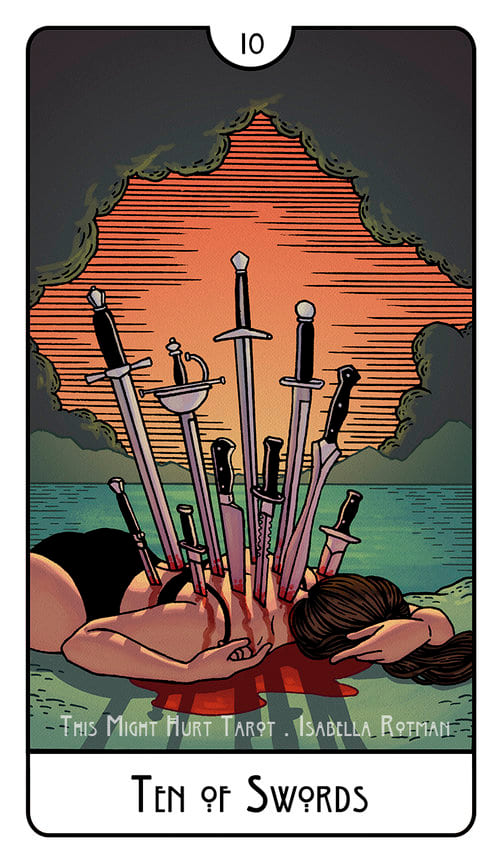
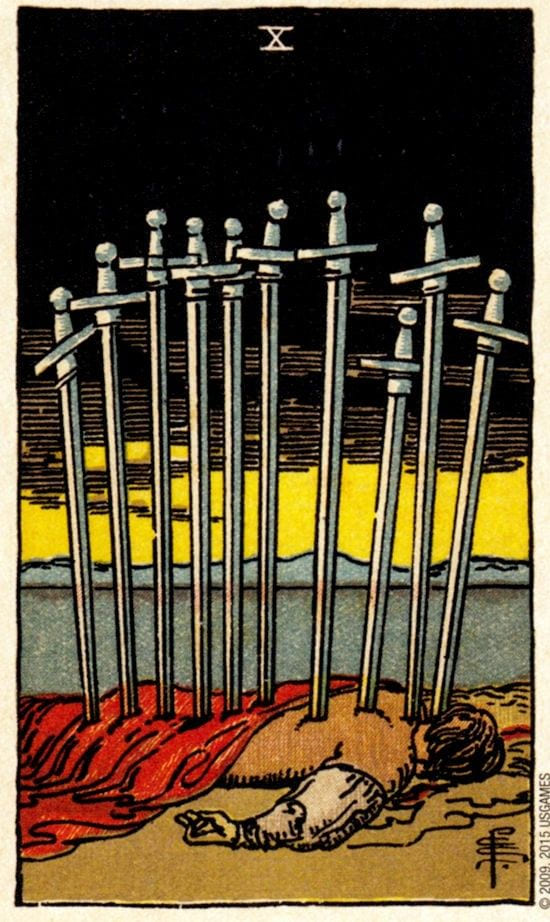
The Ten of Swords is the card people fear most in the Swords suit — and visually, it’s easy to see why. A figure lies face-down with ten swords in their back. The sky is dark. It looks like defeat. It looks like death.
But look closer. In the Rider-Waite-Smith image, there’s a thin strip of golden light at the horizon. Dawn is coming. The figure’s hand makes a gesture of blessing. And the number ten in tarot always represents completion — the end of a cycle, not the beginning of a worse one.
The Ten of Swords says: this is as bad as it gets. And while that sounds terrible, it’s actually one of the most liberating messages in tarot. Because if this is the bottom, there’s nowhere to go but up. The worst has already happened. You survived it.
Key themes: rock bottom, finality, the end of a painful cycle, surrender, dramatic endings, the dawn after the darkest night.
Together: pain with purpose
When these cards appear together, they don’t double the pain. They complete it.
The Three of Swords is the wound. The Ten of Swords is the wound reaching its fullest expression — and in doing so, exhausting itself.
Think of it like this: the Three of Swords is the moment of heartbreak. The Ten of Swords is the moment when you realize you’ve cried until there are no more tears. The grief isn’t getting worse — it has reached its limit. There is no deeper to fall.
This combination says: you are at the end of the suffering, not the beginning. The pain is real. The loss is real. But the thing that was hurting you has played its final card. It has no more moves.
That’s the paradox of these two cards together: they look like devastation, but they contain the promise of release.
In love and relationships
This combination in love readings is always significant, and it rarely appears for small issues.
Betrayal and its aftermath: When both of these cards show up in a love reading, something has been broken fundamentally. An affair discovered. A pattern of lying exposed. Trust shattered in a way that can’t be brushed aside. The Three of Swords is the moment of discovery; the Ten of Swords is the realization that the relationship as you knew it is over.
The breakup that had to happen: Sometimes relationships end not because of betrayal, but because they’ve run their course. This combination can indicate a relationship that has been dying slowly (Three of Swords — the pain you’ve been carrying) and has finally reached its end (Ten of Swords — the last straw). It hurts, but the holding on was hurting too.
Grief after loss: Not all relationship pain is about breakups. This combination can appear when grieving a deceased partner, a friendship that ended badly, or the loss of what a relationship could have been. The cards validate the depth of that grief and say: this is a real loss. Feel it fully.
The relationship with yourself: Sometimes the betrayal is internal. You ignored your own needs. You abandoned your values for someone else’s approval. You let someone treat you in ways you knew were wrong. The Three of Swords is the pain of that self-betrayal; the Ten of Swords is finally hitting the point where you stop.
In career and finances
Job loss or professional betrayal: This combination can indicate losing a job, being pushed out, or discovering that someone you trusted professionally has undermined you. The Three of Swords is the sting of the betrayal; the Ten of Swords is the finality of the situation. It’s over — now what?
Financial rock bottom: If you’ve been watching a financial situation deteriorate, this combination says it has reached its lowest point. Not great news, but genuinely useful: you can stop bracing for impact. The impact happened. Now you can start figuring out what comes next.
The career that was killing you: Sometimes this combination isn’t about external circumstances — it’s about a job or career path that was draining your soul. The Three of Swords is the pain of staying in something wrong; the Ten of Swords is the collapse that finally forces change. Loss of a career you didn’t actually love can be liberation in disguise.
What most readers get wrong
Many readers see this combination and deliver doom. “This is terrible. You’re going to suffer.” And while I understand the instinct — these are hard cards — that reading misses the most important element.
Tens are endings, not beginnings. Every Ten in tarot (Ten of Wands, Ten of Cups, Ten of Pentacles) represents the completion of a cycle. The Ten of Swords completes the cycle of mental and emotional suffering. After the Ten comes the Ace — a brand new beginning. This card doesn’t say “your suffering is starting.” It says “your suffering is ending.”
Pain and suffering are different. Pain is what happens to you. Suffering is what happens when you resist the pain, deny it, or refuse to let it move through you. This combination often appears when someone has been carrying pain (Three of Swords) for a long time, and the Ten of Swords finally says: stop carrying it. Put it down. Let it end.
The sunrise is in the image. Literally. The Ten of Swords shows dawn breaking on the horizon. The artists who designed this card put hope directly into the picture of devastation. That’s not accidental.
The order matters
Three of Swords first, Ten of Swords second: The wound came first, and now the cycle of pain is reaching its end. You experienced heartbreak, and instead of healing, the situation continued to deteriorate — until now. This card order says: the deterioration stops here. You’ve been stabbed by three swords and then ten, and there are no more swords left. It’s over.
Ten of Swords first, Three of Swords second: You experienced a dramatic ending, and the emotional wound it created is still active. You thought hitting rock bottom would bring clarity, but the heartbreak is still fresh. The Three of Swords after the Ten says: don’t rush past the grief. The situation ended, but you haven’t finished feeling it yet. That’s okay. Give yourself time.
Both reversed: The pain is beginning to lift. Reversed Three of Swords suggests the wound is starting to heal — you’re processing the grief, finding acceptance. Reversed Ten of Swords suggests you’re getting back up, refusing to stay down. Together reversed, recovery is happening. You’re not just surviving — you’re beginning to rebuild.
What to do with this reading
Don’t fight it. These cards ask you to stop resisting the pain and let it be what it is. The Three of Swords says: this hurts. The Ten of Swords says: and it’s ending. Fighting either of these truths only prolongs the suffering.
Grieve properly. This is not the time for “positive vibes only.” Cry. Be angry. Tell someone what happened. Write it down. The pain needs expression, not suppression. Unexpressed grief doesn’t disappear — it goes underground and comes back later, usually worse.
Look for the dawn. Not to rush toward it — you’re not ready for that yet. But know it’s there. The golden strip at the horizon of the Ten of Swords isn’t a metaphor — it’s a promise. This darkness has a time limit.
Take stock. When the worst has happened, you have a unique kind of freedom. You no longer need to fear the thing you were dreading, because it already happened. What does your life look like now that the worst-case scenario has arrived? What’s actually still standing? Usually, more than you think.
Remember the Ace. After every Ten comes a new beginning. The Ace of Swords is clarity, truth, a fresh perspective cutting through confusion. It’s coming. Not today, maybe not this week. But it’s coming. And when it arrives, you’ll understand why this ending had to happen first.
Frequently Asked Questions
What does Three of Swords and Ten of Swords mean together?
This combination signals deep emotional pain reaching its absolute limit. The Three of Swords is heartbreak — sharp, specific, personal. The Ten of Swords is the end of the line — total, final, no more room for it to get worse. Together, they say: this is as bad as it gets, and that means the only direction from here is up.
Is Three of Swords and Ten of Swords the worst combination?
It's one of the most painful-looking combinations, but not the worst in terms of outcome. The Ten of Swords specifically means rock bottom — the absolute end of a painful cycle. Unlike cards that suggest ongoing suffering, this combination says the worst is already happening or has happened. It's an ending, which means something new can begin.
What does Three of Swords and Ten of Swords mean in love?
In love readings, this combination indicates a painful ending — betrayal, heartbreak, or a relationship that has reached its final breaking point. It's the combination of discovering the truth and being unable to continue. While devastating, it also signals that holding on is no longer an option, which opens space for eventual healing.
What should I do if I pull Three of Swords and Ten of Swords?
First, breathe. These cards validate your pain — you're not overreacting. Second, understand that the Ten of Swords means this is the end of this particular suffering, not the beginning of something worse. Allow yourself to grieve. Seek support. And know that every Ten in tarot carries the seed of a new Ace — a fresh beginning is embedded in this ending.