Three of Swords Meaning: Heartbreak, Grief, and Emotional Release
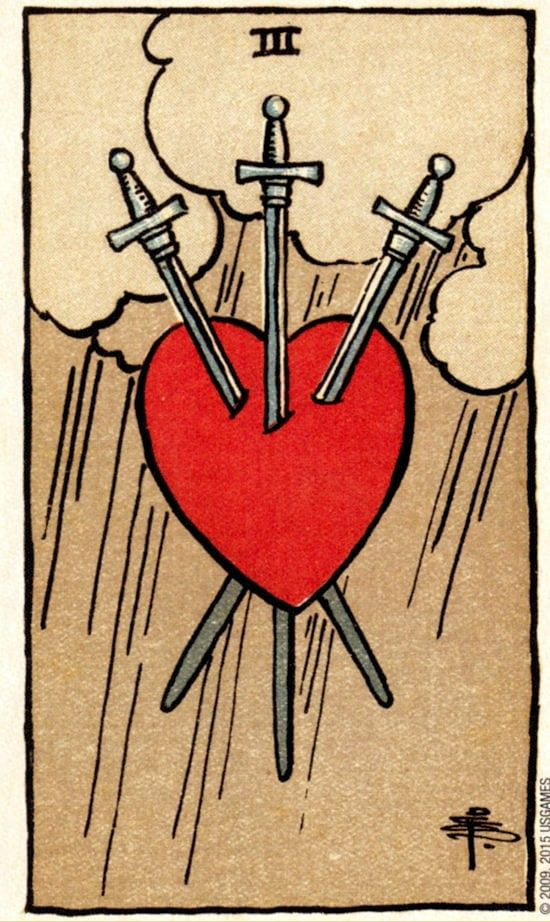
Some tarot cards speak in whispers. The Three of Swords doesn’t bother. It’s a heart with three swords through it. There’s no metaphor to decode, no hidden meaning to unravel. It means exactly what it looks like: this hurts.
And here’s the thing that makes this card so important — it doesn’t apologize for the pain. It doesn’t rush past it. It says: sit here for a moment. Feel this. Because the only way out of heartbreak is through it.
First impression
A bright red heart floats in the air, pierced cleanly by three swords. Behind it, heavy grey clouds release a steady downpour. That’s it. No figures. No landscape. No symbols to soften the blow.
The image is deliberately stark. This card doesn’t dress up pain in pretty metaphors. It looks you in the eye and says: you are hurting. Let’s start there.
Symbolism decoded
The Three of Swords is one of the simplest images in the tarot — and one of the most profound:
The heart represents your emotional core — love, connection, vulnerability, everything you feel deeply about. It’s exposed. Not tucked behind armor or hidden in a chest. It’s right there, floating in the open.
The three swords represent the specific sources of the wound. In the suit of Swords (which governs thought, words, and truth), these blades carry meaning: a painful truth spoken. A betrayal uncovered. A realization that can’t be unfelt. The number three in tarot often relates to growth and creativity — here it suggests that even this suffering has something to teach.
The rain and grey clouds depict the emotional atmosphere — grief, tears, heaviness. But rain also nourishes. What’s being watered by your tears right now? What growth is happening underneath the pain that you can’t see yet?
The absence of a human figure is significant. Unlike most cards, there’s no person on the Three of Swords. The pain is universal. It doesn’t belong to one character in one story. It belongs to everyone who has ever loved and lost, trusted and been betrayed, hoped and been disappointed.
Upright meaning
Keywords: Heartbreak, sorrow, grief, betrayal, rejection, painful truth, emotional pain, loss, disappointment.
The Three of Swords upright doesn’t sugarcoat. Something has happened — or is happening — that cuts deep.
This can be:
- A breakup or the end of a relationship
- Betrayal by someone you trusted
- Rejection — romantic, professional, or personal
- A painful truth you can no longer avoid
- Grief over a loss (of a person, a dream, a version of your life)
- Hurtful words that landed exactly where they’d cause the most damage
The card’s honesty is its gift. While other cards might hint at discomfort or suggest “challenges ahead,” the Three of Swords says plainly: you are in pain. And by naming it directly, it gives you permission to actually feel it instead of performing strength you don’t have.
This is crucial. The Three of Swords teaches that unfelt pain doesn’t disappear — it goes underground. It becomes resentment, depression, numbness, or walls that keep love out. The swords need to be removed from the heart, but they can only be removed if you first acknowledge they’re there.
The most important thing this card says: the pain is real, it matters, and it will pass. Not immediately. Not painlessly. But it will pass.
Reversed meaning
Keywords: Healing, recovery, releasing grief, forgiveness, moving on, processing pain, letting go, optimism returning.
When the Three of Swords reverses, something shifts. The swords begin to withdraw. The rain lightens. Air enters the wound.
The reversed Three of Swords most often signals healing after heartbreak. The worst is behind you. The acute, razor-sharp pain is giving way to something duller — still present, but manageable. You can breathe around it now.
This card reversed can mean:
Active healing. You’re processing the grief. Talking to a friend, writing in a journal, seeing a therapist, giving yourself permission to cry. The work of recovery is happening.
Forgiveness beginning. Not the forced “I forgive you” that you don’t mean. The real kind — the slow, quiet release of bitterness because carrying it costs more than letting it go.
Reopening. After a period of emotional shutdown, you’re starting to feel again. Things that made you numb are making you cry again. That’s actually good. Tears are thawing.
However — sometimes the reversed Three of Swords warns that you’re suppressing rather than processing. Burying pain under busyness, numbing it with distractions, insisting you’re “fine” when you’re not. If the surrounding cards suggest avoidance, the reversal is asking: are you healing, or just hiding?
In love and relationships
Upright
This is the card nobody wants in a love reading. And I won’t pretend it’s easy.
If you’re in a relationship: A significant emotional wound. This could be the discovery of infidelity. A betrayal of trust. A breakup that feels like it tears your world apart. Words said in anger that can’t be unsaid. Or the quiet, slow heartbreak of realizing that a relationship you invested in deeply isn’t what you thought it was.
Not every Three of Swords means the relationship ends. Sometimes the swords are specific wounds — a lie uncovered, a boundary crossed, a need ignored — that demand attention and honest conversation. Whether the relationship survives depends on whether both people are willing to face the pain together rather than pretend it isn’t there.
If you’re single: Old heartbreak is coloring your present. The wound from a past relationship hasn’t fully healed, and it’s affecting how you approach new connections. Or: you’re experiencing a fresh rejection that stings deeply. The card validates your pain while gently reminding you that this isn’t the end of your love story.
Reversed
Healing in love. The relationship that hurt you is becoming a memory rather than a fresh wound. You’re learning to trust again — slowly, carefully, on your own terms.
If you’re in a relationship that went through a painful period, the reversed Three of Swords suggests reconciliation is possible. Partners are forgiving, communicating more honestly, and rebuilding what was damaged. The scar remains, but the bleeding has stopped.
In career and finances
Upright
Professional disappointment or conflict that hits harder than expected. A layoff. A project failure. A colleague’s betrayal. Negative feedback that feels personal. Office politics that cross a line.
Financially, the Three of Swords can signal loss — not necessarily catastrophic, but emotionally difficult. Losing money in an investment, unexpected expenses during an already stressful time, or financial consequences of a relationship ending (splitting assets, losing shared income).
Reversed
Workplace conflicts resolve. The sting of professional disappointment fades. Communication improves with colleagues. If you lost a job or project, you’re finding your footing again and moving forward.
Financially, stability returns after a period of loss or stress.
In health and well-being
Upright: Grief and emotional pain are manifesting physically. Chest tightness, sleep disruption, appetite changes, fatigue — the body processes heartbreak in very real ways. Mental health needs attention right now. This is not the time to power through.
Reversed: Emotional healing supports physical recovery. As the grief lifts, the body follows. Sleep improves. Energy returns. The weight you’ve been carrying gets a little lighter each day.
Important: tarot is not medical advice. If you’re experiencing physical symptoms of grief or depression, please reach out to a healthcare provider.
Yes or no?
The Three of Swords leans toward no — not permanently, but for now:
Asking about love or reconciliation? — No, or at least “not now.” There’s pain that needs to be processed before anything can be rebuilt.
Asking if the pain will end? — Yes. Absolutely. But it needs time.
Asking if someone’s intentions are honest? — Likely no. Deception or hurtful behavior may be involved.
Asking about a decision? — Pause. You’re too emotionally raw to decide clearly right now.
Reversed? — Cautious yes. Healing is underway, and brighter things are ahead. But don’t rush it.
Key combinations
The Three of Swords’ meaning deepens with context:
Three of Swords + The Tower — Sudden, devastating heartbreak. A truth drops like a bomb. Relationship-ending revelation. Painful, but the forced honesty creates space for something real.
Three of Swords + The Star — Pain followed by healing. This is perhaps the most hopeful combination the Three of Swords can have. Yes, you’re hurting. But recovery is already beginning. The light after the storm.
Three of Swords + Death — The end of a painful chapter. The grief transforms you. What dies here needed to die — even though the dying hurts.
Three of Swords + The Lovers — Love is the source of the pain. A relationship choice cuts deep. This could be the heartbreak of choosing between two people, or the pain of being unchosen.
Three of Swords + Ten of Swords — Double pain, but also double finality. This is rock bottom — and the good news about rock bottom is that the only direction from here is up.
Three of Swords + Ace of Cups — Emotional renewal after heartbreak. A new capacity for love is born from the wound. The heart that breaks open can hold more than the heart that stayed closed.
Three of Swords + The Hermit — You need time alone to process this. Don’t rush into the next relationship or distraction. Solitude isn’t loneliness right now — it’s medicine.
The card’s advice
The Three of Swords gives you permission to hurt.
In a world that constantly tells you to “stay positive,” “move on,” “everything happens for a reason” — this card says: not yet. First, feel it. All of it. The anger, the sadness, the betrayal, the grief. Let the rain fall. Let the swords be where they are. Don’t yank them out before you’re ready.
Because here’s what the Three of Swords knows that toxic positivity doesn’t: pain that is fully felt is pain that fully passes. Pain that is suppressed, denied, or rushed simply finds another way to surface.
Try it yourself
A healing spread inspired by the Three of Swords:
- What am I grieving? — The loss or wound at the center
- What do I need to feel right now? — The emotion that needs space, not fixing
- What will this teach me? — The wisdom growing quietly in the wound
Pull these cards gently. This spread isn’t about finding solutions. It’s about witnessing your own experience. Sometimes that’s enough. Sometimes being seen — even by yourself — is where healing begins.
The rain on this card doesn’t last forever. Nothing does. Not even this.
Frequently Asked Questions
What does the Three of Swords mean in a tarot reading?
The Three of Swords represents heartbreak, grief, betrayal, or painful truth. It acknowledges real emotional pain without softening it — and its core message is that feeling the pain fully is the only path through it.
Is the Three of Swords a bad card?
It is a card of pain, not doom. It names something that is already happening rather than predicting catastrophe. Its gift is permission to feel the hurt honestly, which is actually the beginning of healing rather than the end of hope.
What does the Three of Swords reversed mean?
Reversed, the Three of Swords signals healing, the beginning of forgiveness, and emotional recovery. The acute pain is softening. However, it can also warn that you are suppressing grief rather than processing it — check surrounding cards for context.
What does the Three of Swords mean for love?
In love readings, it typically signals a breakup, painful rejection, or a hurtful truth coming to light in the relationship. It does not always mean the relationship ends — sometimes it means a difficult but necessary conversation that clears the air.
Why does the Three of Swords have no person in it?
The absence of a human figure is intentional — the pain it depicts is universal. The floating heart pierced by three swords belongs to everyone who has experienced loss, betrayal, or grief, making it one of the most emotionally resonant cards in the deck.