How to Choose Your First Tarot Deck: A No-Bullshit Guide
Let’s clear something up first
Your first tarot deck does not need to be a gift. Someone made this up, it spread through the community like a rumor in middle school, and now it stops people from buying the deck that’s perfect for them. Buy your own deck. The cards don’t care who paid.
Now that we’ve handled that, let’s talk about how to actually choose a deck you’ll use, love, and learn from.
The one question that matters most
Forget tradition, forget what experts recommend, forget what’s popular on social media. The question that determines whether you’ll actually learn tarot or let the deck collect dust is:
Do you like looking at these cards?
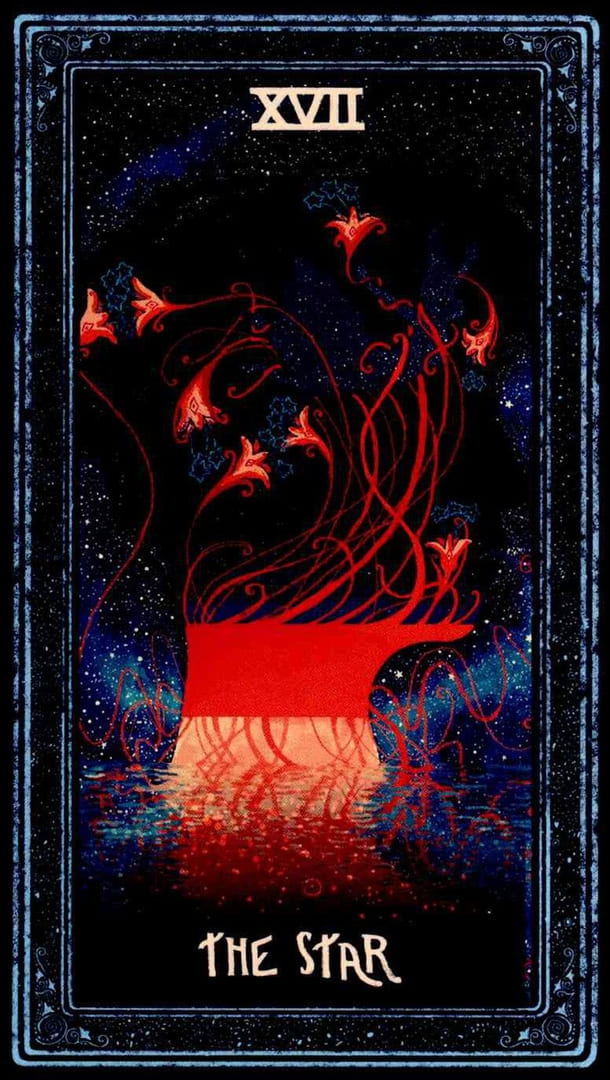
That’s it. If the art doesn’t grab you, you won’t pick the deck up. If you don’t pick it up, you won’t learn. The most traditionally “correct” beginner deck is useless if it lives in a drawer.
You’re going to spend hours staring at these images, pulling them apart symbolically, building relationships with individual cards. The art needs to hold your attention.
Understanding deck structure
Before you shop, know what you’re looking at:
Tarot vs. oracle
Tarot decks have a fixed structure: 78 cards total.
- Major Arcana: 22 cards (The Fool through The World) — big life themes
- Minor Arcana: 56 cards in four suits (usually Wands, Cups, Swords, Pentacles) — daily life
- Each suit has cards Ace through 10, plus four court cards (Page, Knight, Queen, King)
Oracle decks have no fixed structure. They can have 30 cards or 60, any theme, any system. They’re wonderful, but they’re a different tool.
For learning, start with tarot. The structure gives you a framework. You can add oracle later.
Illustrated vs. pip
This matters more than most guides tell you.
Fully illustrated (also called “scenic”) Minor Arcana cards show a scene on every card — people doing things, stories unfolding. The Three of Swords shows a heart pierced by three swords. The Ten of Cups shows a happy family under a rainbow.
Pip-style Minor Arcana just show the suit symbols arranged on the card — three swords, ten cups. Like playing cards with suit-specific decoration.
For beginners: get a fully illustrated deck. The scenes are memory aids. You can look at the card and read the story it’s telling without memorizing an abstract system first. This is the single most practical piece of advice for choosing a first deck.
The usual recommendations (and why)
Rider-Waite-Smith (RWS)
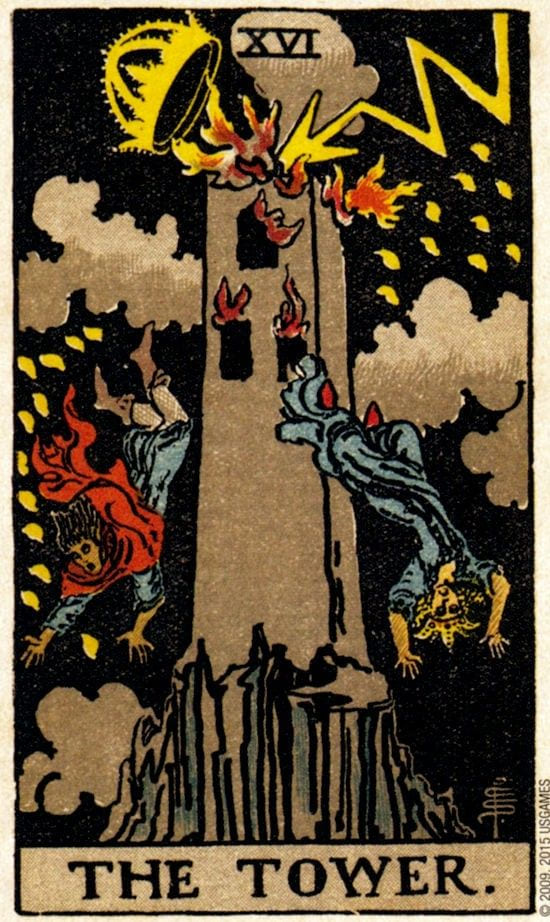
The most recommended beginner deck for a reason: virtually every tarot book, course, and online resource references its imagery. When someone says “the Three of Pentacles shows three people working together on a cathedral,” they’re describing RWS.
Pros: Universal reference point, fully illustrated, affordable, available everywhere Cons: The art is from 1909 and not everyone connects with it. The color palette can feel flat. Some of the imagery feels dated.
If RWS appeals to you, start there. If it doesn’t, keep reading.
Modern alternatives that follow RWS structure
These decks use the same symbolic framework as RWS (so all RWS-based learning resources still apply) but with updated art:
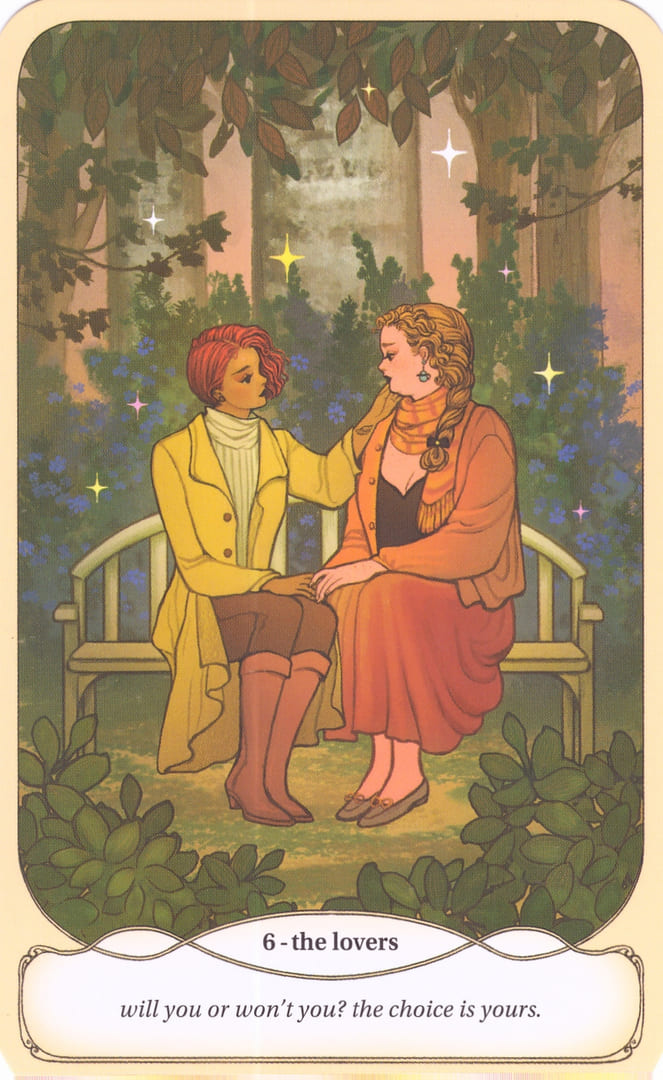
- Modern Witch Tarot: RWS reimagined with diverse, contemporary characters. Extremely popular for good reason.
- Light Seer’s Tarot: Warm, inclusive, beautiful watercolor-style art. One of the most beloved modern decks.
- Everyday Witch Tarot: Charming, approachable, witchy aesthetic with clear symbolism.
- Cosmic Cycles Tarot: Modern celestial aesthetic, clean design, fully illustrated.
Any of these is an excellent first deck. The symbolism maps to RWS, but the art feels alive in a way that resonates with contemporary readers.
If RWS-based structure doesn’t call to you
Some people are drawn to Thoth Tarot, Marseille Tarot, or decks with their own unique systems. These are valid but harder to learn from because less beginner material references them. If you’re drawn there, be prepared to seek out system-specific resources.
Practical considerations
Card size
Standard tarot cards are about 70×120mm (2.75×4.75 inches). Some decks are bigger (impressive but harder to shuffle), some smaller (easy to handle but less visual impact).
If you have small hands, check the card dimensions before buying. A deck you can’t comfortably shuffle is a deck you won’t use.
Card stock and finish
This matters more than you’d think. Thin, flimsy card stock feels cheap and wears quickly. Thick, smooth card stock with a good finish shuffles beautifully and lasts.
You can’t easily assess this online. If possible, handle a deck in person before buying. Otherwise, read reviews that mention card quality specifically.
Guidebook quality
Most decks include a guidebook (sometimes called a Little White Book, or LWB). Quality varies wildly — from a tiny folded pamphlet with one-line meanings to a substantial book with detailed interpretations.
For a first deck, a good guidebook matters because you’ll reference it constantly. Check reviews or preview images to assess guidebook quality.
Budget
Standard mass-market decks: $15-$35. This is the right range for a first deck. You don’t need an $80 indie deck when you don’t yet know what you prefer.
Your first deck is a learning tool. Your fifth deck can be the luxury art piece.
How to decide
Step 1: Browse
Look at decks online. Instagram, Pinterest, YouTube flip-throughs, and tarot review blogs are your friends. Don’t buy the first thing you see. Browse widely.
Step 2: Check the Minor Arcana
Everyone looks at the Major Arcana first because those cards are dramatic. But you’ll spend most of your reading time with the Minor Arcana. Look specifically at the pip cards (numbered cards). Do they tell stories? Do they hold your attention?
Step 3: Check the court cards
Court cards (Page, Knight, Queen, King) are the hardest to learn. Look at how the deck depicts them. Do the characters feel distinct? Can you tell them apart? Do they convey personality?
Step 4: Read reviews
Look for reviews that discuss the deck for learning specifically, not just the art. A gorgeous deck that’s hard to read is frustrating for a beginner.
Step 5: Trust your gut
After all the research, the right deck is the one that pulls you. If you keep coming back to a particular deck, that’s your deck. Trust the attraction.
What not to worry about
- Which edition/printing is best: For a first deck, it doesn’t matter
- Whether it’s “traditional enough”: There’s no tradition police
- What other people think of your choice: They won’t be using it
- Whether you’ll “outgrow” it: You might, and that’s fine. First decks are for learning, not forever.
- Reversals: Don’t worry about reading reversed cards yet. Learn the upright meanings first.
The real first step
Stop researching and buy a deck. The most common mistake isn’t choosing the wrong deck — it’s spending so long choosing that you never start learning.
Any fully illustrated, RWS-based deck in your price range that appeals to your eye is a good first deck. Get it. Open it. Pull a card. Start there.
The cards are patient. They’ll wait for you to learn their language. But they can’t teach you anything while they’re sitting in an online shopping cart.
Frequently Asked Questions
Does your first tarot deck have to be a gift?
No. This is a persistent myth with no basis in tarot tradition. Buy your own deck. The idea that a gifted deck is more 'powerful' or 'connected' has no historical or practical support. The most important thing is that you choose a deck whose imagery speaks to you — and you're the best person to make that choice.
Should beginners start with Rider-Waite-Smith?
It's a solid choice but not the only one. RWS is recommended because most tarot books reference its imagery, making it easier to learn. However, if RWS art doesn't appeal to you, you're less likely to use it regularly. Modern decks like Modern Witch Tarot, Light Seer's Tarot, or Everyday Witch Tarot follow the same symbolic structure with updated art that many beginners find more engaging.
How much should I spend on my first tarot deck?
Most standard tarot decks cost $15-$35. This is a perfectly good range for a first deck. Don't spend $80 on a luxury indie deck as your first — you don't know yet what you prefer. Start affordable, learn what matters to you (art style, card size, card stock thickness, guidebook quality), then invest more in your second or third deck.
What's the difference between tarot and oracle cards?
Tarot decks follow a specific structure: 78 cards divided into Major Arcana (22 cards) and Minor Arcana (56 cards across four suits). This structure is consistent across all tarot decks. Oracle cards have no fixed structure — they can have any number of cards with any theme. For learning, start with tarot, as the consistent structure gives you a framework to build on.