Marseille Tarot vs Rider-Waite: Two Schools of Reading Compared
Two decks, two worlds
If you put a Marseille tarot card next to a Rider-Waite-Smith card, you might wonder if they’re from the same tradition. The Marseille Three of Swords is three swords arranged symmetrically around a floral design. The RWS Three of Swords is a heart pierced by three blades in a rainstorm. Same card. Completely different experience.
These two decks represent two fundamentally different philosophies of tarot — different assumptions about what the cards are, how they work, and what the reader’s job is. Understanding both makes you a better reader regardless of which deck you use.
A brief history of each
The Tarot de Marseille
The Marseille pattern emerged in the 1600s in France, though its roots trace back to earlier Italian card designs. The name “Tarot de Marseille” was coined in the 20th century by card historians — it refers to a specific pattern of card design that was produced by numerous printmakers across France.
The Marseille is not a single deck but a tradition — a consistent set of images reproduced with minor variations by different card makers over centuries. The most famous historical versions include the Nicolas Conver deck (1760) and the Jean Dodal deck (early 1700s).
The Marseille was the standard tarot design for over two hundred years. When people read tarot before the 20th century, this is what they used.
The Rider-Waite-Smith
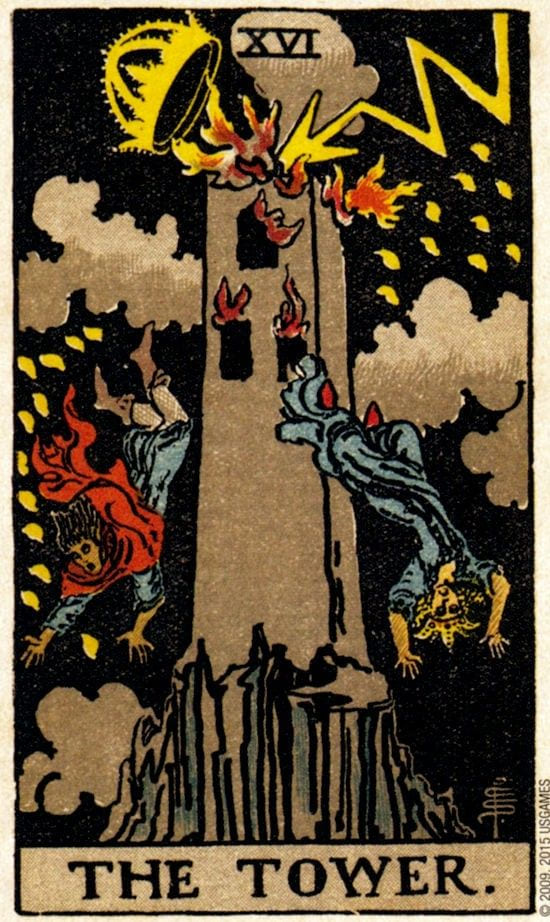
The RWS deck was published in 1909 — a deliberate break from the Marseille tradition. Arthur Edward Waite and Pamela Colman Smith, both members of the Golden Dawn, created a deck that replaced the abstract pip cards with fully illustrated scenes.
This was revolutionary. It democratized tarot by making visual, intuitive reading possible. But it also created a new tradition that diverged significantly from what came before.
The Major Arcana: different but recognizable
Both traditions feature twenty-two Major Arcana cards with broadly similar imagery. The Fool, the Magician, the High Priestess, the Emperor — the archetypes are the same. But there are important differences.
Card order
The Marseille places Justice at VIII and Strength at XI. The RWS reverses them — Strength at VIII, Justice at XI. Waite made this switch based on Golden Dawn astrological attributions (Strength/Leo before Justice/Libra). It’s a small change that reflects a deeper philosophical difference about the sequence of spiritual development.
Visual style
Marseille Major Arcana are bold, flat, and symbolic — closer to medieval woodcuts than to paintings. The figures are stylized rather than realistic. The colors are limited (traditionally blue, red, yellow, flesh tones).
RWS Major Arcana are painterly, detailed, and narrative. Smith placed figures in landscapes, gave them expressions and postures, and created scenes that tell stories. The color palette is richer and more varied.
The Fool’s position
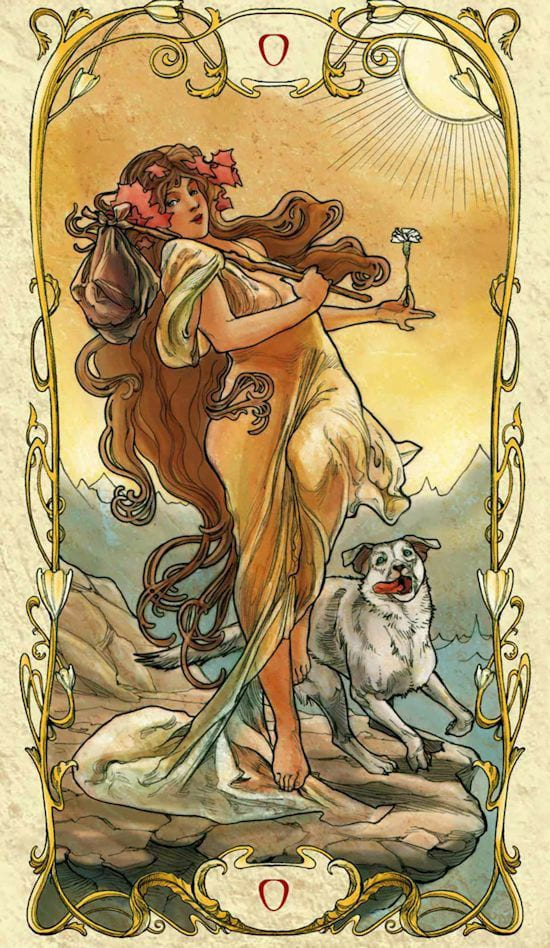
In the Marseille, the Fool is often unnumbered and can be placed anywhere in the sequence — he’s outside the system, a wild card. In RWS, the Fool is firmly numbered 0 and placed at the beginning, starting the “Fool’s Journey” through the Major Arcana that has become central to modern tarot interpretation.
The Minor Arcana: where they truly diverge
This is where the two traditions are most different, and it’s the difference that matters most for actual reading practice.
Marseille pip cards
The Marseille Minor Arcana shows only suit symbols — cups, swords, coins, and batons (wands) — arranged in patterns. The Two of Cups is two cups. The Seven of Swords is seven swords. There are no scenes, no characters, no narrative.
This might seem limiting, but it’s actually a different kind of reading tool. The patterns themselves carry meaning. The way the swords are arranged — crossing each other, pointing up or down, enclosed or open — creates a visual language. And the numbers are central: you read the card primarily through its number (Five = conflict, Eight = mastery) and suit (Cups = emotion, Swords = thought), not through a scene.
RWS illustrated pips
Smith gave every Minor Arcana card a scene. The Five of Pentacles shows two destitute figures in the snow. The Eight of Cups shows a figure walking away from stacked cups under a moon. The Seven of Swords shows a figure sneaking away with stolen swords.
These scenes make the cards immediately readable. You don’t need to know that “Five = difficulty” — you can see the difficulty in the image. This is why the RWS is recommended for beginners and why it dominates modern tarot education.
Court cards
Both traditions have court cards, but the Marseille uses Page, Knight, Queen, King, while some RWS-based decks use Princess, Prince, Queen, Knight or other variations. The visual treatment also differs — Marseille courts are formal and heraldic, while RWS courts are more expressive and characterful.
Reading methods: two philosophies
The Marseille approach
Marseille reading is pattern-based. The reader works with:
- Numerology — the card’s number is its primary meaning
- Elemental associations — the suit’s element (fire, water, air, earth) shapes interpretation
- Directional reading — which way figures and objects face matters (the gaze direction technique)
- Card interaction — how adjacent cards’ images interact creates meaning (do figures face toward or away from each other?)
- Color and line — the geometric patterns in pip cards carry significance
This approach requires more study but produces readings that are precise and direct. Marseille readers often describe their readings as “sharp” — less emotional nuance but more clarity.
The RWS approach
RWS reading is image-based. The reader works with:
- Visual narrative — what’s happening in the scene?
- Emotional response — how does the image make you feel?
- Symbolic detail — what specific symbols appear (roses, mountains, water, animals)?
- Color psychology — what do the dominant colors suggest?
- Intuitive impression — what jumps out at you before you think about the “meaning”?
This approach is more accessible and produces readings that are psychologically rich. RWS readers often describe their readings as “deep” — more emotional texture, more room for personal interpretation.
The strengths of each
Marseille excels at:
- Precise, direct answers — the numbered pip system gives clear, unambiguous responses
- Pattern recognition — the geometric designs train the reader to see mathematical and structural patterns
- Speed — experienced Marseille readers can read very quickly because the system is efficient
- Historical connection — reading Marseille connects you to centuries of tradition
- No preconditioning — because pip cards don’t show scenes, your interpretation isn’t shaped by someone else’s vision
RWS excels at:
- Emotional depth — the illustrated scenes access feelings and psychological dynamics
- Accessibility — anyone can start reading because the images are self-explanatory
- Storytelling — the cards tell stories, making readings narrative and engaging
- Shadow work — the visual depictions of difficult themes (grief, loss, fear) make psychological work tangible
- Creative inspiration — the rich imagery sparks intuition and artistic response
Can you use both?
Yes, and many experienced readers do.
A common approach: use Marseille for questions that need precise answers (“Should I take this job?” “What’s the timing on this?”) and RWS for questions that need emotional exploration (“What am I not seeing about this relationship?” “What does my inner life need right now?”).
Switching between systems also prevents you from getting stuck in one mode of interpretation. When your RWS readings start feeling formulaic, pulling out a Marseille deck forces you to read differently. When your Marseille readings feel too clinical, switching to RWS reconnects you to the emotional dimension.
Which should you choose?
If you’re starting out, RWS is probably easier. The illustrated cards give you more to work with as a beginner, and the vast majority of tarot education assumes an RWS-based deck.
If you’re drawn to structure, numerology, and tradition — or if you’ve been reading RWS and want to expand your skills — try Marseille. The learning curve is steeper, but the precision and directness it develops are worth the effort.
The best answer? Eventually, both. Two lenses are better than one, and the cards themselves don’t care which tradition you’re reading from. They care that you’re paying attention.
Frequently Asked Questions
What is the main difference between Marseille and Rider-Waite tarot?
The biggest difference is in the Minor Arcana. Rider-Waite-Smith (RWS) has fully illustrated scenes on every card — the Five of Cups shows a grieving figure, the Three of Swords shows a pierced heart. Marseille pip cards show only the suit symbols — five cups arranged in a pattern, three swords in a design. This means Marseille requires more numerological and symbolic knowledge, while RWS allows intuitive reading from the images alone.
Which tarot deck is better for beginners?
Most beginners find Rider-Waite-Smith easier because the illustrated scenes provide visual cues for interpretation. You can look at a card and understand it without memorizing meanings. Marseille requires more study upfront because the pip cards are abstract. However, some readers argue that starting with Marseille builds stronger foundational skills because it forces you to learn the symbolic language rather than relying on pictures.
Is the Marseille tarot older than the Rider-Waite?
Yes, significantly. The Tarot de Marseille pattern dates to at least the 1600s (with roots in earlier Italian designs), while the Rider-Waite-Smith was published in 1909. The Marseille represents the older, more traditional approach to tarot design and reading, while RWS represents the modern, illustrated approach pioneered by Pamela Colman Smith.
Can I use both Marseille and Rider-Waite decks?
Absolutely. Many experienced readers use both, switching depending on the type of reading. Marseille is excellent for precise, direct readings that focus on patterns and numbers. RWS is excellent for psychological and emotional readings where the imagery triggers intuitive responses. Using both systems makes you a more versatile reader.