Review: Nicoletta Ceccoli Tarot — Surreal Dreams
First Impressions
This deck unsettled me from the first card. Wide doll eyes staring back — not cute, not scary, but somehow too knowing. As if these porcelain creatures can see what you hide from yourself. My first impulse was to close the box and walk away. My second was to keep looking.
The Nicoletta Ceccoli Tarot doesn’t work through your mind. It works through something older. It doesn’t explain, doesn’t give clear answers, doesn’t comfort. It shows — and waits for you to understand what you’re seeing. If you need a gentle conversation with cards, look elsewhere. But if you’re ready to fall through a fairy tale rabbit hole into your own subconscious — welcome.
About the Deck
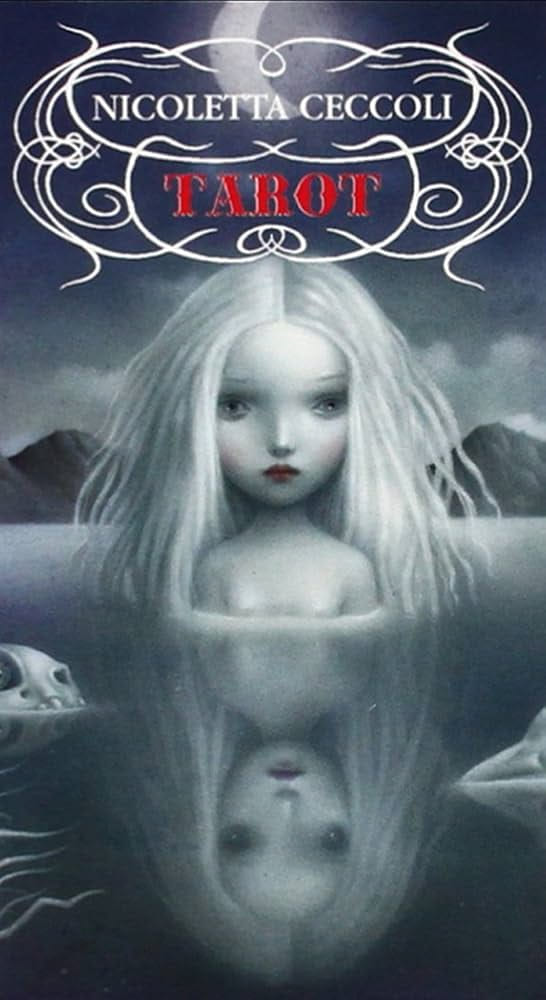
Nicoletta Ceccoli is an Italian illustrator from San Marino, winner of the Andersen Prize (Italy’s equivalent of the Oscar in children’s book illustration). Her style is instantly recognizable: doll-like figures with disproportionately large heads, blurred fairy tale landscapes, a bittersweet atmosphere where human, animal, and plant forms flow into each other.
The deck was published by Lo Scarabeo in 2014. Here’s the crucial detail: this isn’t art created specifically for tarot. Ceccoli adapted her existing portfolio into 78 cards. This means interpretations are loose and far from the Rider-Waite canon. Cards have no titles — just white frames and numbers. The included Little White Book comes in five languages, but honestly, it offers minimal guidance. This deck needs to be read with eyes and intuition, not from a book.
Another quirk: Strength sits at position XI and Justice at VIII, following the Marseilles tradition rather than Waite’s numbering. If you’re used to Waite ordering, keep this in mind.
Visual Style
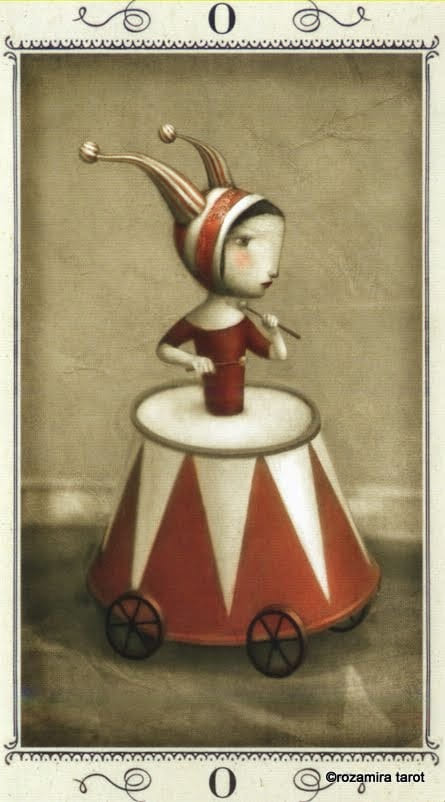
If Salvador Dalí and Tim Burton co-created a storybook, it would look something like this deck. The palette is muted: pastel pinks, milky whites, ashen blues. Backgrounds are blurred, almost dreamlike. The figures — little girls and women with fragile bodies and enormous eyes — are surrounded by impossible objects: flying goldfish, living toys, cakes with pink frosting that feel somehow menacing.
Male figures appear rarely and always in secondary roles. This is a deeply feminine deck — not “feminine and gentle” but “the world seen through a female gaze that doesn’t spare you.”
At first glance — beautiful. At second — unsettling. At third — you begin to understand that the unease itself is the way in.
Core Themes
The deck weaves several intersecting threads:
- Childhood and its shadows — not the pastel childhood of greeting cards, but the real one where wonder and terror lived side by side. The doll figures are like memories: seemingly harmless, but look closely and something is broken in each one.
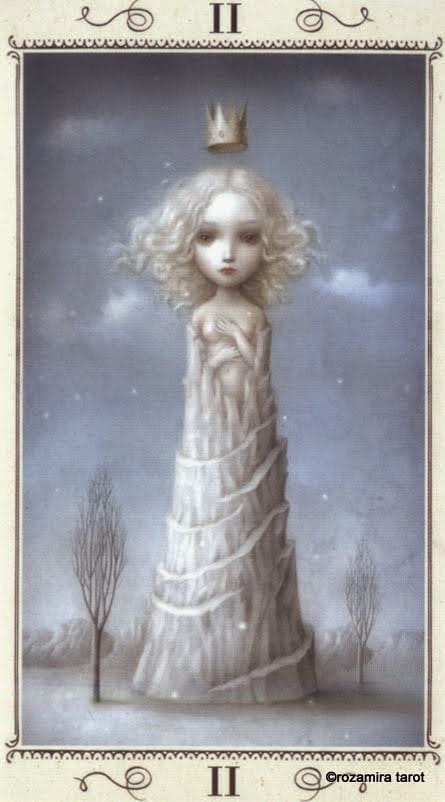
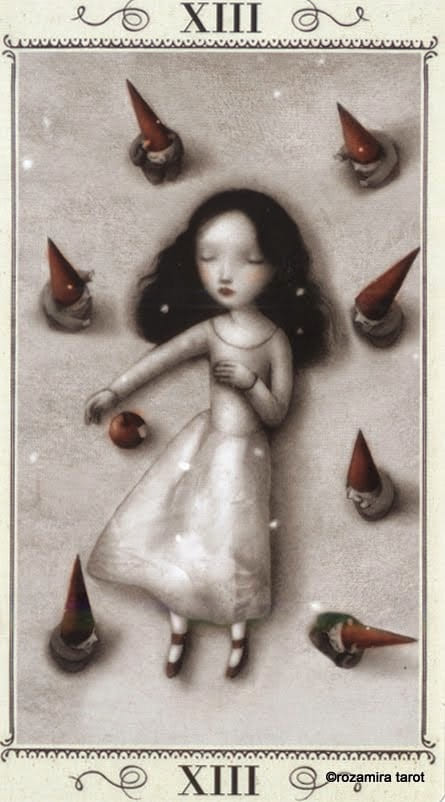
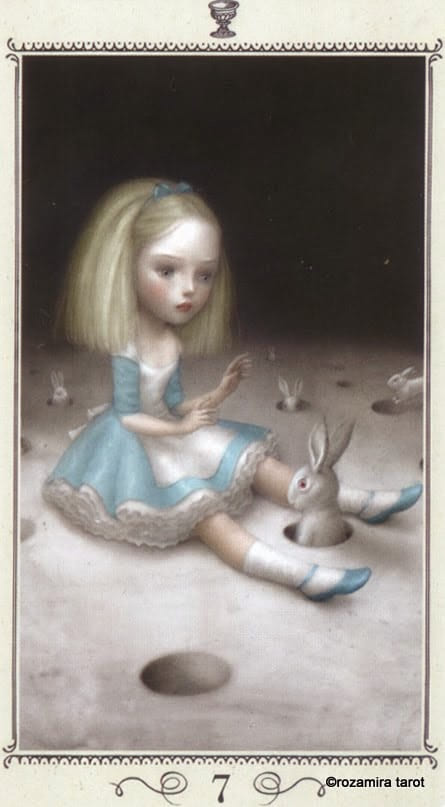
- Fairy tale archetypes — Snow White on the Death card, Alice on the Seven of Cups, the Snow Queen on the High Priestess. The deck braids familiar stories with Jungian psychology.
- Dreams and the subconscious — blurred backgrounds, impossible proportions, objects that don’t follow rules. Everything operates on dream logic, not waking logic.
- Beauty as a trap — attractive at first glance, dangerous upon closer inspection. The deck is honest that beautiful doesn’t mean safe.
- Female experience — through the bodies, fears, fantasies, and strength of girls and women.
Nothing here is accidental. Every “cute” image is a door to somewhere deeper.
Favorite Cards
Death
A girl in the snow, surrounded by seven dwarves. Snow White — but not the one saved by a prince. The one who has already passed through transformation. Death here isn’t an ending but the moment when the old version of you finally falls asleep so the new one can wake. One of the most powerful Death cards I’ve encountered in any deck.
The High Priestess & The Moon
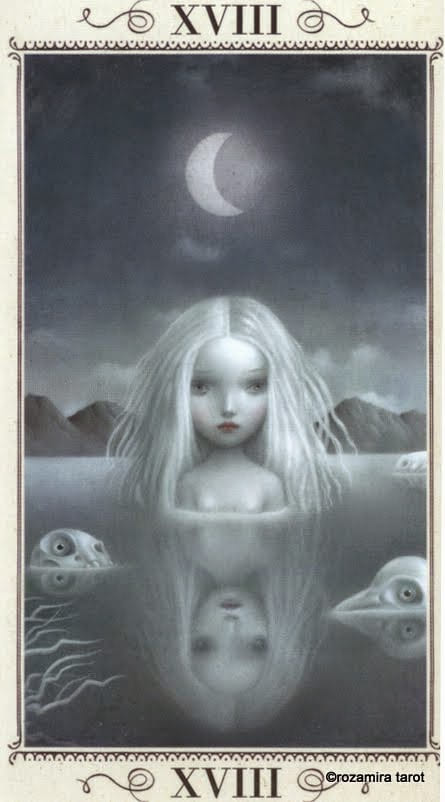
Two cards of the subconscious side by side — and they complement each other perfectly. The Priestess in her ice dress evokes the Snow Queen, keeper of knowledge that burns cold. Wisdom that doesn’t comfort but demands honesty. The Moon beside her speaks to the same cold from within: your dreams, your shadows, everything you hide in darkness.
The Empress
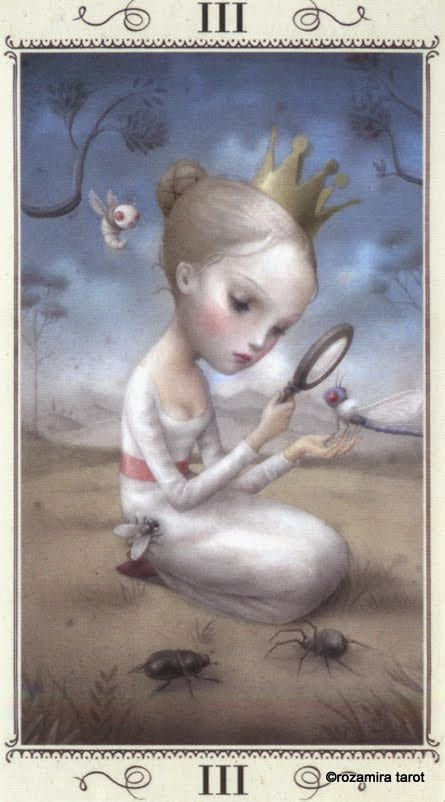
A figure examining insects through a magnifying glass. Not the familiar fertility goddess, but a researcher — someone who studies nature not to worship it but to understand it. Unity with the world through observation, not fusion. An unexpected but precise reinterpretation.
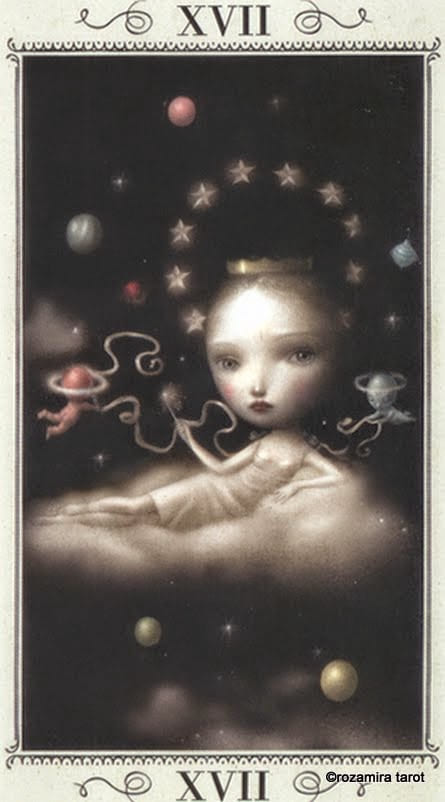
The Star
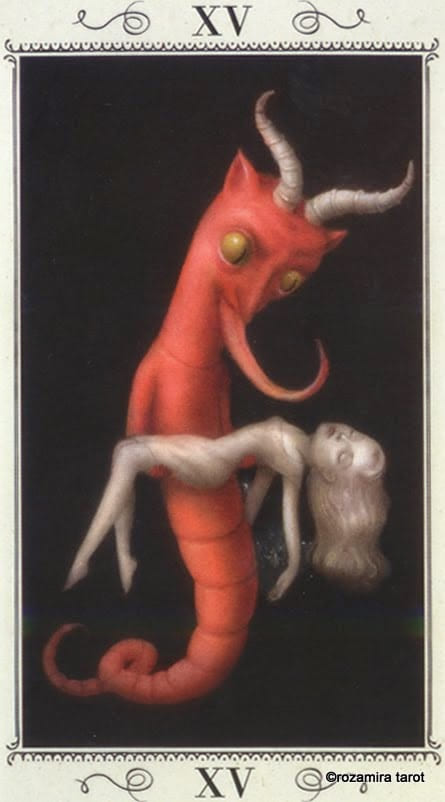
In a deck full of unease and secrets, The Star is a rare exhale. The universe’s eternal song of beauty, an invitation to stop and hear what you’re here for. After the heavy cards — The Tower, The Devil, Death — The Star reminds you: beyond all dreams, there is a morning.
Seven of Cups
A character resembling Alice in Wonderland, chasing white rabbits. Too many choices, too many rabbit holes — and each one promises wonders. The deck advises: let the dust settle. Clarity comes when you stop chasing everything at once.
How to Work with This Deck
This isn’t a deck for quick morning pulls. It demands time and silence.
- Card meditation — pull a card, set it in front of you, and simply look. Don’t try to “read” it — let the image speak. After 5-10 minutes, write down what surfaced. Often it will be about you, not the card.
- Single-card pulls — ask a question and draw. Don’t seek the answer in a book — seek it in the image itself. What do you see first? What attracts you? What repels you? The answer is in your reaction.
- Shadow work — the deck is ideal for questions like “what don’t I want to see?”, “what am I hiding from myself?”, “what part of my childhood still runs me?”
- Dream journaling — pull a card before sleep and place it nearby. In the morning, note whether your dreams connected to the image. This deck and dreams speak the same language.
Who Is This Deck For
Great fit:
- Experienced intuitive readers who are tired of standard spreads
- Those working with psychology, childhood trauma, Jungian archetypes
- Fans of surrealism and dark fairy tales
- Anyone seeking a meditation and deep self-exploration tool
Probably not:
- Beginners — without a tarot foundation, this will be overwhelming
- Anyone needing concrete, practical answers to everyday questions
- If you rely on standard Rider-Waite symbolism
- Those unsettled by doll-like imagery and surreal atmospheres
Deck Pairings
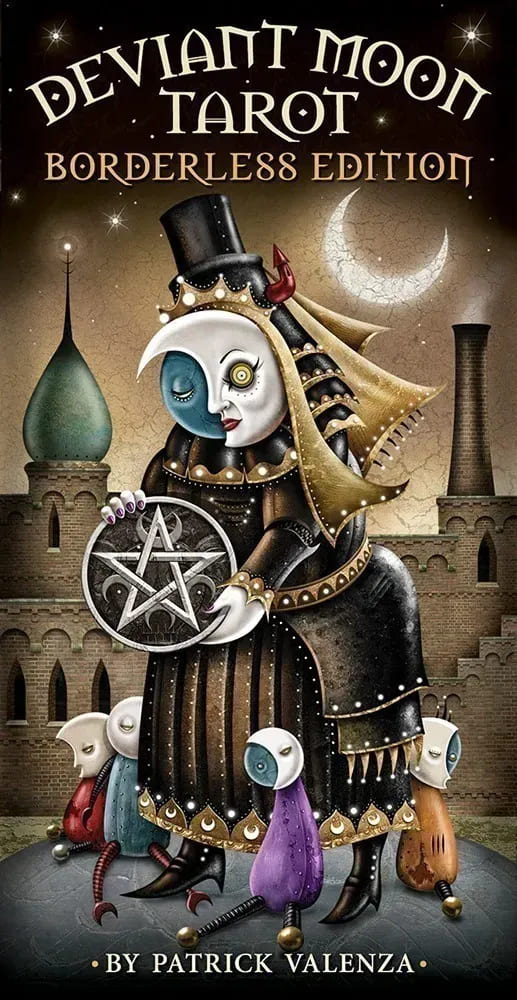
- Deviant Moon Tarot — two decks that work through the subconscious, but by different paths. Ceccoli through childhood dreams, Deviant Moon through lunar nightmares. Together they map the full territory of shadow.
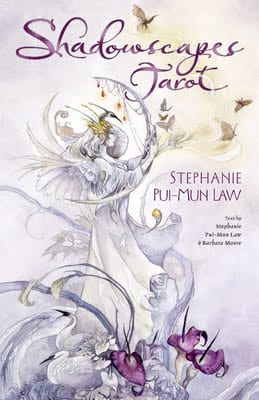
- Shadowscapes Tarot — if Ceccoli is the dark side of fairy tales, Shadowscapes is the light. Alternating between them gives you the full picture: both the enchantment and its cost.
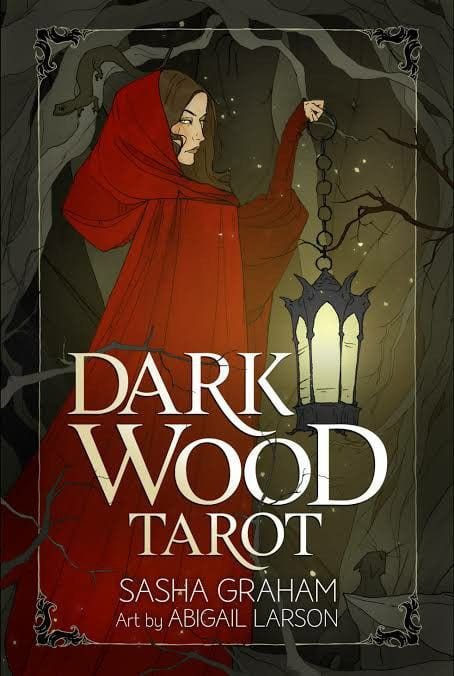
- Dark Wood Tarot — another shadow work deck, but with clearer structure. When Ceccoli feels too abstract, Dark Wood provides specificity.
Try this deck in our app — look into the mirror that doesn’t lie.
Frequently Asked Questions
Is the Nicoletta Ceccoli Tarot good for beginners?
No, this deck is for experienced intuitive readers. The imagery was adapted from the artist's existing portfolio, so interpretations are unconventional and far from standard Rider-Waite symbolism. Beginners will struggle without a strong tarot foundation.
How many cards are in the Nicoletta Ceccoli Tarot?
78 cards: 22 Major Arcana and 56 Minor Arcana. Notable: Strength is at position XI and Justice at VIII, following the Marseilles tradition rather than Waite's ordering.
What are the main themes of the Nicoletta Ceccoli Tarot?
Childhood and its shadows, dreams and the subconscious, fairy tale archetypes (Snow White, Alice in Wonderland, the Snow Queen). The deck works through association and intuition rather than traditional symbolism.
Who created the Nicoletta Ceccoli Tarot?
Nicoletta Ceccoli, an award-winning Italian illustrator from San Marino and winner of Italy's Andersen Prize. Published by Lo Scarabeo in 2014. The artwork was adapted from her existing illustration portfolio.
What type of readings is this deck best for?
Deep psychological exploration, meditation, childhood trauma work, and dream interpretation. The deck bypasses rational thinking and speaks directly to the subconscious through surreal imagery.