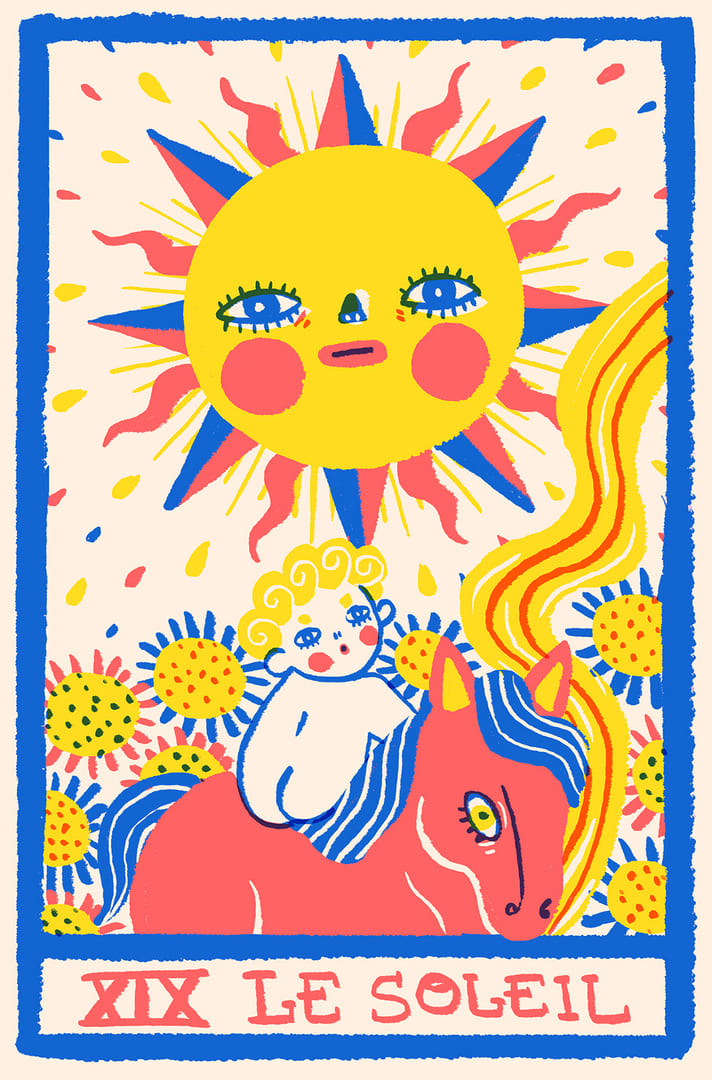
Tarot for Career Change: A Spread for When You're Ready to Quit Your Job
The Sunday night dread test
You know the feeling. It’s Sunday evening. Tomorrow is Monday. And somewhere between folding laundry and brushing your teeth, a heaviness settles in your chest that has nothing to do with the weekend ending and everything to do with where you have to be in twelve hours.
Maybe you’ve been feeling it for months. Maybe years. Maybe you’ve gotten so used to it that you forgot this isn’t how everyone feels about their work — that some people actually look forward to Monday.
If you’re here, reading an article about tarot and career change, I’m guessing the Sunday night dread has moved past background noise and into something louder. Something that sounds a lot like: I can’t keep doing this.
But right behind that thought is the other one. The practical one. The scared one: But what else would I even do?
This is exactly where tarot becomes useful. Not because the cards will hand you a business plan or update your resume. But because they’re remarkably good at cutting through the noise of fear, obligation, and other people’s expectations to show you what you actually want — and what’s actually possible.
Why people reach for tarot during career crossroads
Career change is one of the top reasons people come to me for readings. And I get it. Here’s why tarot and career transitions are such a natural fit:
You’re drowning in practical advice. You’ve read the LinkedIn articles. You’ve taken the personality quizzes. You’ve had the well-meaning conversations with friends who say “just follow your passion!” as if passion pays rent. Practical advice is everywhere. What’s missing is clarity on how you actually feel and what you actually want beneath all the should’s.
The stakes feel enormous. Leaving a job isn’t like changing your haircut. There are finances, insurance, identity, routine, social connections — an entire life structure built around this thing you’re thinking about dismantling. When the stakes are that high, your rational brain can loop indefinitely without reaching a conclusion. Tarot breaks the loop by engaging a different kind of knowing.
You need permission. Not from the cards. From yourself. Sometimes pulling the Eight of Cups — a figure walking away from something that once mattered — gives you permission to acknowledge what you already feel: this isn’t working anymore, and it’s okay to go.
You’re caught between fear and desire. Fear says stay. Desire says leap. Both are loud. Both feel valid. Tarot doesn’t silence either voice, but it helps you see which one is based on reality and which one is running on outdated programming.
The Fool’s journey: a career change metaphor you already know
There’s a reason The Fool appears on the hero image of this article. In the tarot, The Fool stands at the edge of a cliff, bag over one shoulder, about to step into the unknown. Most depictions show them looking up — not down. They’re not calculating the fall. They’re focused on the horizon.
Every career change is a Fool’s journey. You leave the structured world of what you know (The Emperor, The Hierophant — routine, hierarchy, rules) and step into uncharted territory. The path through the Major Arcana that follows mirrors exactly what career changers experience:
The Magician appears when you realize you have more skills and resources than you thought. The High Priestess shows up when your gut has been whispering for months and you finally listen. The Wheel of Fortune turns when circumstances align in ways you couldn’t have engineered. And eventually, The World arrives — not as a destination, but as the completion of one cycle and the beginning of the next.
You don’t have to believe in any of this literally. The Fool’s journey works as a psychological framework even if you’re the most skeptical person in the room. It names the stages of transition: excitement, doubt, struggle, learning, integration, completion. Knowing where you are in that cycle changes how you interpret everything.
Cards that signal: it’s time to go
These cards, especially appearing together or in key positions, suggest that career change isn’t just an option — it might be overdue.
The Fool. New beginnings. A leap of faith. The Fool in a career reading says: the opportunity exists, the energy is available, and the only thing keeping you on this side of the cliff is your own hesitation. The Fool doesn’t promise a soft landing. It promises that staying still is no longer an option that serves you.
Eight of Cups. This is the card of walking away. Not in anger — in quiet acknowledgment that what you built no longer nourishes you. The figure in the Eight of Cups leaves stacked cups behind. They’re not broken. They just aren’t enough anymore. If this shows up in your career reading, you’ve probably already emotionally left. Your body just hasn’t caught up.
Death. Before you panic — Death in career readings almost never means anything catastrophic. It means transformation. An old identity dying so a new one can emerge. If you’ve been “the accountant” or “the teacher” or “the manager” for years, Death says: that chapter is closing. Fighting it makes it harder, not better.
Wheel of Fortune. A turning point. External forces shifting. The Wheel in a career reading often signals that the change is happening whether you initiate it or not — layoffs, restructuring, an unexpected opportunity landing in your lap. The Wheel says: work with the momentum, not against it.
Ace of Pentacles. A new financial opportunity. Seed energy for material growth. The Ace of Pentacles in a career reading is one of the most encouraging cards you can pull — it suggests that the new path has real, tangible potential. Not just a dream. An actual viable beginning.
The World. Completion. You’ve learned everything this role, this company, this chapter had to teach you. The World doesn’t mean you failed — it means you graduated. Staying past The World is like repeating a grade you already passed. You can do it, but why?
Cards that say: not yet
Not every career reading says “quit tomorrow.” Some cards suggest that the restlessness you feel has a different solution than resignation.
Four of Pentacles. Security, stability, holding tight to what you have. The Four of Pentacles in a career reading might mean: now is not the time to let go financially. Maybe you need to save more first, pay off debt, or build a safety net. It’s not saying “never leave” — it’s saying “leave prepared.”
Two of Pentacles. Juggling, balance, managing multiple demands. This card often appears when the answer isn’t “quit your job” but “adjust how you’re managing your energy.” Maybe the job itself is fine, but you’re overcommitting, under-resting, or neglecting the creative outlets that keep you sane. Fix the balance before you burn the whole thing down.
The Hierophant. Tradition, structure, working within systems. The Hierophant in a career reading sometimes says: you still have things to learn here. Maybe a mentor, a credential, or a skill that this role — annoying as it is — is uniquely positioned to give you. The Hierophant asks: have you actually extracted all the value from where you are?
Four of Swords. Rest. Recovery. Not the time for big moves. If you’ve been running on fumes, the Four of Swords says: your urge to quit might be exhaustion talking, not wisdom. Take real time off before making permanent decisions. You might feel completely different after a two-week vacation.
The Hanged Man. Suspension. A shift in perspective. The Hanged Man doesn’t say stay or go — it says you’re not seeing this clearly yet. Something needs to flip before the right answer becomes visible. Patience, not action, is what this moment requires.
Spread 1: Should I Stay or Should I Go? (Career edition)
Five cards. Blunt clarity.
- Position 1: What’s keeping me in this job? (The real reason, not the one you tell people)
- Position 2: What’s pushing me to leave? (The actual energy driving the urge)
- Position 3: What does staying look like in six months?
- Position 4: What does leaving look like in six months?
- Position 5: What I most need to see right now
This spread works because it forces you to look at both paths honestly. Most of us are running from something or toward something — and the distinction matters enormously. Running from a bad boss is different from running toward a calling. Both are valid. But they lead to very different decisions.
Pay special attention to Position 5. It’s the card that cuts through the noise and tells you what your entire reading is actually about.
Spread 2: The Career Transition Spread
Seven cards for when you’ve already decided to change — you just don’t know how.
- Position 1: Where I am right now (current career energy)
- Position 2: What I’m leaving behind (what this job gave me that I need to acknowledge)
- Position 3: What I’m carrying forward (skills, experience, and strengths that transfer)
- Position 4: My biggest fear about this transition
- Position 5: My biggest opportunity in this transition
- Position 6: What I need to learn or develop
- Position 7: The likely energy of my next chapter
Position 2 matters more than people think. Most career changers are so focused on what was wrong with their old job that they forget what it gave them. Acknowledgment isn’t the same as staying. You can be grateful for what a chapter taught you while being done with it.
Spread 3: Hidden Skills Discovery
Four cards for people who say “but I don’t know what else I’d do.”
- Position 1: A skill I use daily but don’t recognize as valuable
- Position 2: A strength others see in me that I underestimate
- Position 3: A passion or interest I’ve been dismissing as “just a hobby”
- Position 4: Where these qualities are most needed right now
This is one of my favorite spreads because it consistently surprises people. The cards have a way of pointing at things you’ve normalized — the problem-solving you do effortlessly, the way people always come to you for advice on a specific topic, the thing you spend your free time on that you’ve never considered monetizing.
A client once pulled the Queen of Pentacles for Position 1 and realized her “just organizing things” skill was actually operations management. She now runs a consulting business. The cards didn’t create that skill. They named it.
Spread 4: The Leap of Faith
Three cards. Simple. For the moment when you’ve done all the analysis and you just need a final gut check.
- Position 1: The energy I’m jumping from
- Position 2: The energy I’m jumping into
- Position 3: What catches me
Position 3 is the anchor of this spread. It’s not asking “will I succeed?” — it’s asking “what resource, person, quality, or circumstance will support me through the uncertain middle?” Because that’s what people are really afraid of. Not the destination. The gap between the edge and the other side.
Reading career spreads without bias
Here’s where I have to be honest with you: career readings are some of the hardest readings to do objectively, because you’re doing them at the exact moment when you’re least objective.
If you hate your job, every card looks like a sign to quit. The Five of Pentacles? “See, I’m suffering!” The Tower? “It’s all falling apart!” The Ace of Wands? “New opportunity awaits!” You’ll twist anything into permission to leave.
If you’re terrified of change, the opposite happens. Every card becomes a reason to stay. The Four of Pentacles? “I should hold on to security.” The Hierophant? “I should respect the system.” The Two of Pentacles? “I just need to balance better.”
Neither interpretation is inherently wrong. But both are one-sided. Here’s how to read more honestly:
Read the cards you don’t want to see. If you want to quit and you pull the Four of Pentacles, sit with it. Really sit with it. What is it saying that you don’t want to hear? If you want to stay and you pull the Eight of Cups, don’t dismiss it. What truth is it reflecting?
Notice your body. When you flip a card, your body responds before your mind interprets. A tightening in your chest, a sigh of relief, a sinking feeling. That first physical response is data. Write it down before you start analyzing.
Read for the question, not the answer. If you asked “should I stay?” and pulled the Three of Wands (expansion, looking toward the horizon), don’t immediately conclude “I should go!” The Three of Wands might be saying: you can find expansion within your current role. Always tie the interpretation back to the specific position in the spread.
Get a second reader. If the stakes are high — and career change stakes usually are — have someone else read the same spread for you. Their interpretation, unfiltered by your hopes and fears, will show you what you’re projecting and what’s actually in the cards.
Combining tarot with real-world career planning
Tarot gives you clarity. But clarity without action is just another form of procrastination. Here’s how to bridge the gap between what the cards reveal and what you actually do about it:
Use tarot for direction, not timeline. The cards can show you what kind of work would fulfill you, what skills to develop, and what’s holding you back. They’re less reliable for “when.” Don’t wait for the Wheel of Fortune to appear before you update your resume.
Make a financial plan alongside your spiritual one. If the Ace of Pentacles shows up promising new opportunity, great. Now calculate your runway. How many months of expenses do you have saved? What’s your minimum viable income? The most empowered career changes happen when faith and spreadsheets work together.
Let the cards inform your networking. If your reading highlights creativity (The Empress), communication (The Magician), or leadership (The Emperor), use that as a lens for exploring career paths. Research roles that center those qualities. Talk to people in those fields. Let the reading give you search terms, then go search.
Do the inner work the cards prescribe. If the Moon appears in your career spread, you have blind spots to address before making a move. If the Seven of Cups shows up, you need to narrow your options instead of fantasizing about all of them equally. If the Four of Swords appears, rest before you decide. The cards often suggest preparation before action — take that seriously.
Set a decision date. Do your career spread. Journal about it. Sit with it for a week. Then decide. Not decide to decide. Not decide to do another reading. Actually decide. The purpose of tarot in career planning is to compress the clarity process, not extend it indefinitely.
The question behind the question
Every person who asks the cards “should I quit my job?” is really asking something underneath that. Something more personal and more important:
Am I allowed to want more?
Is it okay to admit this isn’t enough?
Can I trust myself to survive the unknown?
The cards almost always answer yes. Not because the cards are optimistic by nature, but because the person asking has usually already done more preparation than they realize. You wouldn’t be reading this article if you weren’t already partway across the bridge.
The Fool doesn’t step off the cliff because they’re reckless. They step because they’ve already outgrown the ground they’re standing on — and they know, somewhere past the thinking mind, that the next solid ground exists.
Your career change might be tomorrow. It might be six months from now, after you’ve saved money and built skills and tested the waters. It might look nothing like what you imagine right now.
But the fact that you’re asking? That’s not confusion. That’s the beginning of the answer.
The Elvi Tarot app gives you career clarity on your schedule. With over 100 beautifully illustrated decks, AI-powered interpretations tailored to your specific question, and spreads designed for real-life decisions — including career transitions — you can pull cards whenever the Sunday night dread hits. No appointment needed. Just you, the cards, and the honest conversation you’ve been avoiding.
Frequently Asked Questions
Can tarot tell me if I should quit my job?
Tarot won't hand you a resignation letter. What it can do is help you see the situation more clearly — what's driving you away, what you're moving toward, what fears might be distorting your judgment, and what you'd need to feel secure making a change. The decision stays yours, but the cards help you make it with open eyes instead of panic or fantasy.
What tarot cards indicate a career change is coming?
The Fool (new beginnings, taking a leap), the Eight of Cups (walking away from what no longer fulfills you), the Wheel of Fortune (a turning point), Death (transformation and endings that lead to rebirth), and the Ace of Pentacles (a new financial or career opportunity) are the strongest signals. But context matters — a single card doesn't override your whole reading.
What if I pull scary cards in a career reading?
Cards like the Tower, Death, or the Ten of Swords in a career reading aren't punishment — they're honesty. The Tower might mean a structure that needs to fall. Death usually signals transformation, not disaster. The Ten of Swords often means the worst is already behind you. Scary cards in career readings tend to confirm what you already know but haven't admitted yet.
How often should I do career tarot readings?
Once a month is a solid rhythm for ongoing career reflection. If you're in active transition — interviewing, negotiating, deciding — a weekly check-in spread works well. Avoid pulling cards daily on the same career question. If you're reading about quitting your job every single day, the cards aren't the tool you need — a career coach or a solid exit plan is.