Tarot for Processing Grief: A Gentle Spread for Loss and Healing
Before we begin
I want to say something before we get into spreads and card meanings. If you’re reading this because you lost someone — a person, a relationship, a version of your life that no longer exists — I’m sorry. I’m not going to tell you everything happens for a reason or that they’re in a better place or any of the things people say when they don’t know what to say.
Grief doesn’t need a reason. It doesn’t need a silver lining. It just needs space.
That’s what this article is about. Not fixing your grief. Not speeding it up. Not transmuting it into a “growth experience.” Just giving it space through the quiet, structured practice of laying out cards and looking at what’s there.
Why tarot and grief work together
Grief is one of the loneliest experiences a person can have. Even surrounded by people who love you, there’s a part of grief that nobody can reach — the 3 AM part, the sudden-wave-in-the-grocery-store part, the part where you forget for a second and then remember all over again.
Tarot can’t reach that part either. But it can sit next to it.
Here’s what makes tarot useful during grief, specifically:
It gives form to formless feelings. Grief isn’t one emotion. It’s a tangled mass of sadness, anger, guilt, relief, love, confusion, and a dozen other things that shift hour by hour. Pulling cards separates the tangle into individual threads you can look at one at a time. The Five of Cups names the mourning. The Tower names the shock. The Three of Swords names the pain you can’t explain to people who haven’t felt it.
It holds space without opinions. Cards don’t tell you to be strong. They don’t change the subject. They don’t say “at least…” followed by something that makes you want to scream. They just reflect what’s there, without editing it.
It gives you something to do with your hands. This sounds trivial. It isn’t. Grief lives in the body, and the physical ritual of shuffling, cutting, laying out cards can be grounding when everything else feels untethered. The weight of the deck. The click of cards against each other. Something solid when nothing else is.
It makes room for complexity. You can grieve someone and be angry at them. You can miss a relationship and acknowledge it was harmful. You can feel relief and guilt about the relief simultaneously. Tarot holds all of this without asking you to choose one feeling and discard the rest.
A note about timing
There is no correct time to do a grief reading. Some people pull cards the same week they experience a loss. Others wait years. Both are valid.
What I will say is this: if you’re in the acute phase of grief — the part where you can barely eat or sleep, where reality hasn’t fully registered — tarot might not be the right tool yet. Not because it’s wrong, but because you might not have the capacity to receive what the cards show you. In that phase, your job is just to survive. The cards will be there when you’re ready.
If you’re past the initial shock and into the long middle — the part nobody warns you about, where the world keeps going and you’re supposed to keep going with it even though something fundamental has changed — that’s when these spreads become most useful.
Cards that show up in grief readings
These cards appear frequently when grief is the central theme. Knowing them helps you feel less ambushed.
Five of Cups. The grief card. Three cups spilled, two still standing. This card perfectly captures the experience of being so focused on what you’ve lost that you can’t yet see what remains. It doesn’t shame you for that focus. It just names it. And gently, when you’re ready, it suggests you look behind you.
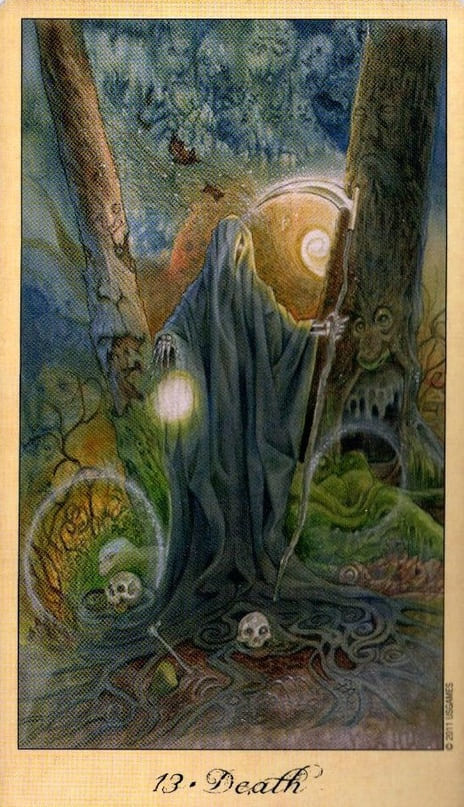
Death. In grief readings, Death often doesn’t represent the loss itself — it represents the transformation the loss demands of you. You aren’t the same person you were before this happened. Death says: that’s true, and it’s okay not to know who you’re becoming yet.
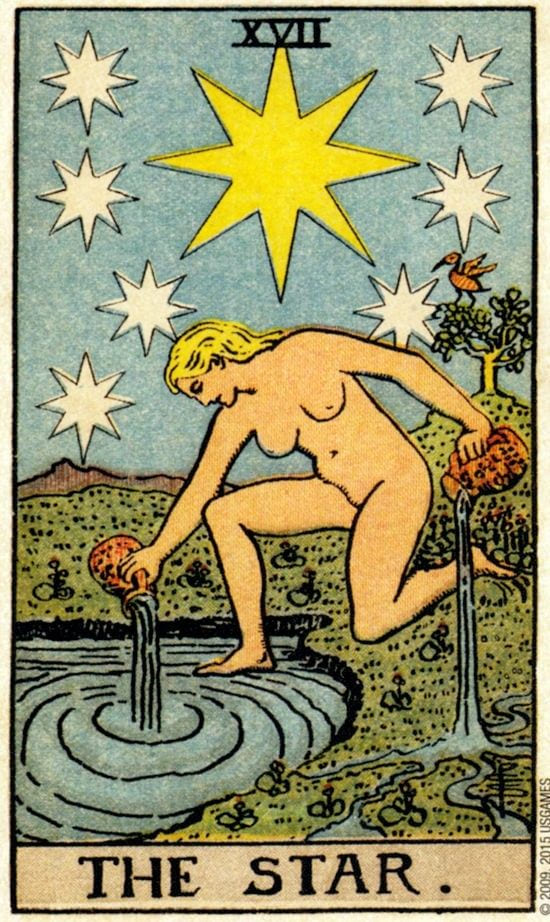
The Star. Hope after devastation. The Star often appears in grief readings as the card of what comes after — not immediately after, but eventually. It’s the quiet light that returns when you’ve stopped expecting it. If The Star appears in your spread, it isn’t saying “get over it.” It’s saying: healing is real, and it’s already in motion, even if you can’t feel it yet.
Three of Swords. Raw pain. Heartbreak. The Three of Swords doesn’t dress up grief in metaphor — it shows you a heart pierced by three swords. Sometimes grief needs that directness. Seeing your pain reflected so starkly can be validating in a world that keeps asking you to be okay.
Four of Cups. Emotional withdrawal. The figure who sits with arms crossed while a cup is offered from a cloud. In grief, this card represents the phase where nothing comforts you and you don’t want it to. The world keeps extending offers — activities, distractions, invitations — and you want none of them. The Four of Cups says: that’s a legitimate phase. Don’t let anyone rush you through it.
The Moon. Confusion, disorientation, the sense that reality has shifted and you can’t trust your perceptions. Grief does this. It makes the familiar feel alien. The Moon in a grief reading validates that experience: you’re not losing your mind. You’re navigating in the dark, and it’s temporary.
Judgement. Reckoning and renewal. Judgement in grief often signals the moment when you’re ready to integrate the loss into your life rather than fighting against it. Not accepting it in the sense of being fine with it. Accepting it in the sense of acknowledging that this happened, it changed you, and you’re still here.
Spread 1: The Grief Witness (5 cards)
This spread doesn’t try to fix anything. It witnesses.
- Position 1: What I’m grieving (The loss itself, or the aspect of it that hurts most right now)
- Position 2: What I’m feeling that I haven’t named (The emotion underneath the obvious sadness)
- Position 3: What I need right now (Not what others think I need — what I actually need)
- Position 4: What I’m afraid to feel (The part of grief I’m avoiding)
- Position 5: What’s holding me (The support, memory, or strength I haven’t recognized)
Position 2 matters deeply. Grief isn’t just sadness. It might be rage. It might be guilt. It might be an aching, complicated relief that you don’t know how to admit to anyone. Whatever the unnamed feeling is, seeing it on the table gives you permission to acknowledge it.
Position 4 is the hardest. There’s almost always a feeling in grief that we push away — sometimes anger at the person who left, sometimes fear of forgetting, sometimes the terrifying thought that we might actually be okay someday and what would that mean. The cards name it so you don’t have to carry it in secret anymore.
Spread 2: Honoring What Was (4 cards)
For when you need to remember not just the loss but the fullness of what existed before it.
- Position 1: What this person/relationship/chapter gave me
- Position 2: What I gave in return
- Position 3: The moment or quality I’m most grateful for
- Position 4: What continues even after the ending
This is a gentler spread. It’s less about processing pain and more about honoring love. I recommend this one for anniversaries, birthdays of someone who’s gone, or moments when grief has softened enough that you can hold gratitude alongside sadness.
Position 4 is the anchor. Because something always continues. The way someone’s laugh changed how you see humor. The strength you built surviving something you didn’t think you could survive. The love that doesn’t stop existing just because the person it connected you to is gone.
Spread 3: The Unfinished Conversation (3 cards)
For grief that carries unresolved things — words unsaid, apologies not given or not received, questions that will never be answered.
- Position 1: What I wish I had said
- Position 2: What I wish I had heard
- Position 3: What can be completed now, even in their absence
This is an intimate spread. Do it alone, in a quiet place, with enough time afterward to sit with whatever comes up.
Position 3 is the healing card. It often surprises people. Sometimes completion looks like writing a letter you’ll never send. Sometimes it looks like forgiving yourself for something the other person already forgave. Sometimes it looks like finally crying the tears you’ve been holding since the funeral because someone told you to be strong and you believed them.
Spread 4: Where Am I in My Grief? (4 cards)
Grief isn’t linear. You don’t move neatly through stages. But it does help to know where you are, especially when you feel lost in it.
- Position 1: Where I’ve been (The phase of grief I’m moving out of)
- Position 2: Where I am now (My current emotional landscape)
- Position 3: What’s emerging (The next shift, even if it’s subtle)
- Position 4: What this grief is teaching me (Not a silver lining — a truth)
Position 4 is delicate. I’m not suggesting that grief exists to teach you a lesson. That would be cruel and untrue. But grief does change you, and sometimes naming how it’s changing you gives the experience a shape that makes it more bearable. Maybe it’s teaching you that you loved more deeply than you realized. Maybe it’s teaching you that you’re stronger than you thought. Maybe it’s teaching you to stop postponing the things that matter.
What NOT to do with grief readings
Don’t use tarot to bypass your grief. If you’re pulling cards to find evidence that you should be “over it by now,” you’re not reading — you’re weaponizing the cards against yourself. Grief has no expiration date. The cards won’t give you one.
Don’t try to contact the deceased through tarot. I know some readers practice this, and I’m not here to tell anyone their beliefs are wrong. But tarot is a reflection tool, not a communication device. If you pull cards “asking” a deceased person questions, what you’re reading is your own psyche’s response to the question, filtered through your grief. That can be meaningful. But confusing it with actual communication can complicate your healing.
Don’t read when you’re in crisis. If your grief has tipped into something that feels like you can’t function — you can’t eat, can’t sleep, can’t stop crying, can’t get out of bed for days — please close the cards and call someone. A therapist, a grief counselor, a crisis line. Tarot is a companion to healing. It is not a substitute for professional help when you need it.
Don’t let someone else interpret your grief reading. Grief readings are deeply personal. The Five of Cups in your reading doesn’t mean the same thing as the Five of Cups in anyone else’s. If you share your reading with someone and they give you an interpretation that doesn’t resonate — trust yourself. You know your grief better than anyone.
The long middle
There’s a phase of grief that nobody prepares you for. It comes after the shock, after the funeral, after the casseroles stop arriving. It’s the phase where everyone else has moved on and you’re still standing in the rubble, trying to figure out how to build a life around the hole that’s left.
This is where tarot becomes most valuable. Not because it speeds up the process — nothing does — but because it gives you a structured check-in with yourself during a time when everything feels structureless. A monthly grief spread can show you shifts you can’t feel. It can remind you that three months ago the Tower was in every reading and now The Star keeps appearing, even though you don’t feel hopeful yet.
The long middle is where people stop talking about grief because it makes others uncomfortable. The cards never get uncomfortable. Pull them at midnight when you can’t sleep. Pull them on the anniversary. Pull them when you hear their song in a coffee shop and have to sit in your car for twenty minutes. The cards are always there, always ready, always honest.
One card, one candle
If full spreads feel like too much, try this: light a candle. Hold your deck. Think about the person or the thing you’ve lost. Pull one card. Just one.
Don’t interpret it. Don’t analyze it. Just look at it. Let whatever it brings up move through you.
Sometimes grief doesn’t need a spread. It just needs a moment of attention. A single card can hold that moment as well as five.
Blow out the candle when you’re ready. Not before.
Frequently Asked Questions
Is it okay to read tarot while grieving?
Yes, as long as you approach it gently. Tarot during grief isn't about getting answers or rushing the process — it's a mirror for emotions you might not have words for yet. If a reading feels too intense, stop. There's no rule that says you have to finish a spread. Come back when you're ready, or don't. The cards will wait.
What tarot cards represent grief and loss?
The Five of Cups (mourning what's gone while missing what remains), Death (transformation through ending), the Three of Swords (heartbreak and emotional pain), the Four of Cups (emotional withdrawal), and the Ten of Swords (the moment when loss feels total). The Star often appears as the healing card — the quiet light that returns after the darkest stretch.
Can tarot help me connect with someone who has died?
Tarot isn't a medium or a spirit communication tool. What it can do is help you process your relationship with someone who's gone — unresolved feelings, things left unsaid, gratitude you want to express, and the grief that needs witnessing. Some people find that pulling cards with a loved one in mind brings comfort and clarity, even without literal contact.
How long after a loss should I wait to do a grief tarot reading?
There's no right timeline. Some people reach for cards within days because it helps them process. Others need months before they can sit with a deck without falling apart. If you're in acute, overwhelming grief, a therapist or grief counselor should be your first resource. Tarot works best as a companion to healing, not a replacement for professional support.