How to Use Tarot for Creative Inspiration: A Guide for Artists and Writers
The creative tool hiding in your tarot deck
Most people think of tarot as a divination tool — something you use to ask about love, career, or the future. And it is that. But there’s another use that artists, writers, musicians, and designers have been quietly practicing for decades: tarot as a creative engine.
The deck is a system of 78 images that map the full spectrum of human experience — from the raw potential of the Fool to the completion of the World, from the romance of the Two of Cups to the heartbreak of the Three of Swords. Every emotion, every archetype, every narrative pattern a human can live through is somewhere in those cards.
That’s not mysticism. That’s a creative goldmine.
If you’ve ever stared at a blank page, a blank canvas, or an empty document and felt the particular despair of having nothing to say, tarot offers you a way in. Not through the front door of inspiration (which locks itself exactly when you need it most) but through a side entrance — the random, surprising, often bizarre doorway of a card pulled at random.
Why randomness is the antidote to creative blocks
Creative blocks don’t come from a lack of ideas. They come from a surplus of judgment. Your inner critic has gotten so loud that every idea gets dismissed before it has a chance to breathe. The page stays blank not because you have nothing to say, but because nothing you think of seems good enough.
Tarot disrupts this cycle by introducing something your critic can’t pre-reject: a random image with no inherent connection to your project. When you pull the Seven of Cups while stuck on chapter three of your novel, your conscious mind has no pre-loaded opinion about it. It’s a stranger at the door. And strangers are more interesting than the same three thoughts you’ve been recycling for a week.
The randomness forces associative thinking — the loose, lateral kind of cognition where creativity actually lives. Your brain has to build a bridge between the card and your project, and that bridge-building process is where the breakthrough hides.
For writers: tarot as a storytelling system
Character development
The tarot deck is essentially a cast of characters. The Major Arcana gives you 22 archetypal personalities. The Court Cards give you 16 character types across four temperaments. Pull a few cards and you have a character’s core traits, contradictions, and growth arc.
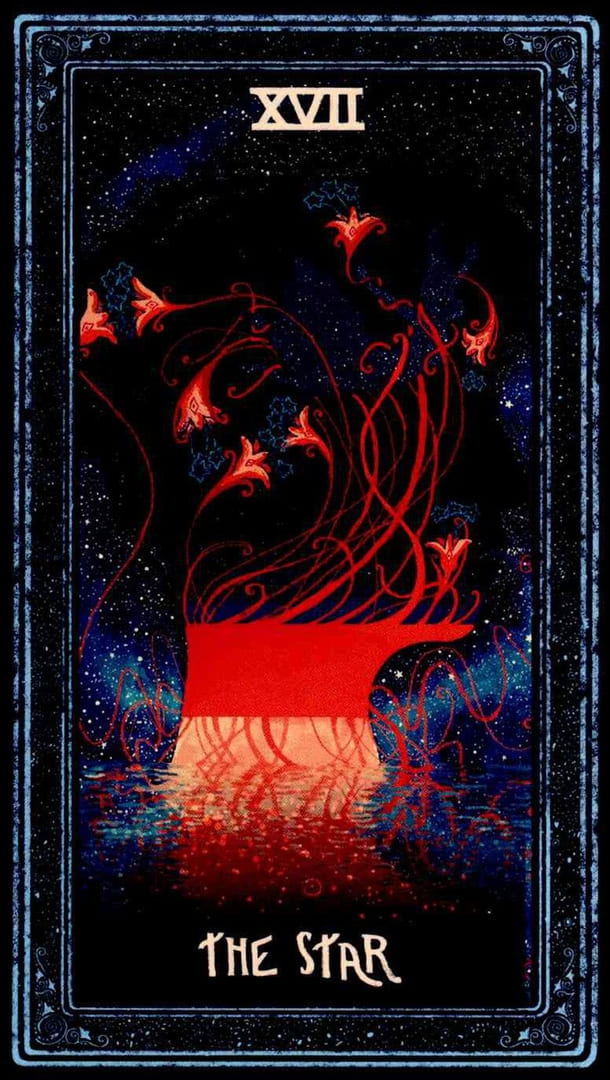
Try this: Pull three cards for a character — one for who they present to the world, one for who they are in private, and one for who they’re becoming. The tension between those three cards creates instant depth. A character who shows the Emperor to the world (authority, control) but is privately the Moon (confusion, hidden fears) and is becoming the Star (vulnerability, hope) — that’s a character with a story.
The Court Cards are especially useful. Each one is a personality archetype:
- Pages: Young energy, students, messengers, beginners with enthusiasm
- Knights: Active energy, pursuers, sometimes obsessive, moving fast
- Queens: Mature inner mastery, receptive power, emotional intelligence
- Kings: Mature outer mastery, authority, responsibility, sometimes rigidity
Plot development
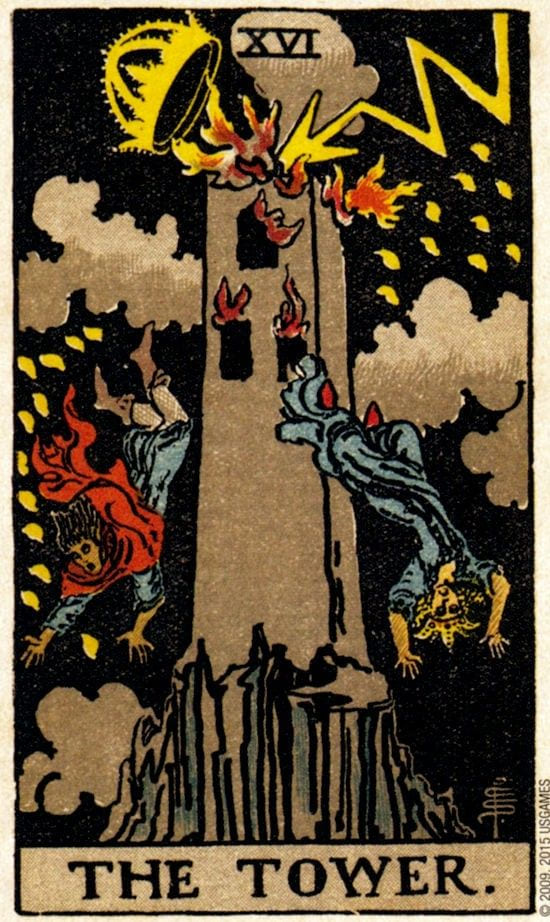
Stuck on what happens next? Pull a card. The Wheel of Fortune suggests a turning point beyond the character’s control. The Tower says something needs to collapse. The Six of Swords says someone leaves for calmer waters. The cards won’t write your plot, but they’ll jolt you out of the narrative corner you’ve painted yourself into.
Try this: Pull five cards in a row and read them as a story arc: beginning, complication, crisis, turning point, resolution. Don’t force it. Let the images suggest connections. The Magician, Three of Swords, the Moon, Death, the Sun — that’s a story of someone who starts with confidence, experiences heartbreak, gets lost in confusion, lets something die, and emerges transformed. That’s a novel outline in five cards.
Dialogue and voice
When your character’s voice sounds flat, pull a card and ask: What would this character say right now? The Five of Wands might suggest conflict — they’d argue. The Hermit might suggest withdrawal — they’d go quiet. The Queen of Swords might suggest brutal honesty — they’d say the thing everyone’s thinking but nobody’s willing to articulate.
World-building
For speculative fiction, fantasy, or any project with invented worlds: pull cards for the society, the landscape, the conflict, and the taboo. Tarot’s rich symbolism provides visual and thematic raw material for world-building that feels layered and mythologically resonant.
For visual artists: tarot as a visual prompt engine
Color and composition
Pull a card and study it purely as a visual object. What colors dominate? What’s the compositional structure? Where does the eye travel? Use the card’s visual language as a starting point for your own piece — not copying, but translating.
The Rider-Waite-Smith deck uses a deliberate color system: yellow for consciousness, blue for spirituality, red for passion, green for growth. Other decks have their own visual languages. Studying how card artists use color can inform your own palette decisions.
Mood and atmosphere
When you know what you want to create but not how it should feel, pull a card for mood. The Moon gives you mystery, shadow, the liminal space between waking and dreaming. The Sun gives you clarity, warmth, celebration. The Eight of Swords gives you claustrophobia, restriction, the feeling of being trapped.
Try this: Before starting a new piece, pull one card and spend five minutes writing down every emotion, sensation, and association it brings up. Use that list as an emotional brief for the piece you’re about to create.
Series and themed work
If you’re working on a series, let the Major Arcana structure it. Twenty-two pieces, each inspired by one card. This gives you a thematic arc (the Fool’s Journey from innocence to completion) while leaving complete creative freedom in how each card is interpreted.
Many artists have done this — the Fool’s Journey series — and every single one looks completely different despite using the same source material. That’s the mark of a genuinely generative creative constraint.
For musicians: tarot as an emotional palette
Pull a card before a writing session to set the emotional key. Not the musical key — the emotional one. The Tower suggests something dissonant and disruptive. The Empress suggests something lush and nurturing. The Nine of Swords suggests something that keeps you up at night.
Try this: Pull three cards — one for the verse energy, one for the chorus energy, one for the bridge. Build the emotional arc of the song around those three energies. The contrast between them creates the tension that makes music interesting.
The daily creative pull
This is the simplest creative tarot practice and the one I recommend most: pull one card at the start of every creative session. Before you open the document, before you pick up the brush, before you sit at the instrument.
Don’t interpret the card. Just look at it. Let it set an unconscious tone for the session. Some days the connection will be obvious. Other days it’ll make no sense until you look at what you created and realize the card is everywhere in it.
The Hermit on a day you wrote the quietest scene in your novel. The Eight of Wands on a day your painting was all movement and energy. Temperance on a day your music found an unexpected balance between two genres.
The card doesn’t direct your creativity. It tunes it. Like a tuning fork you tap before you start playing.
Creative tarot exercises to try this week
Exercise 1: The Character Interview. Pick a card — any card. This card is now a person. Write a one-page interview with them. What’s their name? What do they want? What are they afraid of? What’s in their pockets?
Exercise 2: The Exquisite Corpse Spread. Pull five cards face-down. Flip one at a time and write or draw for three minutes per card, building on what came before. Don’t plan. Don’t edit. Let each card steer the next turn.
Exercise 3: The Shadow and Light. Pull two cards. One represents the light version of your project — what it looks like when everything works. The other represents the shadow — what it looks like when it fails or goes dark. Create something that holds both.
Exercise 4: The Constraint Card. Pull one card and use it as a creative constraint for today’s work. If you pull the Four of Pentacles, everything you create today must involve holding or protecting something. If you pull the Eight of Cups, everything must involve leaving. Constraints liberate.
Exercise 5: The Deck Walk. Spread all 78 cards face-up on a large surface. Walk around them. Pick up the cards that call to you without thinking about why. When you’ve chosen 5-10 cards, arrange them into a story, a mood board, or a creative brief for your next project.
Permission to play
The most important thing about using tarot for creative work is this: you don’t have to take it seriously.
You don’t have to believe in the cards. You don’t have to use them “correctly.” You don’t have to follow traditional meanings. When you’re using tarot creatively, the only rule is that the card must spark something — an image, a feeling, a question, a contradiction.
If the Death card inspires you to write a comedy, that’s valid. If the Sun inspires something dark, that’s valid. If the Two of Cups inspires a painting about loneliness, follow it. The cards are a starting point. Where you go from there is entirely, beautifully, up to you.
Frequently Asked Questions
How can tarot help with creative blocks?
Tarot breaks creative blocks by introducing randomness into a stuck process. When your mind loops through the same ideas, pulling a card forces a completely new image, archetype, or narrative into your thinking. The card doesn't solve your creative problem directly — it gives your brain a new starting point, and that sideways entrance is often exactly what the block needed.
Do I need to believe in tarot to use it for creative work?
Not at all. Many artists and writers use tarot purely as a creative tool without any spiritual practice. The cards are a system of 78 archetypal images covering the full range of human experience — that's useful for creativity whether you believe in divination or not. Think of the deck as a visual brainstorming partner.
What's the best tarot deck for creative work?
Any deck with artwork that inspires you. The Prisma Visions Tarot, Shadowscapes Tarot, and Mucha Tarot are popular with artists for their rich visual detail. For writers, decks with narrative scenes like the Light Seer's Tarot or Tarot of the Divine work well because they suggest stories. But the 'best' deck is the one that makes you want to pick it up.
Can I use tarot to develop fictional characters?
Absolutely — it's one of the most popular creative uses of tarot. Pull a card for your character's core personality, another for their shadow side, one for their desire, and one for their fear. The Major Arcana work especially well for character archetypes. The Court Cards (Kings, Queens, Knights, Pages) are literally character types ready to be fleshed out.