Tarot for Decision Making: How to Use Cards When You're Stuck
You already know the answer. You just can’t hear it yet.
Here’s a pattern I see constantly: someone sits down with their cards, asks about a major life decision, pulls a card they didn’t expect, and their first reaction tells them everything they need to know.
They pull the Five of Pentacles when asking about staying in their job, and their shoulders drop with recognition. Or they pull the Ace of Wands when asking about starting a business, and they feel a surge of energy they’ve been suppressing for months.
The card didn’t decide anything. It created a moment of honesty.
That’s what tarot actually does for decision-making. It doesn’t predict the right choice. It strips away the noise — the overthinking, the people-pleasing, the fear of judgment — and shows you what’s already happening beneath the surface.
If you’re someone who gets stuck in analysis paralysis, who makes endless pro-and-con lists that never resolve anything, who polls every friend and still can’t commit — this approach might be worth your time. Not because tarot is mystical. Because sometimes structured reflection with visual prompts does what rumination can’t.
Why tarot works for decisions (and it’s not magic)
Let’s get the obvious out of the way: tarot cards don’t know the future. They don’t channel cosmic wisdom about your career trajectory. If that’s what you’re looking for, you’ll be disappointed.
What tarot cards do — and do remarkably well — is give you a structured way to examine a situation from angles you’ve been avoiding.
It externalizes your thinking. When a decision lives only inside your head, it’s a tangled mess of emotions, assumptions, and half-formed arguments. Laying cards on a table and assigning each position a specific role (the hidden factor, the likely outcome, the thing you’re afraid of) forces those internal tangles into visible, distinct elements you can actually examine.
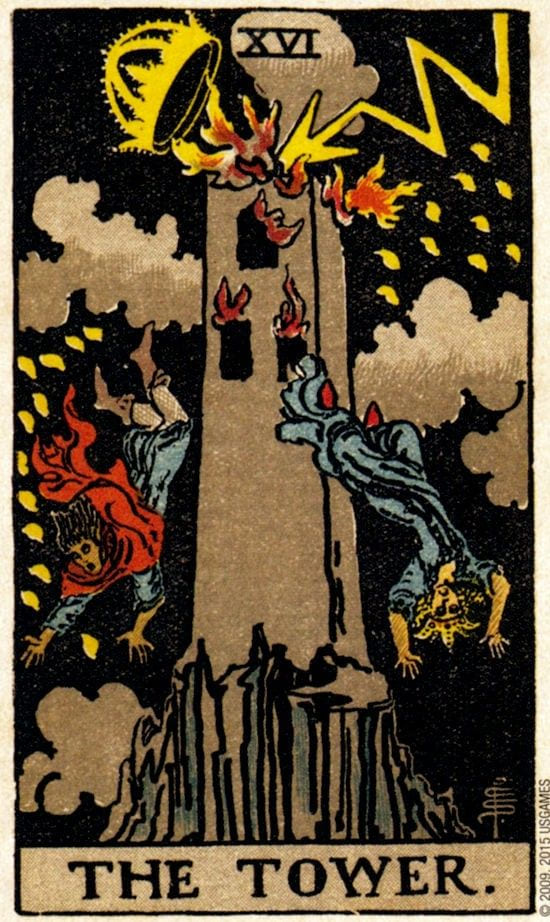
It reveals your subconscious preferences. This is the most practically useful thing about tarot for decision-making. Your emotional reaction to a card tells you more than the card’s textbook meaning ever could. If you pull the Ten of Cups for “staying in your relationship” and feel nothing, that absence of feeling is information. If you pull the Tower for “quitting your job” and feel relief instead of dread, pay attention to that.
It surfaces blind spots. Every decision has factors you’re not considering — sometimes because you genuinely haven’t thought of them, sometimes because you’re deliberately looking away. A spread position labeled “what I’m not seeing” doesn’t magically reveal hidden information. But it forces you to sit with the possibility that your analysis is incomplete, and the card you pull there becomes a prompt for deeper examination.
It breaks the rumination loop. Overthinking is circular. You go around and around the same arguments without ever landing anywhere new. Tarot interrupts that loop by introducing an external element — a random card with a specific image — that your mind has to engage with. It’s the cognitive equivalent of taking a different route to work. Same destination, but you notice things you’ve been driving past for years.
How to frame decision questions for tarot
The quality of your tarot reading depends almost entirely on how you frame your question. Bad questions get vague, unhelpful readings. Good questions get readings you can actually use.
Avoid yes/no questions
“Should I take this job?” is a bad tarot question. It reduces a complex, multi-factor life decision to a coin flip. Even if a card seems to clearly say “yes” or “no,” you haven’t learned anything about why — and the why is where all the useful information lives.
Avoid questions that outsource your agency
“Will this relationship work out?” puts you in a passive role, as if the relationship’s success is something that happens to you rather than something you actively shape. The cards can’t tell you what another person will do, and framing it this way lets you avoid examining your own role in the outcome.
Ask about energies, dynamics, and factors
Instead, try these reframes:
- Instead of “Should I take this job?” ask “What do I need to understand about this career opportunity?”
- Instead of “Will my business succeed?” ask “What strengths and challenges would I face if I start this business now?”
- Instead of “Should I move to a new city?” ask “What is each option offering me, and what would I be giving up?”
- Instead of “Is he the one?” ask “What is this relationship teaching me, and what does it need from me?”
The shift is subtle but critical: you’re asking for insight, not instructions. You remain the decision-maker. The cards become a brainstorming partner, not an oracle.
Be specific about your situation
“What should I do with my life?” is too broad for any tool — tarot, therapy, or otherwise. Narrow it down. “I’m deciding between going back to school for nursing or staying in my marketing role — what factors should I weigh?” gives the reading a clear context and makes the cards’ responses interpretable.
Four decision-making spreads
These spreads are designed as thinking frameworks, not fortune-telling layouts. Each one approaches decisions from a different angle. Pick the one that matches how you’re stuck.
1. The Either/Or Spread (for binary choices)
Use this when you’ve narrowed it down to two options but can’t commit to either one.
Layout: 6 cards
| Position | Role |
|---|---|
| Card 1 | The energy of Option A |
| Card 2 | The likely trajectory of Option A |
| Card 3 | The energy of Option B |
| Card 4 | The likely trajectory of Option B |
| Card 5 | What you’re not seeing about this choice |
| Card 6 | What matters most to you right now |
How to use it: Read cards 1-2 together as a story about Option A, then cards 3-4 as a story about Option B. Notice which story gives you more energy, more clarity, or more dread. Card 5 often reveals a hidden third option or a factor you’ve been discounting. Card 6 acts as your compass — it reflects your current values and priorities, which should guide the decision more than any projected outcome.
Key insight: Most people using this spread discover they already favor one option. The spread’s real value is making that preference visible and testable.
2. The Hidden Factor Spread (for when something feels off)
Use this when you have a decision to make but something doesn’t feel right, and you can’t put your finger on what.
Layout: 5 cards
| Position | Role |
|---|---|
| Card 1 | The situation as you currently see it |
| Card 2 | What you’re telling yourself about it |
| Card 3 | What you’re feeling but not admitting |
| Card 4 | The factor you haven’t considered |
| Card 5 | What would change if you acknowledged all of this |
How to use it: Card 1 is your conscious understanding of the situation — it should feel familiar. Card 2 often reveals the narrative you’ve constructed to justify a position. Card 3 is where it gets interesting: this is the emotional truth beneath the logical story. Card 4 introduces the genuinely unconsidered factor. Card 5 shows what shifts when you stop pretending.
Key insight: This spread is particularly useful for decisions where you’ve already made up your mind but feel uneasy about it. The unease usually lives in card 3.
3. The Decision Tree Spread (for complex, multi-factor decisions)
Use this when the decision has more than two options or involves several interconnected factors.
Layout: 7 cards
| Position | Role |
|---|---|
| Card 1 (center) | The core of the decision — what this is really about |
| Card 2 (branch 1) | Factor: career/practical implications |
| Card 3 (branch 2) | Factor: relationships/how it affects people you care about |
| Card 4 (branch 3) | Factor: personal growth/what you’d learn or become |
| Card 5 (branch 4) | Factor: fear/what you’re trying to avoid |
| Card 6 | The cost of not deciding |
| Card 7 | Your next concrete step |
How to use it: Card 1 cuts through the surface details and names the deeper issue. Sometimes what looks like a career decision is actually about self-worth, or what seems like a relationship choice is really about independence. The four branch cards let you examine the decision through different lenses without everything collapsing into one anxious lump. Card 6 is a wake-up call — indecision has its own consequences. Card 7 keeps things practical.
Key insight: Card 5 (the fear factor) is often the most revealing. Decisions get stuck when fear is driving the process but masquerading as logic.
4. The What I Really Want Spread (for when you’re lost)
Use this when you don’t even know what you want anymore — when you’ve been so focused on what you should do, what others expect, or what’s practical that you’ve lost contact with your own desires.
Layout: 4 cards
| Position | Role |
|---|---|
| Card 1 | What you think you should want |
| Card 2 | What you actually want |
| Card 3 | Why the gap exists |
| Card 4 | One thing that would bring you closer to what you actually want |
How to use it: Read cards 1 and 2 side by side. If they’re similar, you’re more aligned than you think. If they’re dramatically different, that gap is the source of your paralysis. Card 3 explains the gap — usually some combination of external expectations, fear, and past conditioning. Card 4 is intentionally small: not “how to get everything you want,” but “one step.”
Key insight: This is the spread for people who keep making pro-and-con lists that never resolve anything. The lists don’t work because they’re comparing logic to logic, when the real conflict is between logic and desire.
Decision archetypes in tarot: cards that keep showing up
Certain cards appear frequently in decision-related readings, and understanding their patterns can deepen your interpretation.
The Chariot — Determined forward motion
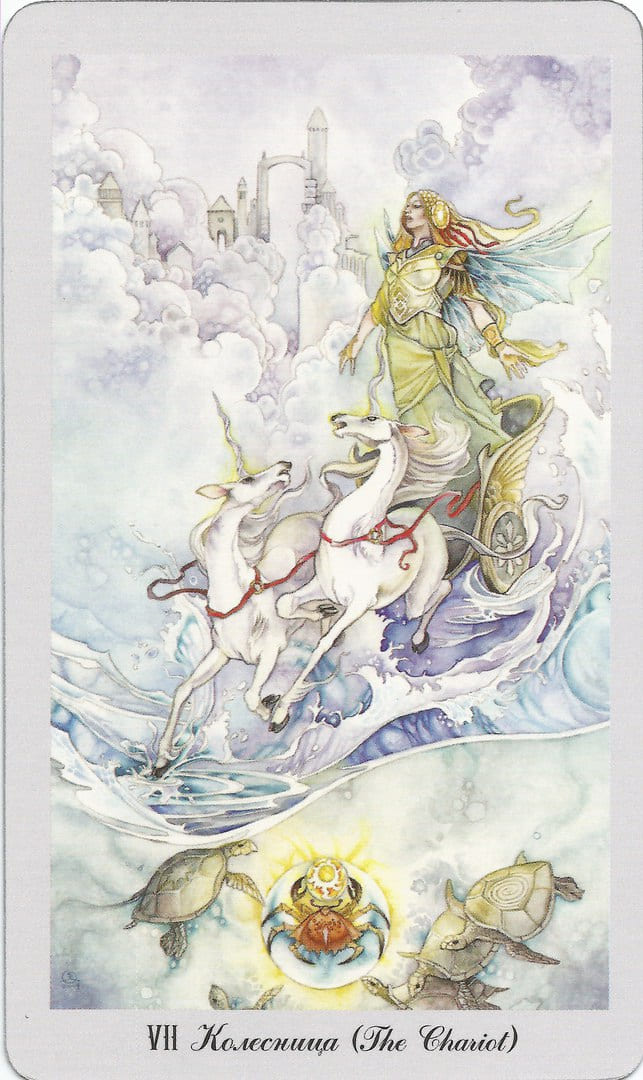
When the Chariot appears in a decision reading, it typically signals that you already know what you want and have the drive to pursue it. The challenge isn’t choosing — it’s committing and pushing through the discomfort of actually doing the thing. If you pull the Chariot and feel resistance, ask yourself: what would it mean to stop deliberating and just go?
Two of Swords — Analysis paralysis
This is the card of being stuck, and it shows up in decision readings with almost uncanny regularity. The blindfolded figure holding two balanced swords is you, trying to weigh options with your eyes closed. The Two of Swords doesn’t mean the options are truly equal — it means you’re blocking yourself from seeing the difference. What are you refusing to look at?
Seven of Cups — Too many options
Daydreaming disguised as decision-making. The Seven of Cups shows up when you’re so enchanted by possibilities that you never commit to any of them. Not all of those cups contain real things — some are fantasies, projections, or options you’ve never actually investigated. This card asks: which of your options have you actually researched versus which ones are just pleasant to imagine?
Justice — Weighing what’s fair
Justice appears when the decision has ethical dimensions or when fairness — to yourself or others — is a key factor. It’s a card of accountability, consequences, and honest assessment. Justice doesn’t tell you what’s right, but it insists that you stop pretending you don’t know.
The Hanged Man — Waiting is a choice too
Sometimes the Hanged Man shows up to say: you don’t have to decide right now. Not every decision has a deadline. The Hanged Man suggests that pausing, gaining a new perspective, and letting things develop might be more productive than forcing a premature choice. But be honest about whether you’re genuinely waiting for clarity or just avoiding discomfort.
The Wheel of Fortune — Forces beyond your control
The Wheel reminds you that not everything is in your hands. Some factors will change regardless of what you decide. This doesn’t mean your choice doesn’t matter — it means building flexibility into your decision is wise. Whatever you choose, will it still work if circumstances shift?
When NOT to use tarot for decisions
Tarot is a useful tool, but it’s not always the right tool. Here’s when to put the cards down:
When you’re in emotional crisis. If you’re sobbing, panicking, or enraged, you won’t interpret the cards accurately. You’ll project your current emotional state onto every card and either terrify yourself or grasp at false comfort. Make decisions from a calmer baseline.
When you’re using tarot to avoid responsibility. “The cards said to do it” is not a decision-making process. If you’re looking for something external to blame if things go wrong, you’re not actually engaging with the tool — you’re using it as a shield. You make the decision. The cards just helped you think.
When you keep pulling until you get the answer you want. If you do a reading, don’t like the result, shuffle, and try again — stop. The first reading already gave you useful information, including the fact that you didn’t like what you saw. That resistance is the data point. Sit with it.
When the decision requires professional expertise. “Should I have this surgery?” is not a tarot question. “What am I feeling about facing this surgery?” is a valid reflective question, but the actual medical decision belongs to you and your doctor.
When you already know and just need permission. Sometimes you don’t need a reading. You need a friend who’ll say, “It’s okay to want what you want.” If you know the answer and you’re just afraid of it, tarot won’t give you anything you don’t already have.
A practical decision-making process with tarot
Here’s a complete workflow for using tarot to work through a real decision. This isn’t mystical — it’s structured reflection with visual prompts.
Step 1: Define the decision clearly (5 minutes)
Write it down. Not “what should I do about work” but “I’m considering leaving my current role to freelance full-time by September. What do I need to see clearly to make this decision well?”
Be specific. Be honest. If there are constraints (financial, relational, health-related), name them.
Step 2: Choose your spread (2 minutes)
Pick the spread that matches your type of stuckness:
- Can’t choose between two options? The Either/Or Spread.
- Something feels off but you can’t name it? The Hidden Factor Spread.
- Too many interconnected factors? The Decision Tree Spread.
- Lost contact with what you actually want? The What I Really Want Spread.
Step 3: Pull and lay out cards (5 minutes)
Shuffle while holding your question in mind. Lay out the cards face-down, then turn them over one at a time. Before looking up any meanings, notice your gut reaction to each image. Write those reactions down — they’re often more useful than the textbook interpretations.
Step 4: Read each position (15-20 minutes)
Go through each card in its assigned position. For each one, ask:
- What does this card suggest about this aspect of my decision?
- How do I feel about seeing this card here?
- Does this confirm something I already suspected, or does it surprise me?
Don’t rush to a conclusion. Let each card do its specific job in the spread.
Step 5: Look for the narrative (10 minutes)
Step back and look at all the cards together. What story are they telling? Is there a dominant suit suggesting which area of life is most affected? Are there repeating numbers or themes? Does the overall energy feel cautious, encouraging, conflicted, or clear?
Step 6: Name your decision (5 minutes)
Based on everything you’ve seen and felt, what are you leaning toward? Write it down as a clear statement: “I’m going to _____ because _____.”
If you can’t write that sentence, you’re not done processing. That’s fine. Sleep on it and come back to your laid-out cards tomorrow.
Step 7: Identify one concrete action (2 minutes)
Not the whole plan — just the next step. “I’ll update my resume this weekend.” “I’ll have the conversation with my partner tonight.” “I’ll schedule the consultation this week.”
Decisions without actions are just thoughts.
The card that changed my approach to decisions
I used to agonize over choices. I’d research endlessly, consult everyone, build elaborate spreadsheets. And then one day, in a reading about yet another decision I was overcomplicating, I pulled the Two of Wands.
A figure standing at a castle wall, holding the world in one hand, looking out at the horizon. The card of actually doing the thing instead of planning to do the thing.
It hit me: my problem was never that I couldn’t see the right choice. My problem was that seeing the right choice meant I’d run out of reasons to delay, and delay felt safer than action.
Tarot didn’t give me the answer. It showed me I was asking the wrong question. I didn’t need to figure out what to do. I needed to figure out why I was so afraid to do what I already knew.
That’s what these cards do at their best. They don’t make decisions for you. They make it harder to hide from yourself.
The Elvi Tarot app gives you a private space to explore decisions with over 100 beautifully illustrated tarot and oracle decks. Get AI-powered interpretations that adapt to your specific question, save your readings for reflection, and track patterns over time. Available for free — try your first decision-making spread today.
Frequently Asked Questions
Can tarot actually help me make better decisions?
Tarot doesn't make decisions for you — it surfaces the factors you might be ignoring. Research on decision-making shows that we often know what we want but struggle to articulate it. Tarot gives you a structured framework to externalize the competing forces, examine blind spots, and check whether your reasoning aligns with your values. Think of it as a decision audit, not a magic answer.
What's the best tarot spread for making a choice between two options?
The Either/Or spread works well for binary decisions. You lay out cards for Option A's likely outcome, Option B's likely outcome, what you're not seeing about each option, and what matters most to you right now. It forces you to examine both paths with equal seriousness instead of just validating the one you already prefer.
Should I ask tarot yes or no questions?
Generally, no. Yes/no questions flatten complex situations into false binaries and hand over your agency to a card flip. Instead, reframe: 'Should I take the job?' becomes 'What do I need to know about this career opportunity?' or 'What would each path look like six months from now?' You get far more useful information this way.
How do I know if I'm using tarot as a crutch for decision-making?
Warning signs include: pulling cards repeatedly until you get the answer you want, feeling unable to make any choice without consulting cards first, using readings to avoid taking action, or asking the same question multiple times because you didn't like the answer. Tarot should clarify your thinking — if it's replacing your thinking, step back.