Tarot for Situationships: When Modern Dating Needs Ancient Clarity
The relationship that doesn’t have a name
You’re not single. You’re not in a relationship. You’re in a… thing. A something. A “we’re just talking” that’s lasted four months. A “we don’t need labels” that somehow still hurts when they post with someone else.
Welcome to the situationship — the modern dating phenomenon where the lack of definition IS the definition.
And if you’ve ever pulled tarot cards about this kind of connection, you’ve probably noticed something: the cards don’t struggle with ambiguity the way humans do. You ask “what are we?” and the Seven of Swords stares back at you with that look that says you already know what this is. You just don’t want to name it.
Here’s the thing: tarot was built for moments exactly like this. Before “situationship” was a word, before “ghosting” had a name, before “breadcrumbing” became a verb — the tarot was already mapping these patterns with 78 cards and zero tolerance for self-deception.
Every modern dating behavior has an ancient card. Let me show you which ones.
The modern dating decoder: which card is which
Ghosting = Seven of Swords
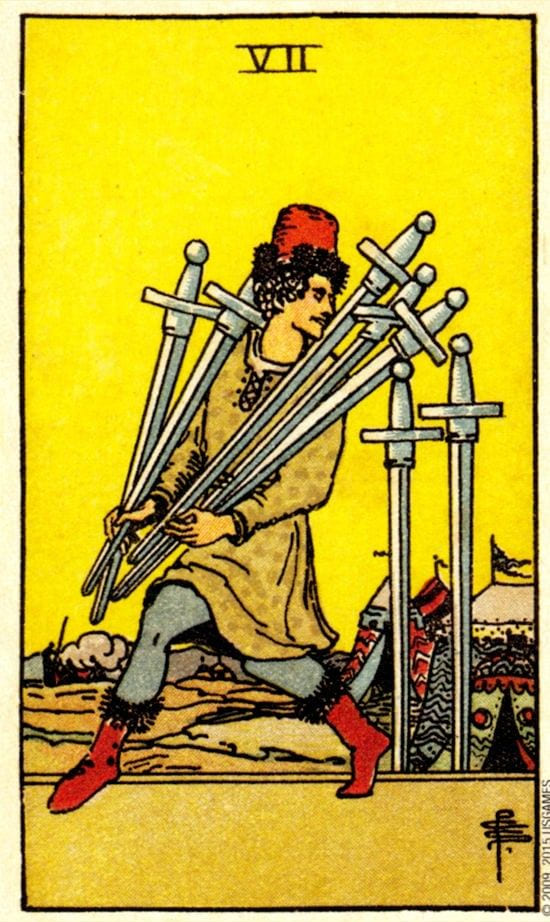
The figure sneaking away with five swords, leaving two behind, looking over his shoulder. He’s not having a confrontation. He’s avoiding one. He’s leaving — and he’d rather you not notice until he’s gone.
That’s ghosting. The person who was texting every day, then every other day, then once a week, then… nothing. No closure. No conversation. Just a slowly expanding silence and the horrible suspicion that you’re the last to know.
When the Seven of Swords appears in a dating reading: someone isn’t being honest about their intentions. And their exit strategy is disappearance, not dialogue.
Breadcrumbing = Seven of Cups
The Seven of Cups — a person staring at seven floating cups, each containing a different temptation. Castles, jewels, snakes, veiled figures. Everything is attractive. Nothing is real.
That’s breadcrumbing. Just enough attention to keep you hoping. A late-night “thinking about you” text after a week of silence. The like on your story but no actual conversation. The plans that are always “soon” and never “Tuesday at 7.”
When the Seven of Cups appears: someone is offering you fantasies, not commitments. And you might be accepting fantasy because it’s easier than demanding reality.
Love Bombing = Knight of Cups Reversed

The Knight of Cups upright is the genuine romantic — the person who shows up with flowers because they mean it, not because they’re performing. Reversed, though? That’s the love bomber. Grand gestures. Instant intensity. “I’ve never felt this way about anyone” on date three. The emotional fast track that feels intoxicating until you realize it was about their need for intensity, not about you.
When the Knight of Cups reversed appears: someone is leading with performance, not presence. The charm is real — the substance behind it is the question.
The Situationship Itself = Two of Swords
The woman blindfolded, two swords crossed over her chest. She can’t see. She won’t choose. She sits between options and calls it peace.
That’s the situationship. Two people hovering between something and nothing, neither willing to define it because definition would force a decision. And decisions have consequences.
When the Two of Swords appears in a relationship reading: nobody is choosing. And not choosing is its own kind of cruelty — because it keeps both people frozen in potential instead of letting them live in reality.
The DTR Conversation = Judgement
The angel blows the trumpet. The dead rise. What was hidden becomes visible. What was avoided becomes unavoidable.
That’s the DTR — the “define the relationship” talk. The conversation where you say what you actually want and find out whether they want it too. It’s scary because the answer might be no. But the Judgement card knows: the only thing scarier than hearing “no” is spending another six months pretending you don’t need to ask.
Zombieing = Death Reversed
Death reversed — the transformation that didn’t complete. The thing that was supposed to end but didn’t fully die. The connection that keeps twitching back to life.
That’s zombieing — the ex who comes back after months of silence, slides into your DMs like nothing happened, acts like the ghosting never occurred. Death reversed says: this person didn’t complete the ending. And neither did you.
The “Define This” spread: 5 cards for situationship clarity
This spread is designed for the moment when you’re tired of ambiguity and ready for the truth — even if the truth is uncomfortable.
Layout:
    [3]  [4]
      [1]
    [2]  [5]
Position 1 — What this actually is. Not what you call it. Not what you hope it is. Not what you tell your friends. What the energy between you actually consists of, stripped of narrative.
Position 2 — What you’re pretending it is. The story you’re telling yourself to avoid facing Position 1. This is the card of the fantasy — the version of this connection that only exists in your imagination and late-night overthinking.
Position 3 — What they’re offering. Not what they say. Not what they imply. What they’re actually giving you — consistently, reliably, with their actions. This card is often a wake-up call.
Position 4 — What you actually need. Not from them — from any relationship. What you require to feel safe, valued, and respected. This card often reveals the gap between what you’re accepting and what you deserve.
Position 5 — Your next move. Not theirs. Yours. The action you can take regardless of what they do or don’t do. This card shifts the power back to you.
How to read this spread
Shuffle while thinking about the specific person and connection — not the fantasy version, the actual version. The one that keeps you checking your phone. The one that makes you feel brilliant at 11 PM and confused at 7 AM.
If Cards 1 and 2 match: Congratulations — your perception aligns with reality. This is rare in situationship readings. Usually they don’t match, and the gap between them is where your work lives.
If Card 3 is a Minor Arcana card: What they’re offering is limited. Not necessarily bad, but specific and bounded. They’re giving you a fraction, not a whole.
If Card 3 is a Major Arcana card: The connection carries significant weight for them too — even if they can’t name it. But Major Arcana without matching action means potential without commitment.
Card 4 is the most important card. If you can only read one card in this spread, read this one. Knowing what you actually need makes every other card irrelevant. If you know what you deserve, you can measure any connection against it.
Card 5 should scare you a little. If the next move feels comfortable, you’re probably reading it wrong. The right move in a situationship is almost always the one that risks the comfortable ambiguity in exchange for an actual answer.
When the cards say “leave”
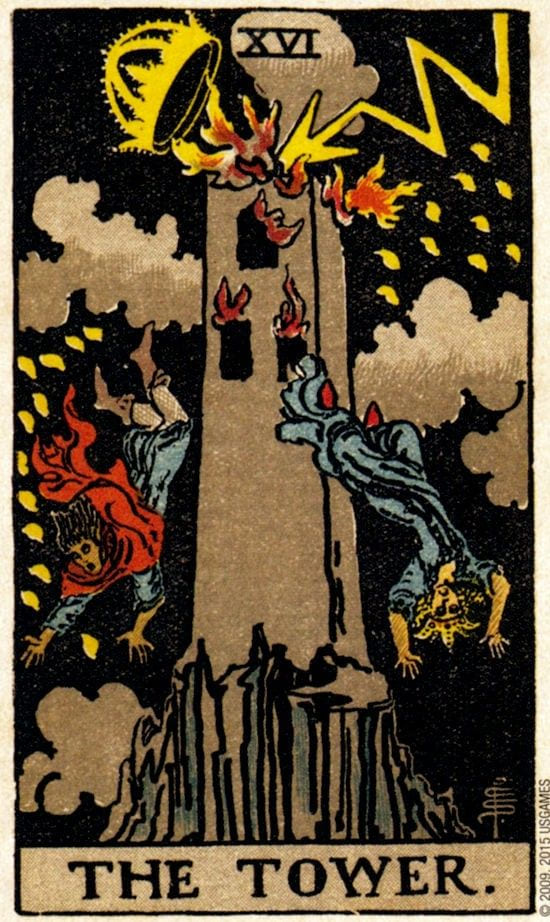
Sometimes the reading is clear. The Eight of Cups. The Three of Swords. The Tower. The reversed Lovers. The spread looks at you and says: this isn’t going anywhere. And you know it.
If the cards say leave, they’re not being dramatic. They’re being honest. And the reason this hurts isn’t because the reading is wrong — it’s because it confirms what the situationship was specifically designed to help you avoid knowing.
The undefined relationship exists because definition would reveal incompatibility. The label was missing because the label would have been “this doesn’t work.”
That’s painful. But it’s also the beginning of clarity. And clarity, uncomfortable as it is, is always preferable to the particular torture of waiting for someone to choose you while they’re actively choosing not to.
When the cards say “stay — but speak”
Sometimes the reading doesn’t say leave. It says: this has potential, but only if someone speaks first.
The Ace of Cups. The Two of Cups. The Empress. Strength. Cards that suggest the connection is real but needs to be named before it can grow.
If the cards say stay, they always come with a condition: the DTR conversation must happen. Not eventually. Not when the timing is “right.” Now. Because Judgement doesn’t wait for convenient moments. It blows the trumpet when the trumpet needs blowing.
What tarot knows about modern dating that TikTok doesn’t
Modern dating culture has created an entire vocabulary for connection avoidance. Ghosting, breadcrumbing, benching, orbiting, slow fading — these are all words for different flavors of the same thing: the refusal to be honest about what you want.
Tarot has no patience for this. The cards don’t ghost. They don’t breadcrumb. They don’t “keep their options open.” They lay down, face up, and tell you exactly what’s happening — whether you asked for that level of honesty or not.
And here’s what the cards consistently reveal in situationship readings: the ambiguity isn’t protecting you. It’s preventing you. Preventing you from finding what you actually want. Preventing you from healing what makes you accept less than you need. Preventing you from being the kind of person who asks for what they want and walks away when they don’t get it.
That’s not the cards being harsh. That’s the cards being the honest friend your 2 AM brain won’t let you be.
Try it yourself
Pull a card with this question: “What am I tolerating in this connection that I wouldn’t advise a friend to tolerate?”
Because the situationship survives on a simple trick: it convinces you that your standards don’t apply to THIS situation. That THIS is different. That you’re being “chill” and “not needy” when actually you’re being silent about what you need.
The cards don’t fall for that trick. And deep down, neither do you.
Frequently Asked Questions
Can tarot tell me if I'm in a situationship?
Tarot won't label your relationship — but it will show you the energy. Cards like the Two of Swords (deliberate avoidance), Seven of Cups (fantasy over reality), or the reversed Knight of Cups (charm without follow-through) often appear in readings about undefined relationships. If the cards keep saying 'unclear,' that IS the clarity.
What tarot card represents ghosting?
The Seven of Swords is the classic ghosting card — someone leaving quietly, avoiding confrontation, slipping away without honesty. The reversed Knight of Cups (romantic gestures that vanish) and the Eight of Cups (walking away from something emotionally) also frequently appear in ghosting-related readings.
Should I do a tarot reading about someone who won't define the relationship?
Yes — but ask the right question. Instead of 'Does he like me?' (which keeps you in the waiting position), try 'What does this connection actually offer me?' or 'What am I avoiding by staying in this ambiguity?' The best situationship readings focus on YOUR clarity, not theirs.
What's the best tarot spread for an undefined relationship?
The 'Define This' spread in this article uses 5 cards: What this actually is, What you're pretending it is, What they offer, What you actually need, and Your next move. It cuts through the ambiguity by separating fantasy from fact.