Tarot for Starting a Business: Spreads for Entrepreneurs (2026)
The entrepreneur’s secret advantage
There’s a particular kind of person who reads tarot cards and also wants to build a business. You might not expect the overlap, but it’s enormous. Because building a business requires exactly the kind of self-knowledge that tarot develops: understanding your real motivation, recognizing your patterns, seeing through your own excuses, and making decisions under uncertainty.
Every entrepreneur I know — the successful ones — operates on a blend of data and intuition. They read the market and they read the room. They make spreadsheets and they make gut calls. Tarot formalizes the intuition half of that equation.
This isn’t about asking the cards whether your business will succeed. That’s the wrong question. The right questions are: What’s really driving me to start this? What am I afraid of? What do I need that I don’t have yet? What’s the energy I should bring to this phase?
Those are the questions that separate entrepreneurs who launch from entrepreneurs who spend three years “getting ready.”
Cards that speak the language of business
These cards show up frequently in entrepreneurial readings. Knowing them gives you a business-specific vocabulary for interpretation.
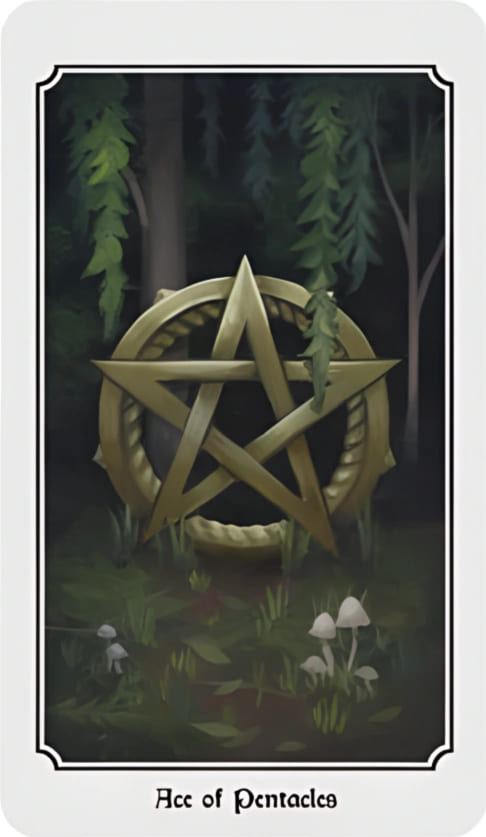
Ace of Pentacles. The seed of material opportunity. In business readings, this card is the green light for a new venture — but a green light with conditions. The Ace holds potential, not guarantee. It says the opportunity is real, the timing is right, and the foundation can support growth. But you still have to plant the seed and tend it.
The Emperor. Structure, authority, systems. Every business needs an Emperor phase — the part where you stop dreaming and start building infrastructure. The Emperor in a business reading says: get organized. Create systems. Make decisions with authority instead of waffling.
Three of Pentacles. Craftsmanship and collaboration. This card says your business needs skill — real skill, not just enthusiasm — and probably other people. The Three of Pentacles is the card of the apprentice who becomes the master, the solopreneur who learns when to hire, the creative who develops business acumen.
Nine of Pentacles. Self-made abundance. The woman in her garden, surrounded by beauty she created through her own effort. This is the card of the business that works — not just financially, but in alignment with your values. If this appears as an outcome card, what you’re building has real potential.
The Magician. All the tools are on the table. The Magician says: you already have what you need to begin. Stop collecting more tools, courses, certifications, and permissions. Use what’s in front of you. Resourcefulness matters more than resources.
The Wheel of Fortune. Market timing, external forces, luck. The Wheel reminds you that not everything is within your control. Markets shift. Trends rise and fall. The Wheel says: pay attention to what’s moving around you and position yourself accordingly.
Spread 1: The Business Idea Check (5 cards)
Use this before committing time and money to a business idea. It reveals whether the motivation is solid and what needs attention first.
- Position 1: What’s really driving this idea? (Your true motivation)
- Position 2: What problem does this solve — for others? (Market reality)
- Position 3: What I bring to this that’s genuinely valuable (Your edge)
- Position 4: What I’m missing or underestimating (The blind spot)
- Position 5: The energy of this idea’s potential (Not a prediction — a temperature check)
Position 1 is the truth card. If your motivation is freedom and the Ace of Wands appears — passion is real, energy is available. If the Five of Pentacles appears — you might be running from financial anxiety rather than toward something you care about. Both can drive a business, but they lead to very different outcomes.
Position 4 saves people from expensive mistakes. Every entrepreneur has blind spots. Maybe you’re underestimating how long it takes to build an audience (Seven of Pentacles — patience required). Maybe you’re overestimating your ability to do everything alone (reversed Three of Pentacles — collaboration needed). See it now, address it before launch.
Spread 2: The Launch Timing Spread (3 cards)
For when the idea is solid but you’re agonizing over when to start.
- Position 1: The energy of launching now
- Position 2: The energy of waiting three months
- Position 3: What I’ll regret more — acting too soon or acting too late
This spread cuts through analysis paralysis. Most entrepreneurs delay not because the timing is wrong but because fear disguises itself as prudence. “I need more research” sometimes means “I’m scared to find out if this works.”
Position 3 is brutal in the best way. It asks you to confront which regret weighs more. And in my experience, the cards almost always confirm what you already feel — people who are ready to launch regret waiting, and people who genuinely need more time regret rushing.
Spread 3: The Fear vs. Reality Spread (4 cards)
Because every business decision is distorted by fear, and you need to know which fears are useful signals and which are just noise.
- Position 1: My biggest fear about this business
- Position 2: How realistic is this fear? (The reality check)
- Position 3: What my fear is protecting me from seeing
- Position 4: What I’d do if I weren’t afraid
Position 3 is the insight bomb. Fear doesn’t just scare you — it hides things. Fear of failure might be hiding the fact that you’ve never been willing to try your best because then failure would really mean something. Fear of success might be hiding an outdated belief that visible people get punished. Fear of running out of money might be hiding a deeper fear about your own self-worth without a steady paycheck.
Position 4 is the action card. What would you do if fear weren’t a factor? Not in fantasy — in reality. The answer to that question is usually the right next step. The fear will still be there when you take it. But you’ll have taken it anyway.
Spread 4: The Quarterly Business Check-In (6 cards)
Once you’ve launched, do this spread every three months to stay aligned.
- Position 1: The overall energy of my business right now
- Position 2: What’s working that I should amplify
- Position 3: What’s not working that I need to change or release
- Position 4: What my clients/customers need from me right now
- Position 5: What I need from my business right now
- Position 6: Focus for the next quarter
Position 5 is often neglected. Entrepreneurs pour into their business without asking what they need back. If the Four of Swords appears here, you need rest. If the Six of Cups appears, you need to reconnect with why you started. If the Devil appears, the business might be consuming you in ways that aren’t sustainable.
A business that serves your customers but destroys you isn’t a business — it’s a hostage situation with a nicer logo. Position 5 keeps you honest about that.
The tarot cards of “not yet”
Not every card is a green light. Some cards in business readings are clear yellow or red signals — not to abandon the dream, but to adjust the approach.
The Moon. You don’t have all the information. Something about your market, your audience, or your business model is hidden from you. Research more before committing money. The Moon doesn’t say stop — it says investigate.
Four of Pentacles. Clinging to security. The Four of Pentacles in a business context often means you’re not ready to risk the financial stability you have. Maybe you need to save more first. Maybe you need to start the business as a side project before going full time. Protect your foundation while building.
Seven of Swords. Something isn’t quite right. Maybe the business model has a flaw you’re not acknowledging. Maybe you’re not being fully honest with yourself about the value proposition. The Seven of Swords asks: what are you pretending not to see?
The Hanged Man. Surrender and perspective shift. The Hanged Man in a business reading means: you’re trying to force something that needs to mature. Step back. Look at it from a completely different angle. The delay isn’t wasted time — it’s incubation.
Tarot and business planning — how they work together
Tarot gives you clarity on the internal landscape. Business planning gives you structure for the external one. Together, they’re more powerful than either alone.
Use tarot for: motivation clarity, fear identification, blind spot awareness, energy management, creative direction, and quarterly recalibration.
Use business tools for: financial projections, market research, competitive analysis, legal structure, marketing strategy, and operational planning.
The entrepreneur who only uses tarot ends up with great intuition and no revenue model. The entrepreneur who only uses business tools ends up with a perfect plan that doesn’t align with who they actually are. The best businesses are built by people who know both their spreadsheet and their soul.
The real question behind “should I start a business?”
Every person who asks the cards about starting a business is really asking something deeper:
Am I capable of building something on my own?
The answer, almost always, is: you’re more capable than you think, less prepared than you should be, and the gap between those two things is exactly where entrepreneurship lives.
The Ace of Pentacles doesn’t land in the hand of someone who’s fully ready. It lands in the hand of someone who’s willing to start before they’re ready and learn the rest along the way.
Frequently Asked Questions
Can tarot help me decide whether to start a business?
Tarot won't write your business plan, but it's excellent at revealing what's really driving the desire — and what's really holding you back. The cards show you patterns you can't see when you're caught between excitement and fear. Use tarot for clarity on motivation and internal blocks, then use spreadsheets for the numbers.
What tarot cards indicate business success?
The Ace of Pentacles (new financial opportunity with real potential), the Three of Pentacles (skill and collaboration), the Emperor (structure and authority), the Nine of Pentacles (self-made success and independence), and the World (completion and achievement). But context matters — a single 'success' card doesn't guarantee anything without the work behind it.
What if I get negative cards in a business reading?
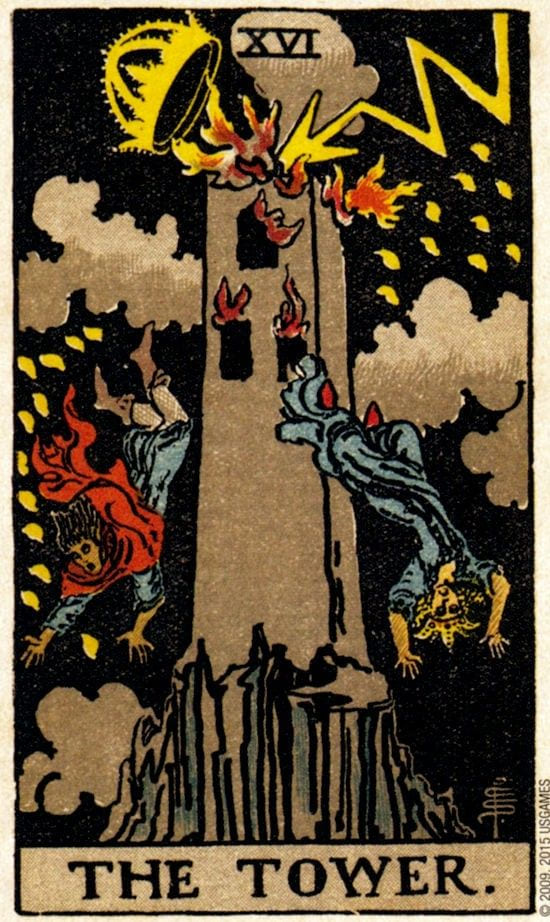
Negative cards aren't warnings to stop — they're information about what needs attention. The Tower might mean your current business concept needs major restructuring before launch. The Five of Pentacles might mean your financial runway isn't long enough yet. The Moon might mean you're missing crucial market information. Address what the cards reveal, don't just abandon the dream.
How often should I do tarot readings about my business?
Monthly during the planning phase, quarterly once you've launched. Avoid reading about the same business question daily — it creates anxiety, not clarity. Use tarot for strategic direction and internal alignment, not for daily operational decisions. The cards are better at 'what energy should I bring to this?' than 'should I post on Instagram today?'