Tarot Symbolism Decoded: Hidden Meanings in the Rider-Waite Artwork
What you’re not seeing
You’ve looked at the Rider-Waite-Smith deck hundreds of times. You know what the Fool looks like, what the Tower shows, what the Ten of Swords means. But have you noticed the snail in the Nine of Pentacles? The lobster crawling from the pool in the Moon card? The tiny ship sailing in the Two of Pentacles?
Pamela Colman Smith didn’t paint casually. Every element in every card was placed with intention — the flowers, the animals, the landscapes, the colors, even the direction the figures face. These details aren’t decoration. They’re a second language running underneath the obvious meanings, adding depth and nuance that most readers miss.
This guide decodes the major symbolic systems in the RWS deck. Once you learn to read them, you’ll never look at your cards the same way.
Flowers: the botanical code
Roses
Roses are the most important flower in the deck. They appear in at least fifteen cards, and their color matters enormously.
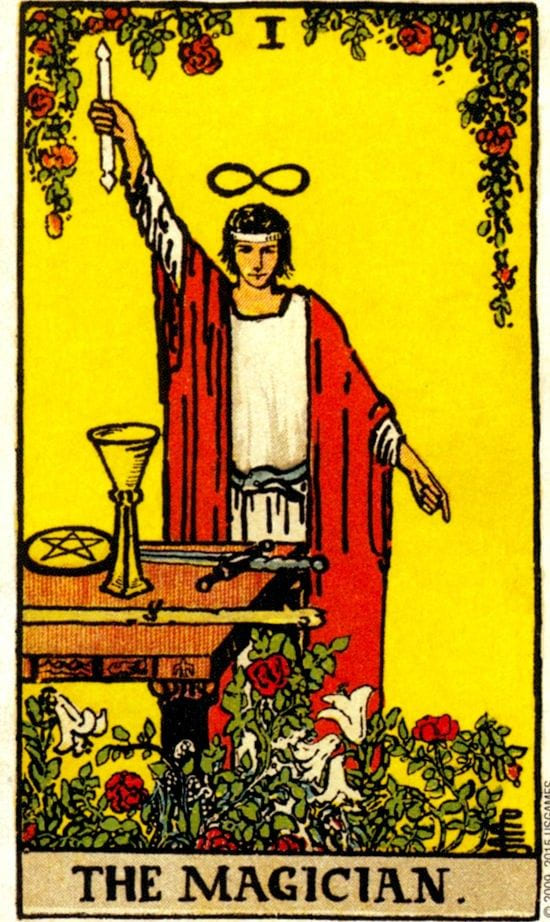
Red roses = passion, desire, earthly love, the physical world. You’ll find them in the Magician’s garden (desire channeled through will), on the Strength card (passion tamed by gentleness), and throughout cards dealing with love and desire.
White roses = purity, innocence, spiritual love, transcendence. The Fool carries a white rose — he’s pure potential, not yet touched by the world’s complexity. The Death card’s flag shows a white rose — purity emerging from transformation.
The five-petaled rose = the five senses, the physical body, Venus. When you see a rose with exactly five petals, it’s referencing the body’s connection to the material and sensual world.
Lilies
White lilies represent purity, fertility, and the divine feminine. They appear in the Magician’s garden alongside roses — the pure (lily) and the passionate (rose) growing together, suggesting the Magician works with both spiritual and physical energy.
Sunflowers
Sunflowers follow the sun — they represent devotion, loyalty, and the soul’s orientation toward the divine. The Sun card features sunflowers prominently, reinforcing the card’s theme of pure, radiant vitality.
Pomegranates
Pomegranates represent fertility, abundance, and the mysteries of the feminine. They appear on the High Priestess’s veil — referencing the myth of Persephone and the hidden knowledge that lies behind the curtain between worlds.
Animals: the bestiary
The dog
The dog appears at the Fool’s feet, following him off the cliff. It represents instinct, loyalty, and the animal nature that accompanies us on our journey. The dog doesn’t question where they’re going — it follows with complete trust.
The lion
The lion appears in Strength, where it’s tamed by gentle hands, and in the World, where it represents the element of fire. Untamed, it’s raw passion and power. Tamed, it’s strength directed by wisdom.
The eagle/phoenix
The eagle appears in the World card and on the Wheel of Fortune, representing the element of water (counterintuitively) and the transformative power of spiritual vision. Eagles see from above — they represent the perspective gained through rising above the situation.
The bull
The bull appears in the World and the Wheel of Fortune, representing the element of earth — groundedness, material stability, and patient strength.
The sphinx
Sphinxes sit atop the Chariot — one black, one white — representing opposing forces that must be directed through willpower. They won’t pull together unless the driver commands them. The sphinx is also a guardian of mysteries: to pass, you must answer the question.
The crayfish/lobster
The creature emerging from the pool in the Moon card represents the earliest stirrings of consciousness — primitive, instinctual, crawling from the subconscious depths toward awareness. It’s the part of you that knows things before your mind does.
Landscapes: the geography of meaning
Mountains
Mountains in the background are never random. They represent:
- Challenges ahead — obstacles that must be climbed
- Spiritual attainment — the heights of consciousness
- The distant future — what lies beyond the current situation
- Isolation and achievement — the Hermit’s mountain, where wisdom is found in solitude
The size and distance of the mountains matter. Close, looming mountains suggest imminent challenges. Distant peaks suggest long-term goals or eventual destinations.
Water
Water in any form represents emotion, the subconscious, and flow:
- Calm rivers = emotional peace, life flowing smoothly
- Turbulent seas = emotional upheaval, being overwhelmed
- Waterfalls = emotions releasing, catharsis
- Pools and ponds = the subconscious, reflection, what lies beneath
- Rain = cleansing, grief, emotional release from above
Paths and roads
When a path appears in a card, it represents the journey — where you’ve been and where you’re going. Winding paths suggest an indirect route. Straight paths suggest clarity of direction. Paths that disappear into the distance suggest an unknown destination.
Cities and buildings
Cities in the background represent civilization, society, and the collective. When a figure is moving away from a city (Eight of Cups), they’re leaving behind social structures. When a figure faces toward a city, they’re engaging with the world.
Colors: Smith’s palette
Smith’s color choices were systematic, not decorative.
Yellow/gold backgrounds = spiritual illumination, divine light, consciousness. Cards with yellow backgrounds carry an energy of clarity and awareness. The Fool, the Sun, and many court cards feature this golden glow.
Gray backgrounds = the mundane world, difficulty, ambiguity. Gray doesn’t mean “bad” — it means “this is where life gets complicated.” Five of Cups, Eight of Swords, and many challenge cards use gray.
Red garments = passion, desire, action, physical energy. Characters in red are driven by want and will.
Blue garments = spiritual knowledge, intuition, emotional depth. Characters in blue are connected to inner wisdom.
White garments = purity, spiritual transformation, innocence. Characters in white are in states of transition or transcendence.
Black garments = the unknown, the unconscious, mystery. Characters in black are engaged with shadow material.
Directional symbolism
Which way are they looking?
In the RWS deck, the direction a figure faces carries meaning:
- Looking right = facing the future, moving forward
- Looking left = facing the past, reflecting on what’s been
- Looking straight ahead = present-focused, confronting the viewer directly
- Looking down = introspection, grief, contemplation
- Looking up = aspiration, prayer, seeking guidance from above
Which hand holds what?
The right hand traditionally represents the conscious mind and active will. The left represents the subconscious and receptivity. When the Magician points his wand with his right hand upward and his left hand downward, he’s directing conscious will (right) toward the divine (up) while channeling subconscious energy (left) toward the earth (down).
Numbers hiding in the images
Beyond the card numbers themselves, Smith embedded numerical symbolism in the artwork:
- Three pillars, towers, or objects often represent mind-body-spirit or past-present-future
- Four corners, walls, or objects represent stability and structure (the four elements)
- Seven objects suggest spiritual seeking and assessment
- Eight objects suggest mastery and infinity (the lemniscate — the figure-eight — appears above the Magician and Strength)
How to use this knowledge
Don’t try to catalog every symbol in every reading. Instead:
-
Notice what catches your eye first. If the roses jump out at you before the figure, the message might be about passion or love rather than the figure’s action.
-
Check the background. After reading the central image, look at what’s behind it. Mountains? Water? City? The background gives context the foreground doesn’t.
-
Compare colors across the spread. If one card is dramatically brighter or darker than the others, that contrast carries meaning.
-
Follow the animals. They represent instinctual wisdom that the human figures might not be expressing consciously.
The symbols have always been there. Smith painted them for you to find — one detail at a time, reading by reading, year after year. The deck reveals itself slowly, to those who keep looking.
Frequently Asked Questions
What do the symbols in tarot cards mean?
Every element in the Rider-Waite-Smith deck was placed deliberately. Red roses mean passion and desire. White roses mean purity and innocence. Mountains represent challenges and spiritual attainment. Water represents emotion and the subconscious. Yellow backgrounds signal illumination. Gray skies indicate difficulty. Even the direction figures face carries meaning — looking right suggests the future, looking left the past.
Why are there so many roses in tarot cards?
Roses are the most common flower in the RWS deck and they carry layered meanings. Red roses represent passion, desire, and earthly love. White roses represent purity, spiritual love, and innocence. The five-petaled rose represents the five senses and the physical world. Roses appear in the Magician's garden, on the Death card's flag, in the Fool's hand, and throughout the suit cards — each time with a specific symbolic purpose.
What do the colors mean in the Rider-Waite deck?
Smith used color systematically. Yellow/gold backgrounds signal divine or spiritual illumination (the Fool, the Sun, many court cards). Gray backgrounds suggest difficulty, ambiguity, or the mundane world. Red clothing indicates passion and action. Blue clothing represents spiritual knowledge and intuition. White represents purity. Black represents the unknown or the unconscious.
Do the mountains and water in tarot cards mean something?
Yes. Mountains in the background represent challenges to overcome, spiritual heights to attain, or the long-term future. The closer and larger the mountain, the more immediate the challenge. Water represents emotion and the subconscious — calm water means emotional peace, turbulent water means emotional upheaval. Rivers often represent the flow of life or emotional energy moving through a situation.