Rider-Waite-Smith: The Story Behind the World's Most Famous Tarot Deck
The deck that changed everything
Every tarot reader alive today owes something to two people: a ceremonial magician who designed a deck and an artist who painted it. The deck they created in 1909 didn’t just become popular — it redefined what tarot could be.
Before the Rider-Waite-Smith deck, tarot’s Minor Arcana cards looked like playing cards. The Three of Cups was three cups. The Seven of Swords was seven swords. There were no scenes, no characters, no stories. Reading these cards required memorizing a table of meanings because the images themselves told you nothing.
Pamela Colman Smith changed that. She painted 78 images that turned every card into a window — a scene you could look into and understand without ever opening a book. That innovation is so fundamental that we take it for granted. We shouldn’t.
This is the story of the deck, the people who made it, and why it still matters more than a century later.
Arthur Edward Waite: the designer
Arthur Edward Waite (1857-1942) was a British mystic, scholar, and member of the Hermetic Order of the Golden Dawn — the most influential occult society of the late 19th and early 20th centuries. He was serious, scholarly, and somewhat humorless — the kind of man who believed that spiritual truth could be systematized and codified.
Waite was deeply versed in Kabbalah, Christian mysticism, alchemy, and the Western esoteric tradition. He wanted to create a tarot deck that encoded these teachings in visual form — a deck that would serve as both a divination tool and a key to occult knowledge.
He didn’t draw. He had the vision but not the artistic skill. For that, he needed a collaborator.
Pamela Colman Smith: the artist
Pamela Colman Smith (1878-1951) was everything Waite wasn’t — colorful, theatrical, internationally connected, and comfortable at the margins of society. She was born in London to an American father and British mother, spent much of her childhood in Jamaica, and moved between New York and London throughout her life.
She was mixed-race in an era when that complicated everything. She was likely bisexual. She was a suffragist. She was an artist, a storyteller, a folklorist who collected Jamaican Anansi stories, and a theatrical set designer who worked with the famous actress Ellen Terry.
She joined the Golden Dawn in 1901 and met Waite through the order. When he commissioned her to illustrate his tarot deck, she was already an accomplished artist with a distinctive style — flat, bold compositions influenced by Japanese woodcuts, Art Nouveau, and the theater.
The collaboration
Smith illustrated the entire 78-card deck in approximately six months during 1909. Waite provided symbolic specifications — what elements each card should include, which Kabbalistic correspondences to encode — but the visual compositions were Smith’s.
She was paid a flat fee. No royalties, no ongoing credit. For decades, the deck bore only Waite’s name and the publisher’s: “The Rider-Waite Tarot.” Smith’s contribution was so thoroughly erased that most people who used the deck had no idea a woman had painted it.
This has changed in recent decades. The tarot community now uses “Rider-Waite-Smith” or “RWS” to honor her work. But the damage of a century of erasure is real — Smith died in poverty in 1951, having never benefited financially from the deck that became the world’s best-selling tarot.
What made the deck revolutionary
Illustrated Minor Arcana
This is the innovation that changed tarot forever. Before RWS, Minor Arcana cards in most decks showed only the suit symbols — three swords arranged in a pattern, five pentacles in a design. They were decorative but not narrative.
Smith painted scenes. The Three of Swords became a heart pierced by three swords in a rainstorm. The Five of Pentacles became two destitute figures in the snow outside a church. The Ten of Cups became a family celebrating under a rainbow.
These scenes made intuitive reading possible. You didn’t need to know that the Five of Pentacles traditionally meant “material loss” — you could see it in the image. A reader who had never opened a tarot book could look at Smith’s artwork and understand what the card was saying.
This single innovation is why the deck endured and why nearly every modern tarot deck follows the same template.
Color symbolism
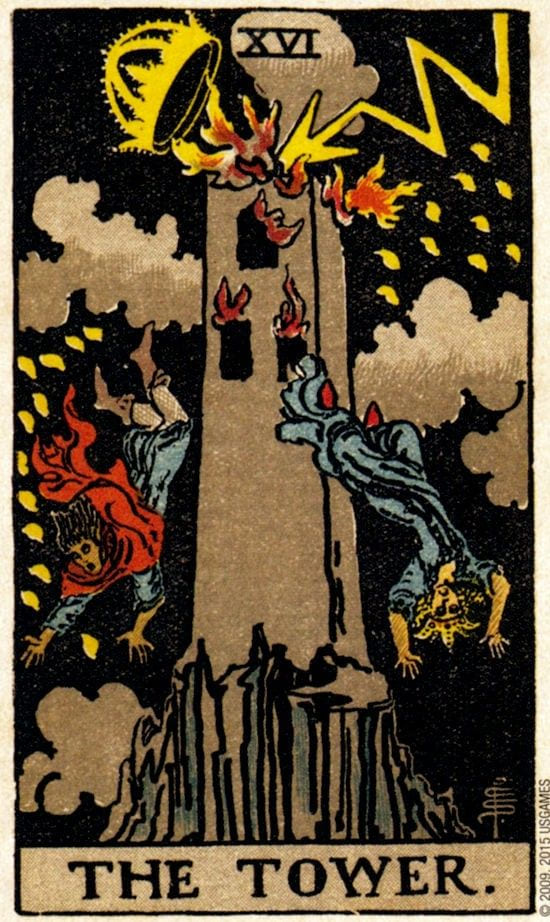
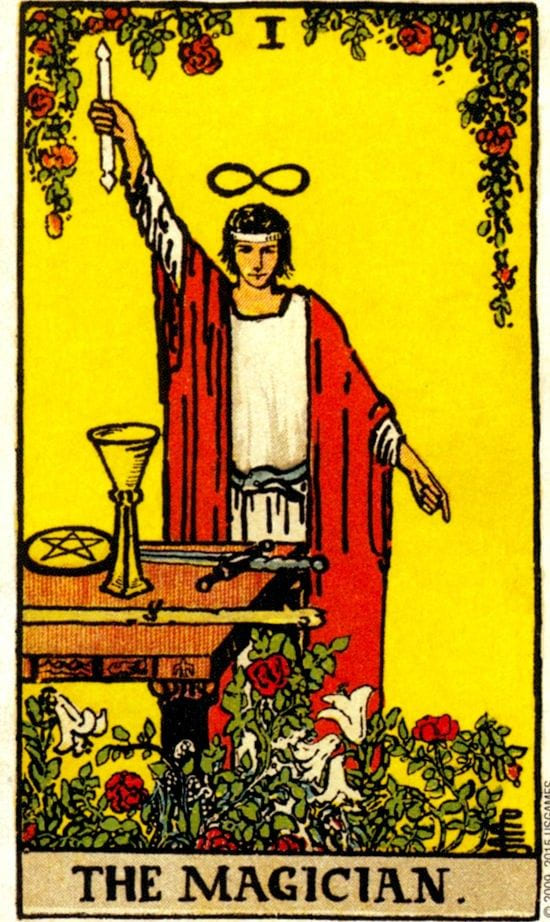
Smith’s color choices were deliberate and systematic. Yellow backgrounds signaled spiritual illumination (the Fool, the Sun). Gray skies indicated challenge or ambiguity. Red roses represented passion, white roses purity. Water appeared in Cups cards as an extension of the suit’s elemental nature.
This color language created a secondary layer of meaning that works subconsciously even when you’re not aware of it.
Theatrical staging
Smith’s background in theater shows in every card. Her figures are posed like actors on a stage — their gestures, their facing direction, their spatial relationships all convey meaning. The figure in the Two of Cups leans toward the other, showing attraction. The figure in the Four of Cups sits with arms crossed, showing disengagement.
This theatrical quality makes the cards feel alive in a way that symbolic diagrams don’t. You’re not reading symbols — you’re watching scenes.
The Golden Dawn’s influence
The Hermetic Order of the Golden Dawn (founded 1888) developed a comprehensive system that connected tarot to Kabbalah, astrology, and elemental magic. Each Major Arcana card was assigned a Hebrew letter, a zodiac sign or planet, and an elemental correspondence.
Waite embedded this system into the deck — sometimes obviously (the astrological symbols on some cards), sometimes subtly (the arrangement of elements in the background, the specific flowers and fruits depicted). The deck works perfectly well without knowing any of this. But for those who study the Golden Dawn system, the deck is a coded textbook.
The competing vision: Crowley and the Thoth deck
Waite wasn’t the only Golden Dawn member to create a tarot deck. Aleister Crowley — a far more controversial figure — designed the Thoth deck with artist Lady Frieda Harris between 1938 and 1943.
Where RWS told stories anyone could read, Thoth encoded esoteric systems in abstract, geometric art. Where Smith’s style was warm and accessible, Harris’s was intense and challenging. The two decks represent the two sides of tarot’s personality — the accessible and the occult, the intuitive and the systematic.
Both decks emerged from the same magical tradition. Both are still in print. But RWS won the popularity contest by a wide margin, largely because Smith’s illustrated Minor Arcana made it usable without esoteric training.
The deck’s second life
The RWS deck was modestly popular after its 1909 publication but didn’t become a cultural phenomenon until the 1960s and 70s. The counterculture’s interest in alternative spirituality, Eastern philosophy, and self-exploration created an audience for tarot that hadn’t existed before.
University Paperbacks published a mass-market edition with a yellow box — the version most people over 40 remember as their first tarot deck. Sales exploded. By the 1980s, it was the world’s best-selling tarot deck, a position it still holds.
The RWS template
The deck’s influence goes far beyond its own sales. The vast majority of modern tarot decks are “RWS-based” — they follow Smith’s visual template even when the artistic style is completely different.
If a modern deck’s Three of Swords shows a heart with swords through it — that’s Smith. If the Eight of Cups shows someone walking away from stacked cups — that’s Smith. If the Ten of Pentacles shows a family scene with an elderly figure — that’s Smith.
Her compositions became the standard vocabulary of tarot illustration. Even decks that deliberately depart from the RWS tradition define themselves in relation to it — “this deck is not based on Rider-Waite-Smith” is a meaningful statement only because so many decks are.
The recognition question
Pamela Colman Smith painted one of the 20th century’s most reproduced and influential sets of images. She did it in six months, was paid once, and was forgotten.
The modern tarot community has worked to change this. Her name appears in the deck’s title now. Her biography has been researched and published. Her other artwork — beyond tarot — has been exhibited and collected. The Pamela Colman Smith Commemorative Set, published by U.S. Games Systems, explicitly centers her contribution.
But the full recognition she deserved in her lifetime never came. She died in Bude, Cornwall, in 1951, in relative obscurity. Her belongings, including original tarot artwork, were sold to pay debts.
Why it still matters
The Rider-Waite-Smith deck is 116 years old. In that time, thousands of decks have been created. Some are more beautiful. Some are more diverse. Some are more artistically sophisticated.
None has been more important.
Every time you look at a tarot card and understand its message through the image — without memorizing a list, without consulting a book — you’re benefiting from what Pamela Colman Smith invented. She made tarot visual, intuitive, and accessible. She gave the cards their stories.
Everything built since is built on her foundation.
Frequently Asked Questions
Who created the Rider-Waite-Smith tarot deck?
The deck was designed by Arthur Edward Waite, a British mystic and member of the Hermetic Order of the Golden Dawn. The artwork was created by Pamela Colman Smith, also a Golden Dawn member and a talented artist and storyteller. The deck was published by the Rider Company in London in 1909. For decades it was called the 'Rider-Waite' deck, but modern tarot communities increasingly use 'Rider-Waite-Smith' or 'RWS' to credit Pamela Colman Smith's essential artistic contribution.
Why is the Rider-Waite-Smith deck so important?
It was the first widely available deck to illustrate every card — including the 56 Minor Arcana — with full scenic artwork. Before this deck, Minor Arcana cards just showed arrangements of suit symbols (like playing cards). Smith's illustrations made it possible to read tarot intuitively from the images alone, without memorizing meaning tables. Nearly every modern tarot deck is based on her visual template.
Who was Pamela Colman Smith?
Pamela Colman Smith (1878-1951) was a British-American artist, writer, folklorist, and occultist. She was mixed-race, bisexual, and deeply connected to Caribbean folk traditions through her upbringing in Jamaica. She illustrated the entire RWS deck in about six months, was paid a flat fee with no royalties, and died in poverty in 1951. Her artistic genius went largely unrecognized during her lifetime.
Is the Rider-Waite-Smith deck good for beginners?
It's the most recommended beginner deck for good reason — virtually all tarot education references it, the imagery is clear and readable, and the illustrated Minor Arcana makes intuitive interpretation accessible from day one. Most other modern decks are variations on Smith's visual template, so learning with RWS gives you a foundation that transfers to almost any other deck.