Best Tarot Decks for Shadow Work
The shadow doesn’t fear the dark — it fears an honest look
Shadow work isn’t about pretty cards. It’s about the parts of you that you’ve pushed away for years: the anger you’re “not supposed to show,” the envy you’re ashamed of, the fear that you’ll be left if anyone sees the real you. Carl Jung called this the shadow — everything in us we don’t want to claim as our own.
And this is exactly where the deck starts to matter. Not because it’s “magical,” but because this particular conversation needs a deck that won’t look away. A soft, pretty deck will smooth everything over — and here you actually need a card brave enough to show the uncomfortable. Below are six decks that take shadow work deeper for me and for many readers, plus a short checklist so you can judge any deck yourself.
What makes a deck good for the shadow
Before you look at the art — four signs that separate a shadow-work deck from one that’s merely “dark and pretty.”
- Honest imagery. The deck isn’t afraid to show fear, shame, rage, death. Where a pretty deck draws a sad little figure, a shadow deck shows the thing you want to turn away from — and that’s exactly what works.
- Depth, not decoration. Dark aesthetics for their own sake wear thin fast. You want a deck with meaning behind the images: it’s about the inner world, not just “in black tones.”
- Room for intuition. Sometimes fewer words and more symbol. Decks that don’t spell everything out force you to finish the meaning yourself — and in shadow work your reaction matters more than the book definition.
- You’re not afraid to take it out. The paradox: the deck should be deep, yet still feel like yours to hold. If the cards scare you so much the box stays shut, the work never begins. Look for the darkness you personally feel ready to touch.
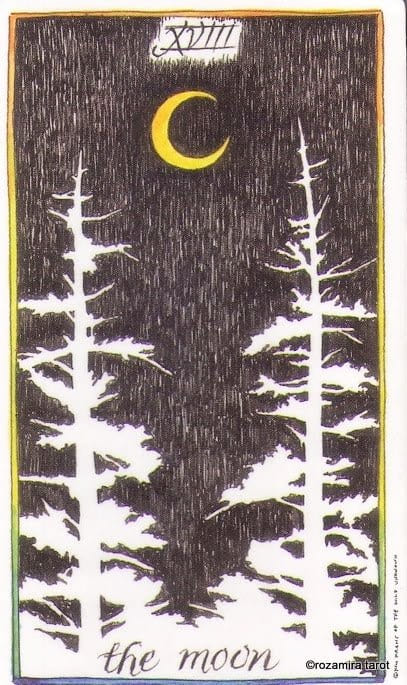
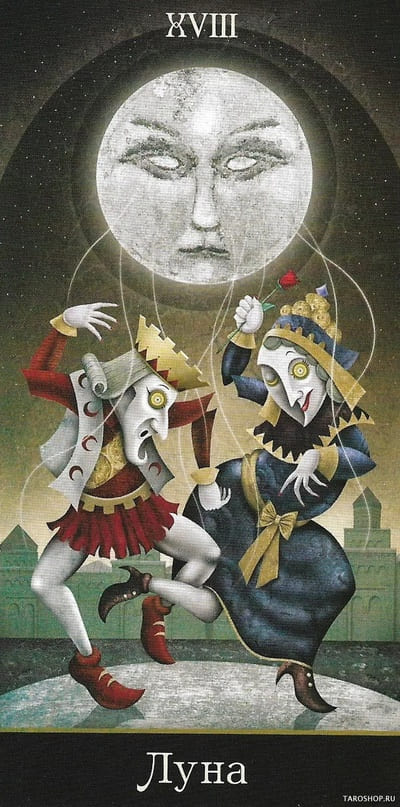
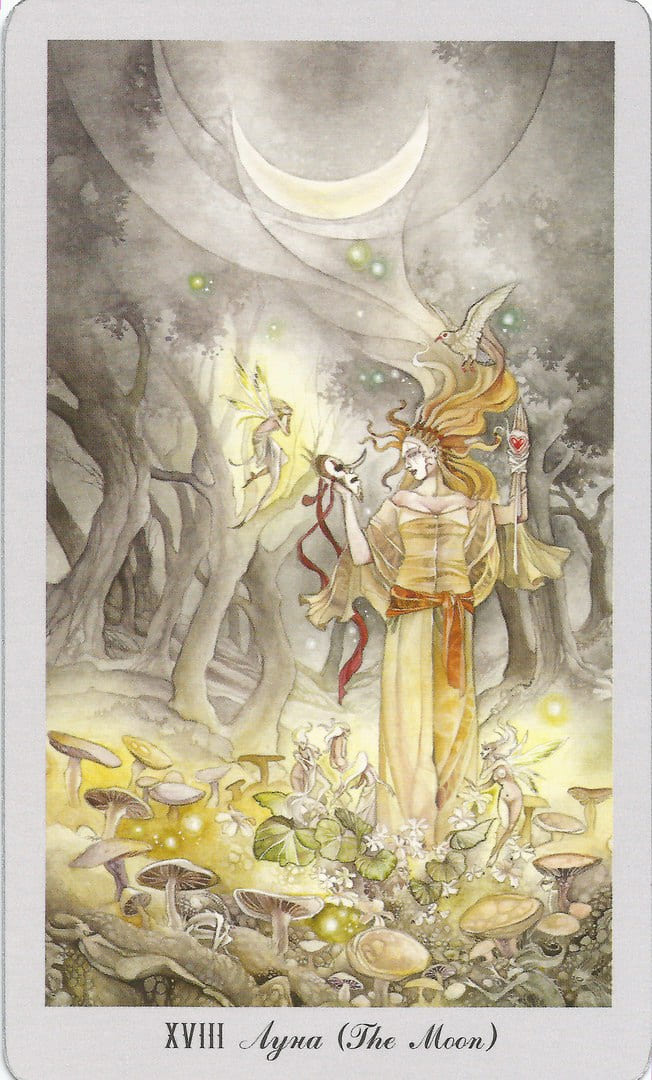
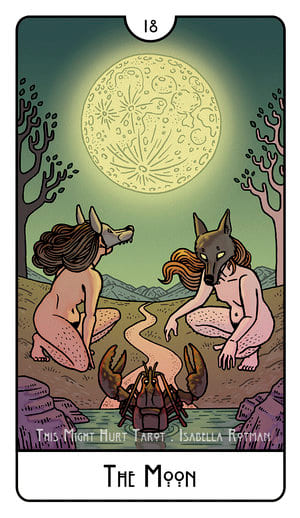
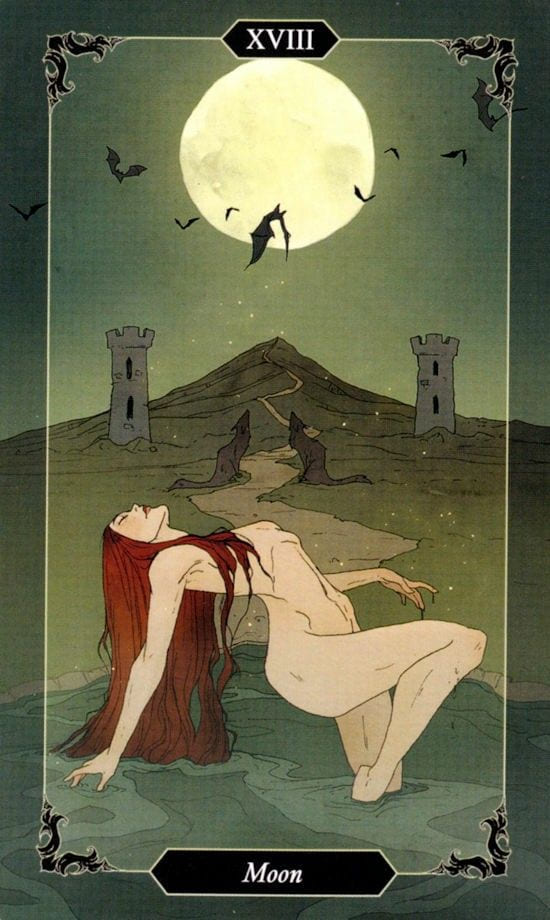
The same card — The Moon, the card of the unconscious and the repressed — across six decks. See how differently each one speaks about the shadow.
1. The Wild Unknown Tarot — intuition without prompts
If someone asked me to name one deck for the shadow, I’d start here. Wild Unknown has almost no people — only animals, plants, elements, stark black lines on white. And that works surprisingly hard: when there’s no human face on the card, you have nothing to lean on but your own reaction. A raven, a snake, a charred tree — you fill in what’s about you.
That’s exactly why the deck is so good for inner work: it doesn’t explain, it asks. Many readers name it as the first deck that “switched on” their intuition. More in the review and card meanings.
2. Deviant Moon Tarot — the language of the unconscious
Patrick Valenza’s deck looks drawn straight out of a dream — the kind that comes just before dawn and leaves an uneasy residue. Moon-faced figures, the shadows of an old asylum, elongated silhouettes. It’s the pure visual language of the unconscious: what we usually repress becomes a character here.
For shadow work that’s a gift. Deviant Moon doesn’t shy from the distorted, the strange, the “wrong” in us — and it turns out looking at it isn’t as frightening as hiding it. Not a beginner deck in the usual sense, but for the shadow, one of the strongest. See the review and card meanings.
3. Shadowscapes Tarot — a shadow you’re not afraid to approach
Not all shadow work has to be harsh. Shadowscapes is Stephanie Pui-Mun Law’s airy watercolor deck, where even the heavy cards are painted in soft, flowing light. That’s its strength: it opens the door to the subconscious for people whom frightening art hinders rather than helps.
I often recommend it to those just approaching the shadow who are scared of “falling” into the dark. With Shadowscapes the descent is gentle — images of dreams, not nightmares. It’s still a conversation about the deep, just in a kinder tongue. Review and card meanings.
4. This Might Hurt Tarot — the one that says it straight
The name is honest: “This might hurt.” Isabella Rotman’s deck takes the classic Waite system and flips the emphasis toward uncomfortable truth. The cards put words to what you already know but don’t want to say aloud: where you’re deceiving yourself, where you’re clinging to something that’s been hurting you for a long time.
For shadow work it’s an almost therapeutic tool — as long as you’re ready for the bluntness. If you want a deck that won’t comfort you but will gently rub your nose in the truth, this is it. It doesn’t have its own review on the site yet, but there are card meanings.
5. Dark Wood Tarot — a descent into the forest of the psyche
The dark forest is an ancient image of the unconscious: the place the fairy-tale hero walks into to meet their monsters and come out changed. Dark Wood Tarot is built entirely on that metaphor. Muted tones, bone and earth colors, the sense that you’re walking deeper with no way back yet.
This deck is good when shadow work is about a passage: you’re living through a loss, an ending, a fear, and you don’t know who you’ll be on the other side. Dark Wood holds that state without trying to sweeten it. Review and card meanings.
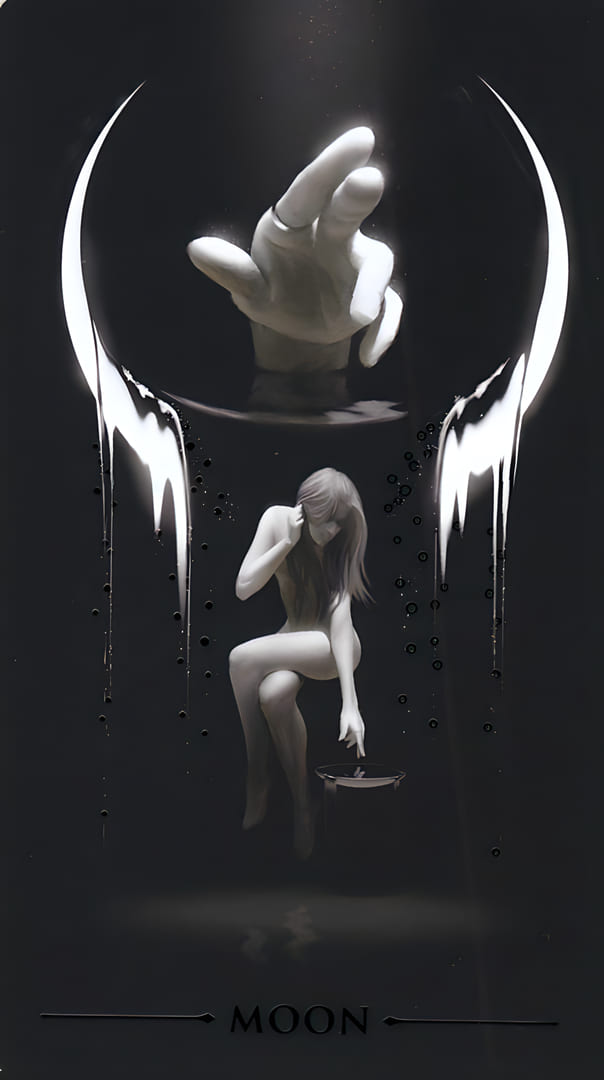
6. True Black Tarot — the shadow stripped to its essence
Sometimes an honest conversation needs everything extra removed. True Black is a deck on deep black, where only the essential remains: a minimalist symbol glowing out of the dark. No sets, no visual noise — as if everything but the essence has been stripped from the image.
For the shadow this works in an unusual way: the black field around the card becomes that very space of the unknown you’re peering into. The deck is almost meditative — good for sitting in silence and listening to what rises. Review and card meanings.
Which one is yours
The short version:
- You want to switch on intuition — The Wild Unknown.
- Drawn to the language of dreams and the unconscious — Deviant Moon.
- Afraid to go into the dark too fast — Shadowscapes.
- Ready for blunt, uncomfortable truth — This Might Hurt.
- Living through a loss or a passage — Dark Wood.
- You want silence and essence, nothing extra — True Black.
For completeness, one classic we don’t host: the Thoth deck by Aleister Crowley and Frieda Harris is often used for deep psychological work — it’s complex, symbolically dense, and asks for preparation. If one day you want to go even deeper, look its way. But I’d start with something from the list above — the descent there is gentler.
And the most important thing: the deck doesn’t do the shadow work for you. It poses the question — you answer. If things are genuinely hard for you right now, shadow work won’t replace the support of a real person or a therapist. Cards are good at showing you where to look, but it’s worth going there on your own terms and at your own pace.
Try it yourself
Before you buy a physical deck for the shadow, try it live. In the Elvi bot all six (and a hundred more decks) are free to use — ask yourself one honest question and see whose visual language answers. Sometimes that’s exactly how you find “your” shadow deck: by the single card you can’t look away from, because it’s about you.
Frequently Asked Questions
What is the best tarot deck for shadow work?
There's no single answer, but the two most often named are The Wild Unknown Tarot and Deviant Moon Tarot — they don't soften hard imagery and they push you to rely on intuition rather than memorized meanings. The main thing is a deck that's honest but doesn't personally repel you.
What is shadow work in tarot?
It's a practice where the cards help you see what you usually hide from yourself: shame, anger, fear, envy, old wounds. Here tarot doesn't predict the future — it works as a mirror, surfacing the repressed parts of you so you can acknowledge and move through them.
Do I need a separate deck for shadow work?
No — you can start with any deck you already own. But many people find that a darker, deeper deck helps them drop into the right state faster; it's easier to talk about the uncomfortable with it. It's more about mood than a hard rule.
Is it dangerous to work with dark tarot decks?
Dark aesthetics on their own aren't dangerous — it's just a visual language. What matters more is gentleness with yourself: don't dive into shadow work during an acute crisis, and don't use it as a substitute for therapy. Cards ask good questions, but it's your honesty and real support that heal, not the deck.